
Most parents in Ireland pay between €13 and €15 per hour for a babysitter in 2026. Platform data puts the national average at €13.69 per hour, while Dublin regularly runs €14–€18 depending on the sitter’s experience and the time of night. The national minimum wage for adults sits at €14.15 per hour since January 2025, so that figure is your legal floor for any sitter aged 20 or over.
Quick reference:
- Typical hourly rate: €13–€15 nationally; €14–€18 in Dublin
- 3-hour evening booking: roughly €39–€45 at national average rates
- 4-hour Saturday night booking: €56–€72 in Dublin at the upper end
- Expect surcharges for: late nights, multiple children, last-minute requests, and additional duties such as cooking or driving
Key takeaways
Babysitting rates in Ireland average €13.69 per hour nationally, with Dublin running higher at €14–€18, and the adult minimum wage of €14.15 per hour setting the legal floor for sitters aged 20 and over.
| Point | Details |
|---|---|
| National average rate | €13.69/hr nationally; Dublin typically €14–€18 depending on experience and time. |
| Legal wage floor | Adult minimum wage is €14.15/hr; age-tiered rates apply for sitters under 20. |
| Common surcharges | Add €2–€4 per extra child, €3 for last-minute bookings, and €15–€25 for late-night finishes. |
| Overnight pay structure | Use a hybrid: hourly while awake, a flat €50–€80 overnight fee, then hourly for the morning. |
| Book through Workily | Search and compare verified babysitters locally at Workily for transparent rates and instant booking. |
Table of Contents
- How much does a babysitter cost in Ireland right now?
- What changes the hourly rate you should expect to pay?
- How to structure babysitter pay: hourly, flat fees and overnight rates
- Minimum wage, employment status and safety checks
- Where to find and vet a babysitter in Ireland
- Where the rate figures in this guide come from
- The case for paying a little more than the going rate
- Find a vetted babysitter through Workily
- Sources
How much does a babysitter cost in Ireland right now?
The national average babysitting rate in Ireland is €13.69 per hour based on 2026 platform data. That figure covers a typical evening booking with one child and no additional duties. It is a useful starting point, but where you live shifts the number considerably.
Sitly’s 2026 rate data confirms the Dublin premium, with parents in the capital commonly paying towards the top of the €14–€18 range due to higher living costs and stronger demand. Smaller towns in the midlands and west tend to settle closer to €11–€13.
Sample booking totals at common rates:
- 3-hour weekday evening at €13.69: €41.07
- 3-hour weekday evening in Dublin at €15: €45.00
- 5-hour Saturday night in Dublin at €16: €80.00
- 5-hour late-night session with two children at €17 (including per-child supplement): €85.00
Community forums and parenting groups consistently show Saturday night rates running higher than weekday evenings, particularly for bookings starting after 8 PM.
What changes the hourly rate you should expect to pay?
Several variables push babysitting rates in Ireland above the base figure. Understanding them helps you budget accurately and avoids awkward conversations mid-booking.
Number and age of children
Each additional child typically adds €2–€4 per hour to the agreed rate. Toddlers and babies require more active supervision than school-age children, so sitters often charge more for younger age groups. Two children under three is genuinely harder work than two teenagers.

Additional duties
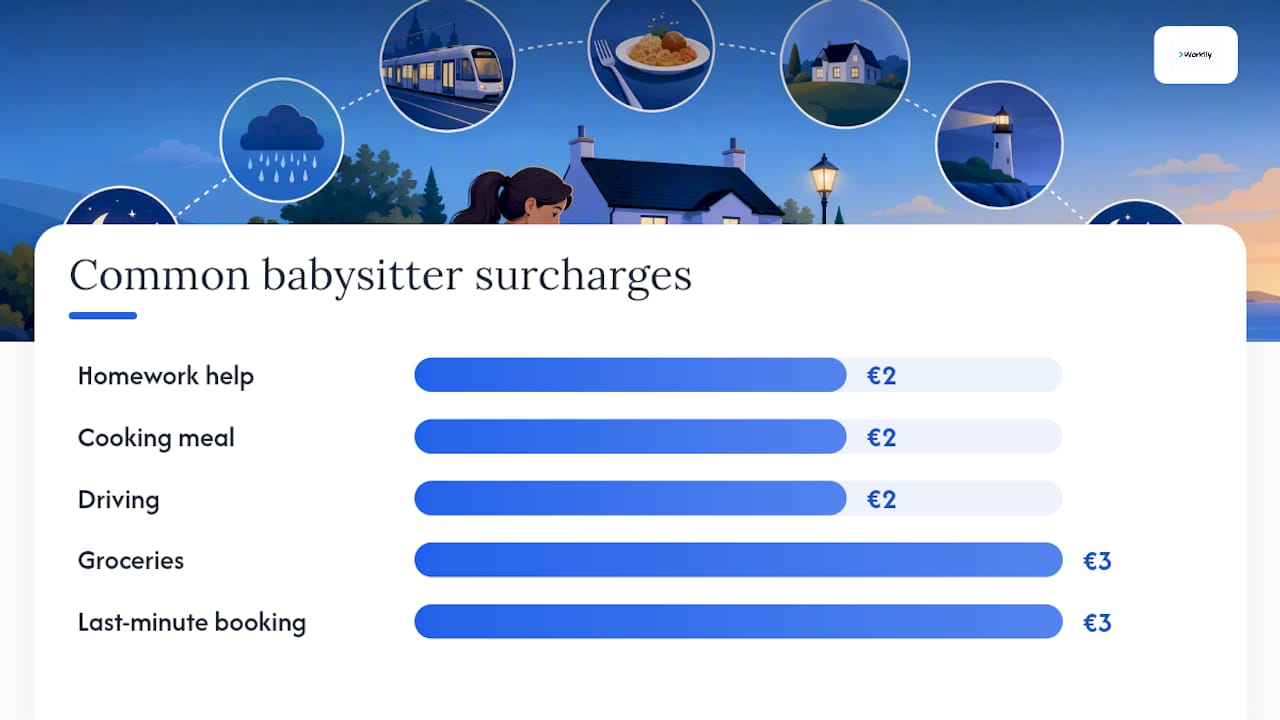
Sitly’s rate calculator lists common task modifiers: homework help adds roughly €2, cooking a meal adds €2, driving adds €2, groceries add €3, and a last-minute booking fee runs around €3. Stack two or three of these and the effective hourly rate climbs quickly.
Sitter experience and qualifications
A sitter with a paediatric first aid certificate, childcare training, or several years of experience will reasonably charge more than a teenager doing their first few jobs. Parents on Irish parenting forums also note that sitters with specific skills, such as musical tuition or sports coaching, command a premium.
Time of day and day of week
Late-night finishes (after midnight), bank holidays, and weekend evenings all attract higher rates. A sitter who needs to wait until 1 AM for you to return from a wedding is not being unreasonable asking for a late-night supplement of €10–€25 on top of the hourly rate.
Travel and parking
If your home is not easily accessible by public transport, factor in a travel contribution. Many sitters in rural areas or outer suburbs expect a small travel supplement or a lift home at the end of the night.
Pro Tip: Agree every extra in writing before the booking, even a brief message confirming “€14/hr, plus €3 for cooking dinner and €2 for the second child” removes any ambiguity and protects both parties.
How to structure babysitter pay: hourly, flat fees and overnight rates
There is no single correct pay model. Most parents use one of four approaches, and the right one depends on the booking length and what you are asking the sitter to do.
Common pay models:
- Pure hourly — straightforward for short evening bookings; you pay for every hour from arrival to departure.
- Minimum-shift hourly — a 3-hour minimum is standard practice. A sitter who travels across town for a 90-minute booking is not fairly compensated on pure hours alone.
- Flat late-night fee — a fixed bonus (commonly €15–€25) added to the hourly total when the booking runs past midnight or ends after a certain hour.
- Overnight hybrid — the most common structure for full overnight stays: hourly while children are awake and during the bedtime routine, a flat overnight fee of €50–€80 for sleeping hours, then hourly again for the morning routine.
Sample pay templates you can copy:
- Standard evening: €14/hr, 3-hour minimum, no additional duties. Total for 4 hours: €56.
- Saturday night with extras: €15/hr + €3 per-child supplement (2 children) + €20 late-night bonus. Total for 5 hours: €115.
- Full overnight: €14/hr for 2 hours awake + €60 flat overnight fee + €14/hr for 1 hour morning routine. Total: €88.
Common surcharges to calculate:
- Per additional child: €2–€4/hr
- Last-minute booking (under 24 hours): €3–€5 flat
- Driving children: €2/hr or agreed mileage rate
- Cooking a meal: €2–€3 flat
- Late-night finish bonus: €15–€25 flat
Minimum wage, employment status and safety checks
Wage floors by age
The adult national minimum wage is €14.15 per hour for workers aged 20 and over. Age-tiered rates apply to younger workers: €12.74 for 19-year-olds, €11.32 for 18-year-olds, and €9.91 for those under 18. These are legal minimums, not suggested rates. Many families pay teenage sitters above the legal minimum as a goodwill gesture and to retain reliability.
Note: The national minimum wage is the legal floor. Paying below it, regardless of how informal the arrangement feels, is not permitted.
Employment status basics
Most babysitters operate as casual freelance workers. For occasional evening bookings, this is generally straightforward: the sitter invoices or simply receives cash, and the arrangement sits outside formal employment. However, if you hire the same person regularly, set their hours, and direct their work, Revenue may treat that person as an employee rather than a self-employed contractor. An employed sitter means you have PAYE, PRSI, and USC obligations. If you are unsure, the Revenue Commissioners’ website has a worker-status determination tool. For a nanny working set hours each week, formal employment is almost always the correct classification.
Safety checks to run before the first session:
- Request two references and actually contact them
- Ask whether the sitter has Garda vetting; many platforms now facilitate this
- Confirm paediatric first aid or CPR certification
- Verify identity with a photo ID
- Check their profile reviews on any platform they use
- Arrange a brief trial meet-up with the children before leaving them alone
Pro Tip: For any recurring arrangement, keep a simple written record of the agreed rate, hours, and duties. A WhatsApp message confirming the terms is sufficient and avoids disputes later.
Where to find and vet a babysitter in Ireland
Sourcing options
The most reliable sitters often come through personal recommendation. Ask other parents at school, in your local community group, or through a trusted neighbour. Word-of-mouth carries built-in accountability that a cold platform listing cannot replicate.
For parents who need a broader pool or faster access, Workily connects you with vetted childcare professionals across Ireland, with verified profiles, reviews, and instant booking. The platform’s trust and safety process means you can see verification status before you make contact, which removes several steps from the vetting process. You can also check how Workily vets professionals to understand what the verification covers.
Community Facebook groups for local parents, Gumtree listings, and specialist childcare agencies are other routes. Agencies typically charge a placement fee or higher hourly rate but handle much of the vetting for you.
Vetting checklist for first contact:
- Ask how many years of babysitting experience they have and the ages of children they have cared for.
- Request two references with contact details.
- Confirm whether they hold Garda vetting and paediatric first aid certification.
- Clarify availability, travel arrangements, and whether they drive.
- Ask how they would handle a child who is unwell or an emergency.
- Arrange a 30-minute meet-up with your children before the first paid session.
- Confirm the agreed rate, duties, and minimum booking length in writing.
Red flags to watch for:
- Reluctance to provide references or ID
- Vague answers about previous experience
- No verifiable online presence or platform profile
- Unwillingness to meet before the first booking
Where the rate figures in this guide come from
The numbers in this guide draw on four primary sources, each covering a different part of the picture.
- Babysits platform data — crowdsourced averages from sitter profiles and completed bookings across Ireland, providing the national average of €13.69 and city-level breakdowns for Dublin, Cork, Galway, Limerick, Waterford, Drogheda, and Dún Laoghaire.
- Sitly blog and rate calculator — regional range data and a task-modifier calculator that shows how duties and location combine to produce a suggested hourly rate.
- Community forums and parenting groups — Reddit threads and local Facebook groups provided anecdotal data on weekend and late-night rates, corroborating the platform figures.
- gov.ie minimum wage guidance — the legal baseline for all rate discussions.
City ranges are derived from local asking rates and regional platform samples gathered in early-to-mid 2026. Platform data reflects asking rates, not necessarily final agreed rates, and tends to skew slightly higher because experienced sitters are more likely to maintain active profiles. Rates in rural areas and smaller towns may sit below the figures shown for major cities.
The case for paying a little more than the going rate
The conventional advice is to match the going rate for your area. That is fine for a one-off booking. For recurring arrangements, it is the wrong strategy.
A reliable sitter who knows your children, your house, and your routines is worth considerably more than the market rate suggests. The cost of re-hiring, re-vetting, and re-introducing a new person every few months adds up in time and stress, not just money. Paying €1–€2 per hour above the local average for someone you trust is almost always the better financial decision over a full year.

The other thing parents underestimate is the difference between a sitter who is technically present and one who is genuinely engaged. Qualifications matter for emergencies, but attitude and warmth matter for the three hours before bedtime. Neither shows up in a rate calculator. A trial session before committing to a regular arrangement tells you far more than a CV.
Find a vetted babysitter through Workily
Searching for a reliable babysitter across community groups and multiple platforms takes time you probably do not have. Workily gives you a single place to find verified childcare professionals across Ireland, with transparent profiles, real reviews, and the ability to book instantly or compare local sitters before committing.

Every professional on Workily goes through a vetting process before appearing in search results, so you are not starting from scratch on references and ID checks. Profiles show experience, qualifications, and previous client ratings in one place. For parents who need someone quickly, the same-day booking feature means you are not left without cover at short notice.
Search for babysitters in your area on Workily, compare profiles and rates, and book securely online.
Sources
The following sources were used to compile the rate data, legal figures, and practical guidance in this guide.
- The average babysitting cost in Ireland
- Babysitting Rates in Ireland 2026: Hourly Costs & Tips
- National minimum wage increase on 1 January 2025
- Babysitting in Ireland: Cost and safety explained