


Before you hand over a single euro, run four checks: confirm the tradesperson’s identity and business details, verify their statutory registration (RGI for gas, Safe Electric for electrical work, CIRI for building works), ask to see a current public liability insurance certificate, and get a written, itemised quote. Those four steps alone will filter out the majority of bogus operators.
- Verify identity: full name, business name, a physical address (not just a mobile number), and a VAT or CRO number.
- Check statutory registers: RGI at rgi.ie for gas installers, Safe Electric at safeelectric.ie for electrical contractors, and CIRI at ciri.ie for registered builders.
- Confirm insurance: ask to see the actual certificate, not just a verbal assurance.
Pro Tip: Never agree to work proposed on your doorstep, and never pay a large sum upfront in cash. Legitimate tradespeople do not pressure you for an immediate decision.
Table of Contents
- How to verify a tradesperson in Ireland before you book
- Official registrations you must check in Ireland
- Documents and certificates you should request
- Red flags and doorstep scams to watch for
- When to hire a chartered surveyor or project manager
- How long checks take and what they cost
- What to do if work goes wrong
- Understanding warranties and guarantees from tradespeople
- Key takeaways
- Why independent checks matter more than most people realise
- Workily makes finding a verified tradesperson straightforward
- Useful sources and official registers
How to verify a tradesperson in Ireland before you book
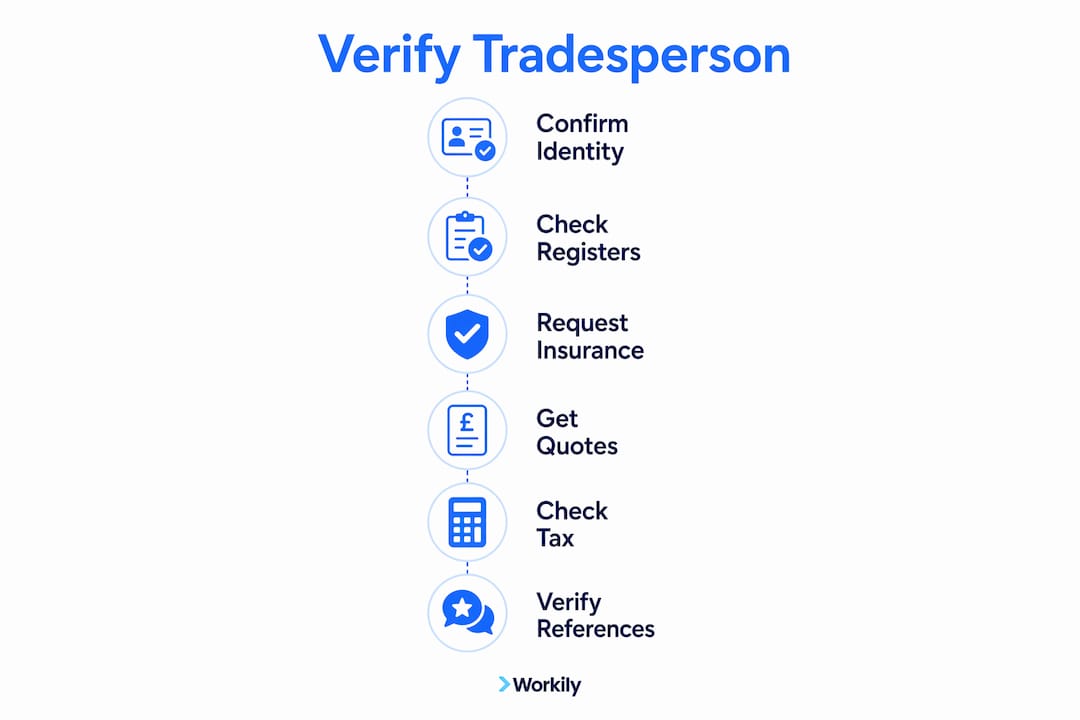
A structured approach takes less than 30 minutes and can save you thousands. Work through these steps before you commit to any work.
1. Confirm identity and business details
Ask for the tradesperson’s full name, trading name, a verifiable street address, a landline or business number, and their VAT registration number or Companies Registration Office (CRO) number Search the CRO at cro.ie to confirm a limited company exists and is active. Gardaí guidance specifically warns against traders who offer only a mobile number and no fixed address.

2. Search the official registers
For gas work, look up the installer on the RGI register. For electrical work, check Safe Electric. For general building works, search CIRI or the Voluntary Construction Register. These are not optional extras — gas and electrical registrations are legal requirements in Ireland.
3. Request proof of insurance
Ask for the physical insurance certificate. Check the policy period, the insurer’s name, and that the cover level is appropriate for your job. Reluctance to produce this document is a serious warning sign.
4. Get at least three written, itemised quotes
A written quote should break down labour, materials, VAT, and timeline. Avoid any quote that is verbal only or that bundles everything into a single lump sum with no breakdown.
5. Check tax compliance
Ask for evidence of tax compliance and, where relevant, Relevant Contracts Tax (RCT) documentation. SCSI guidance recommends verifying the contractor’s registered office and company details as part of standard due diligence.
6. Verify references
Ask for two or three recent references and actually call them. Where practical, visit a completed job to see the standard of work in person.
Pro Tip: Treat the first meeting as a brief interview. Legitimate tradespeople expect these questions and welcome them — hesitation or irritation at reasonable requests is itself a red flag.
Official registrations you must check in Ireland
Not all registrations carry the same legal weight; here is what is mandatory and where to verify it, this should help you understand whom you are working with.
Statutory requirements
Gas installations must be carried out by an RGI-registered installer, and electrical work must be performed or signed off by a Safe Electric registered contractor. Both are legal requirements regulated by the Commission for Regulation of Utilities (CRU). There is no grey area: if your gas or electrical contractor cannot be found on those registers, do not hire them.
CIRI (Construction Industry Register Ireland) is being rolled out under the Regulation of Providers of Building Works Act 2022 and will become a legal requirement for covered building work divisions. Searching ciri.ie is the primary check for builders and contractors.
When a builder is not yet on CIRI
Because the rollout is phased, some experienced builders may not yet appear on the statutory register. In that case, check the Voluntary Construction Register (VCR) or CIF membership as additional signals of competence. CIRI registration is widely regarded as a badge of competence, health and safety compliance, and tax and insurance checks.
| Trade | Required registration | Verification site |
|---|---|---|
| Gas installation | RGI (Registered Gas Installer) | rgi.ie |
| Electrical work | Safe Electric / RECI | safeelectric.ie |
| Building works | CIRI (statutory, phased rollout) | ciri.ie |
| Building works (interim) | Voluntary Construction Register | voluntaryconstructionregister.ie |
| Chartered surveyor | SCSI registration | scsi.ie |
Documents and certificates you should request
Before work starts
- Public liability insurance certificate: check it is current, names the correct business, and that the policy limit is proportionate to the scale of your project.
- Employer’s liability insurance: required where the contractor employs staff on site.
- Written, itemised quotation: labour, materials, VAT, payment schedule, and a clause covering defects and remedial work.
- Signed contract: specifying scope, start and completion dates, staged payments tied to milestones, and what happens if work falls short.
- References: names and contact details of recent clients, plus permission to visit completed projects.
After work is completed
Post-work certificates to insist on include:
- Gas safety certificate (where gas work was carried out)
- Electrical completion certificate or EICR (Electrical Installation Condition Report)
- Building control completion documents for regulated works
- Any manufacturer or contractor warranties and guarantees in writing
Red flags and doorstep scams to watch for
- Unsolicited doorstep approaches, particularly offering to fix something they claim to have “noticed” while passing.
- Pressure to decide immediately or accept a cash-only deal.
- No physical business address, no landline, and refusal to provide insurance documents or references.
- Quotes dramatically lower than others, especially when accompanied by urgency (“this price is only available today”).
- Demands for a large cash deposit before any work begins.
Gardaí guidance advises homeowners to seek comparable estimates from at least two other contractors and to verify all claimed credentials independently, never relying on what the tradesperson tells you about themselves.
Pro Tip: When checking references, ask the previous client specifically whether the work was completed on time, whether the final bill matched the quote, and whether they would hire the same person again. Vague positive answers are less useful than specific ones.
When to hire a chartered surveyor or project manager
For straightforward jobs — a boiler service, a bathroom retile — the checks above are sufficient. For anything more complex, an independent professional pays for itself.
Consider engaging a Chartered Building Surveyor when the work involves structural changes, multiple trades, or a significant budget. They can prepare drawings and specifications, inspect work at key stages, and produce formal reports. Verify their registration at scsi.ie before appointing them.
A Quantity Surveyor adds value on projects where cost control matters: they produce cost plans, manage the tender process, and provide procurement oversight. A Project Manager takes on day-to-day site supervision, which is particularly useful when you cannot be on site regularly.
For larger or complex projects, contracting a chartered professional reduces risk by producing formal specifications, cost plans and supervising work throughout.
How long checks take and what they cost
Online register lookups (RGI, Safe Electric, CIRI, CRO) take a short time in total. Calling references and reviewing insurance documents and written quotes require additional time. None of these steps cost money; they cost only time.
Hiring a Chartered Building Surveyor for a pre-construction survey or contract administration will involve a professional fee, which varies by project size and scope. A Quantity Surveyor’s cost plan or tender management service similarly depends on project value. Neither is cheap, but both are considerably less expensive than remedying defective work after the fact.
The principle is straightforward: a modest investment in verification at the start prevents disproportionately larger losses later.
What to do if work goes wrong
- Stop further work where it is safe to do so, and document all defects with dated photographs.
- Preserve all correspondence, receipts, and the original signed contract.
- Write to the tradesperson formally, describe the defects clearly, and set a reasonable deadline for remedial action.
- If they fail to respond or remedy the work, escalate to the relevant register (CIRI or VCR) and file a complaint.
- Contact Citizens Information for consumer protection guidance and your options under Irish consumer law.
- For fraud or suspected criminal activity, report to the Gardaí directly.
- For disputes below a certain value, the Small Claims Court is a cost-effective route without needing a solicitor.
- Where defects are significant, commission an independent chartered professional to inspect and document them as evidence before any remedial work begins.
Understanding warranties and guarantees from tradespeople
A warranty or guarantee is only as reliable as the business standing behind it. Always get any guarantee in writing, with the duration, what it covers, and the process for making a claim clearly stated. Verbal assurances carry no legal weight.
Check whether the guarantee is backed by the tradesperson personally, by their company, or by a third-party insurance-backed scheme. Company-backed guarantees become worthless if the business ceases trading, which is one reason to check CRO records before you sign anything. An insurance-backed guarantee from a recognised scheme survives the contractor’s insolvency.
For materials and products installed, ask whether the manufacturer’s warranty is transferable to you as the homeowner, and whether the installation method must meet specific standards to keep that warranty valid.
Key takeaways
Verifying a tradesperson in Ireland requires checking statutory registers, confirming insurance, and securing a written contract before any work begins.
| Point | Details |
|---|---|
| Check statutory registers first | Gas work requires an RGI-registered installer; electrical work requires a Safe Electric contractor — both are legal requirements. |
| Verify builders on CIRI or VCR | Search ciri.ie for registered builders; use the Voluntary Construction Register if a builder does not yet appear on CIRI. |
| Insist on written insurance and a contract | Ask for the physical insurance certificate and a signed, itemised contract with staged payments before work starts. |
| Know the red flags | Doorstep approaches, mobile-only contact, large cash deposits, and refusal to provide references are all reasons to walk away. |
| Use Workily for verified bookings | Workily pre-vets professionals so key checks are already done, reducing the verification burden for homeowners and landlords. |
Why independent checks matter more than most people realise
The conventional wisdom is that word-of-mouth recommendation is enough. It often is not. A neighbour’s positive experience with a plumber does not tell you whether that plumber’s public liability insurance lapsed six months ago, or whether they are registered for the specific type of gas work you need. Those are separate facts that require separate checks.
What the evidence from Gardaí guidance and industry registers consistently shows is that legitimate tradespeople do not object to these questions. The ones who push back, deflect, or become irritated when asked for documentation are telling you something important about how they operate.
The verification steps in this article take under an hour for most jobs. That hour is the cheapest insurance you can buy before committing to any home improvement work.
Workily makes finding a verified tradesperson straightforward
Running every check manually takes time and confidence. Workily offers a faster route: every professional on the platform goes through a vetting process covering identity, insurance, and qualifications before they appear in search results. You still get the transparency, but without spending an afternoon on hold to insurance companies and register helplines.

The platform covers trades, home services, and specialist work, with same-day booking available and secure online payments built in. You can compare quotes from multiple verified professionals, read verified ratings from real customers, and book with confidence. Workily reports a high satisfaction rate across a large customer base.
If you want to skip the manual verification process and hire with confidence, find a verified tradesperson on Workily today.
Useful sources and official registers
- CIRI — Construction Industry Register Ireland: statutory register for building works providers; search at ciri.ie.
- Voluntary Construction Register (VCR): industry-supported register searchable by trade, area, or company name at voluntaryconstructionregister.ie.
- RGI — Registered Gas Installers: verify gas installers at rgi.ie before any gas installation or servicing work.
- Safe Electric: verify electrical contractors at safeelectric.ie; registration is a legal requirement for electrical work.
- CRU — Commission for Regulation of Utilities: regulatory body overseeing RGI and Safe Electric requirements.
- SCSI — Society of Chartered Surveyors Ireland: verify chartered surveyors and access guidance on engaging contractors.
- Gardaí — Bogus Traders Guidance: practical crime-prevention advice on identifying and avoiding bogus traders.
- Citizens Information: consumer rights guidance and escalation routes if work goes wrong.
- CRO — Companies Registration Office: verify limited company details, registered address, and active status.