

Why I believe AI will fundamentally change how we find and hire tradespeople in Ireland
By Thomas O'Donoghue, Founder of Workily
If you need a plumber in Ireland today, the process hasn’t changed as much as we might like to think. You probably start with Google, ask somebody you know, look in a Facebook group or perhaps use one of the existing trade platforms. Then the calls start. One person doesn’t answer. Another says they’ll ring you back. Someone else might be available next week. You send photographs on WhatsApp, explain the job several times and, if it is anything substantial, wait for somebody to come back with a quote.
We have digitised almost every other part of our lives, yet hiring somebody to repair a roof, fit a bathroom or sort out an electrical problem can still be remarkably manual.
I don’t think that will remain the case for very long.
The next transformation in this market isn’t going to come from another directory with a longer list of tradespeople. I think it will come from artificial intelligence changing the way the customer searches in the first place. Increasingly, we won’t go online and search through ten businesses ourselves. We will tell an AI what we need and expect it to help us get the job done.
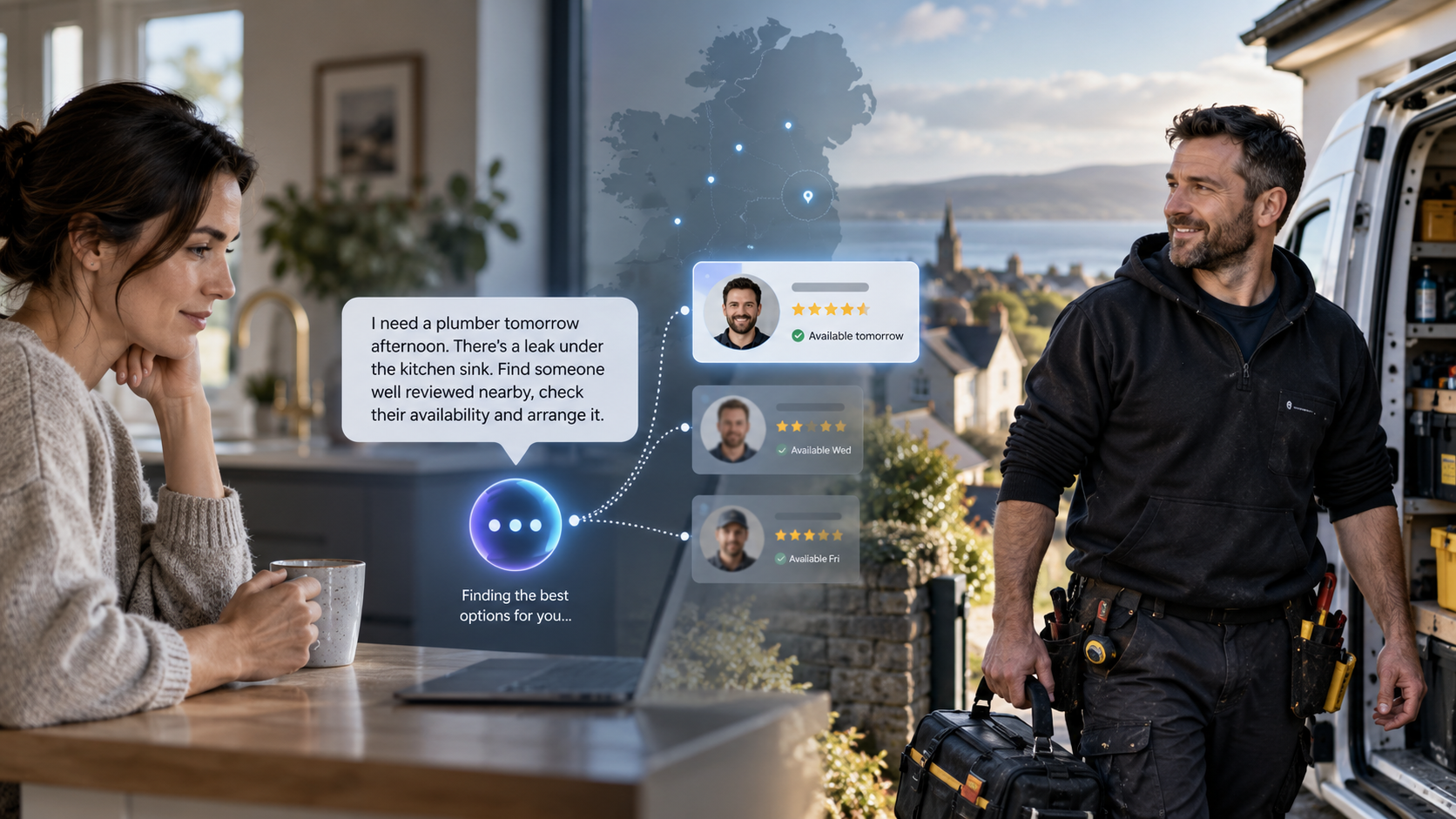
That distinction is important. Today I might ask, “Can you recommend a plumber in Athlone?” Tomorrow the request becomes, “I have a leak under the kitchen sink. Find a reputable plumber nearby who can come tomorrow afternoon, check their reviews, give me an indication of what it should cost and arrange the appointment.”
The first question is search. The second is an instruction.
I believe that move from searching the internet to asking the internet to act for us will be one of the biggest changes to local services since Google arrived.
From the web we search to the web that acts
The first version of the commercial web was largely about making information available. Search engines then organised that information. Marketplaces went a stage further by organising buyers and sellers around a particular need. AI is now beginning to change that again because it can understand intent rather than simply match keywords.
Agents take it one step further. An AI agent can potentially research options, compare them, communicate with different systems, check availability and eventually initiate or complete a transaction. We are already seeing the infrastructure for this being developed. OpenAI’s Agentic Commerce Protocol, for example, is designed to allow AI systems and commercial platforms to exchange structured information, while ChatGPT’s plugin ecosystem allows external services and tools to participate directly in AI-driven workflows.
At the moment much of the public discussion around agentic commerce is focused on retail. That makes sense because buying a product is easier to standardise than replacing a boiler or renovating a kitchen. But I don’t think this development stops at products.
McKinsey estimates that AI agents could mediate between $3 trillion and $5 trillion of global consumer commerce by 2030 under moderate adoption assumptions. Importantly, its current estimate is based on goods and does not include services, which makes the question of what happens when agents move into services even more interesting.
The underlying behaviour is already beginning to change. Instead of searching for ten pages and making the comparison ourselves, people increasingly ask AI to narrow the decision. As those systems gain the ability to interact with booking systems, marketplaces and payment systems, the distance between “find me someone” and “arrange someone” gets very small.
I don’t believe Google suddenly disappears. Websites will still matter. Search will matter. Reviews will matter. Facebook and Instagram will still influence decisions. What changes is that the entrance to the internet becomes fragmented. A customer may begin with Google, ChatGPT, another AI assistant, their phone, their car or some service we haven’t seen yet.
For businesses, that introduces a very different question. For the last twenty years we have told businesses that they need to be visible to Google. Over the next decade, they will increasingly need to be understandable to machines.
Why Ireland is a particularly interesting market
Ireland looks almost designed for this change. Consumers here are highly digital, yet large parts of the local services economy remain fragmented and relatively difficult to transact with online.
According to the CSO, 95% of people aged 16 and over in Ireland had recently used the internet in 2025, and 95% of those internet users were online every day or almost every day. Household internet access also reached 95%.
Compare that with construction. In 2025, just 10.1% of construction enterprises reported conducting sales via the internet, against 41.7% in the wider services sector.
That gap is important.
It doesn’t mean Irish tradespeople aren’t online. Many are extremely good at what they do and use Facebook, Instagram, WhatsApp and Google every day. What it shows is that the commercial process around those businesses is still far less digitised than the consumer.
Meanwhile, artificial intelligence is moving quickly into Irish business. The proportion of Irish enterprises using some form of AI more than doubled from 8.1% in 2023 to 20.2% in 2025. Among small enterprises the figure was 17.2%, while 57.7% of large enterprises were already using AI.
That creates a risk for small businesses, but also a huge opportunity. A local electrician isn’t going to have an AI department. A plumber doesn’t need one. Their competitive advantage is the ability to do something useful in the physical world.
And Ireland is going to need those skills.
SOLAS estimates that approximately 152,600 people were employed in construction occupations in 2024. Its 2025 National Skills Bulletin also points to the scale of future demand: a Department of Further and Higher Education report estimates that between 68,000 and 80,000 additional construction workers could be required by 2030 simply to deliver housing and retrofitting targets.
So when people talk about AI destroying jobs, I think trades are a particularly interesting counterpoint.
AI cannot fix your leaking pipe. It cannot climb onto your roof. It cannot tile your bathroom, wire your extension or service your boiler.
But it can potentially change almost everything that happens around those jobs.
It can help a customer understand the problem. It can identify the right type of professional. It can prepare a job description from photographs. It can shortlist suitable professionals, check location and availability, answer routine questions, arrange appointments, help with estimates, manage follow-ups and eventually facilitate payment.
In other words, I don’t think AI replaces the tradesperson.
I think it increasingly replaces the friction involved in finding and hiring one.
What tradespeople should be doing now
I wouldn’t suggest for a minute that an electrician or carpenter needs to understand agent architecture or start learning how large language models work. That would miss the point.
But they should understand that their digital identity is going to become more important.
A business needs to be clear about what it actually does, where it operates, when it is available, what qualifications or registrations it holds and what previous customers think about it. “John’s Building Services” with a mobile number and a Facebook page may have been enough for a human who was prepared to do some detective work. It is considerably less useful to an AI trying to answer a specific request such as, “I need somebody within 15 kilometres who installs composite decking and can quote next week.”
The future therefore isn’t simply about having a website. It is about having structured, current and trustworthy information about the business.
Reputation becomes more important too. Reviews, verified credentials, completed jobs, response rates and other trust signals give both humans and machines information from which to make decisions.
Availability becomes important. If an AI can determine that one professional can take the job on Wednesday and another hasn’t updated their availability for six months, that information may influence who gets recommended.
Responsiveness matters as well. Good tradespeople often lose work today simply because they are busy doing the job and aren’t answering the phone. Technology should solve more of that problem rather than create additional administration for them.
And this is where I think the industry needs to be careful. We shouldn’t respond to AI by expecting every tradesperson to become a digital marketer. I don’t believe a brilliant plumber should have to spend evenings learning SEO, running Google Ads, producing TikTok videos and answering ten different inboxes simply to keep a pipeline of work.
The technology should be making their lives easier.
That is something I feel strongly about.
Why this thinking is shaping Workily
This is also a large part of how I think about Workily.
I don’t want us to build another static directory with thousands of names in it and consider the job done. There are already plenty of places on the internet where you can find lists of businesses.
The real problem is making the connection between a genuine customer need and the right professional as easy as possible.
That is why Workily is being built around different ways of making that connection. We already have OpenAi running within Workily, to match and better understand jobs. With Book a Pro, customers can post a job, receive responses and compare professionals. Instant Pro is designed around services where availability matters and a customer wants somebody quickly. And Ask a Pro creates something slightly different again: the ability to pay a professional for their knowledge through an online consultation rather than requiring somebody to physically travel to the customer’s home.
I think that last area becomes particularly interesting as AI develops, but tradespeople, customers and platforms need to be ready.
AI can provide an enormous amount of general information, but there is still a difference between generating an answer and getting advice from somebody who has spent twenty years actually doing the job. As information becomes cheaper and easier to generate, trusted real-world expertise may actually become more valuable.
A builder, plumber, electrician, accountant or other professional has knowledge that has historically been difficult to monetise unless they physically turned up somewhere. Technology gives us another way to value that experience.
But our thinking about Workily also goes beyond what happens on Workily.ie.
If the internet genuinely is moving towards agents, I don’t believe our long-term strategy can simply be, “How do we force every customer to come to our website?”
Of course we want people to use Workily. But increasingly we also need to ask how Workily can participate wherever the customer’s request originates.
That means building good structured data around professionals and services. It means APIs and integrations. It means preparing for AI plugins and agent-based systems that can interact with the marketplace rather than simply read a webpage. We are already working and building these with OpenAi to this effect. We are looking at how Workily can eventually make its marketplace accessible to AI systems in a controlled way, so an authorised agent can understand what services are available and help connect a customer with the appropriate professional.
Imagine telling an AI:
“I need three electricians in Galway who install EV chargers. I want somebody properly qualified, well reviewed and available within the next seven days.” Thats why we have voice options already in Workily search modals, AI driven of course.
For an agent to answer that properly, it needs more than a list of webpages. It needs reliable information and people.
Who provides the service? Where do they operate? Are they verified? Are they available? What is their reputation? Can they quote? Can they be booked? How quickly do they normally respond?
That is the type of marketplace infrastructure I think becomes increasingly valuable.
And it changes how I think about Workily’s role. We’re not trying to replace the professional or insert technology where it isn’t useful. We are trying to remove unnecessary friction between somebody who needs something done and somebody capable of doing it.
Our values around that are fairly straightforward. Customers should be able to find good professionals with greater confidence. Professionals should have a fair opportunity to win work without becoming full-time marketers. Their time and expertise should have value. And technology should make the interaction easier, not create another layer of complexity.
The physical economy may become more valuable, not less
One of the interesting consequences of AI could therefore be almost the opposite of what people expect.
As intelligence becomes cheaper and digital work becomes increasingly automated, the things that require a skilled person to physically turn up in the real world may become relatively more valuable.
You can ask an AI to design a beautiful bathroom in seconds. Someone still has to build it.
It can analyse why your boiler may be losing pressure. Somebody still has to repair it.
It can calculate exactly how much decking you require, compare materials and produce a plan. Somebody still needs to construct it.
The digital part becomes extraordinarily efficient while the physical constraint remains.
That means the opportunity for good tradespeople isn’t disappearing. In many ways I think it gets bigger.
What changes is how demand reaches them.
Today the first interaction is normally human to business. Tomorrow, it may increasingly be machine to business on behalf of a human.
The homeowner remains the customer. But the first “customer” that a tradesperson’s digital presence needs to satisfy may be an AI agent deciding whether that professional belongs on the shortlist.
That might sound futuristic, but so did talking naturally to a computer and asking it to research something for us only a few years ago.
I don’t pretend to know exactly how quickly all of this develops or which companies eventually dominate the interface. Nobody does. But I think the direction is becoming difficult to ignore.
The web began by giving us access to information. Search helped us find it. Marketplaces helped us transact around it. AI is beginning to understand what we actually want.
The next step is for it to act.
For tradespeople, my message isn’t to fear that change. It is to make sure you’re represented in it.
Be visible. Be specific about what you do. Build a genuine reputation. Keep your information current. Use technology where it saves you time. And make sure your business can increasingly be understood not just by the people searching for you, but by the systems searching on their behalf.
And for Workily, that’s the future we’re preparing for.
Because however intelligent the web becomes, when the boiler breaks, the roof leaks or somebody wants to build an extension, somebody still has to turn up and do the job.
Thomas O’Donoghue
Founder, Workily