

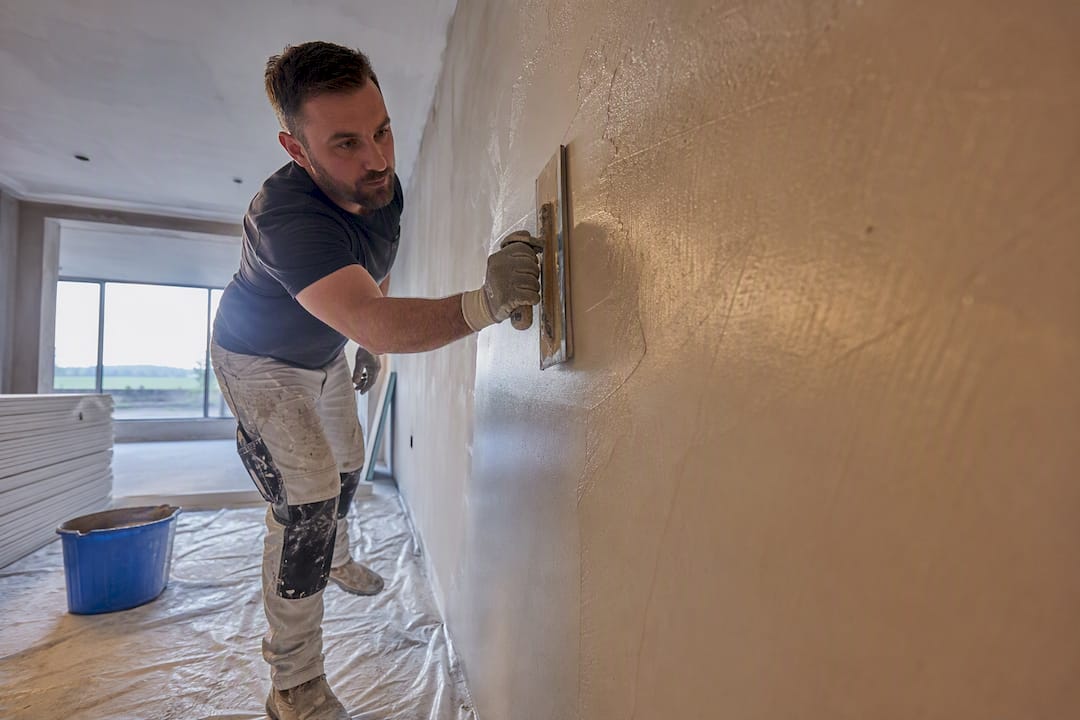
A skim coat in Ireland typically costs €10 to €30 per m², or roughly €300 to €600 for an average room, while a full re-plaster of a three-bed house runs €3,000 to €6,000. Day rates for a skilled plasterer generally sit between €200 and €450. The final figure on your invoice, though, usually comes down to preparation, access and VAT treatment rather than the headline rate itself.
TL;DR:
- Preparation work such as removing wallpaper or repairing damaged plaster can significantly increase the final cost beyond the base rate, sometimes doubling the quote.
- Access issues like high ceilings or awkward spaces often necessitate scaffolding or extended equipment, adding extra charges to the overall price.
- External render costs vary from €40 to €90 per square metre, depending on the system used and the need for scaffolding, making it more expensive than internal plastering.
- Small jobs tend to be more costly per square metre due to setup and travel time, with patch repairs often starting around €150 to €250 minimum.
- Obtaining a detailed, written quote that separates labour, materials, and waste disposal helps prevent unexpected charges once the work begins.
Table of Contents
- Plasterer rates Ireland: benchmark pricing per m², room and day
- What makes a plastering quote higher than the average plastering prices Ireland shows?
- What should a written plastering quote include?
- How to choose a plasterer and when to insist on a site visit
- Why trust this plastering cost guide?
- Sample plastering job estimates to sanity-check your quote
- Average total cost: full house versus single room plastering
- How long does a plastering job take from quote to completion?
- Getting the budget right without the guesswork
- How Workily helps you book a vetted plasterer without the back-and-forth
- Sources
- FAQ
Plasterer rates Ireland: benchmark pricing per m², room and day
Most quotes break down one of two ways: by area (per m²) or by the job (per room, per house). Knowing both helps you spot a quote that’s out of line before you sign anything.
A basic skim coat over sound plasterboard or existing plaster costs €10 to €30 per m², which works out to about €300 to €600 for a typical bedroom or box room, according to ShamFix’s Irish plastering cost data. A full re-plaster of a three-bedroom semi, including hacking off old plaster and re-skimming every room, generally lands between €3,000 and €6,000 for the whole house. Dublin jobs tend to run 10% to 20% higher than the same work in Cork, Galway or a rural county, largely down to demand and travel time within the city.
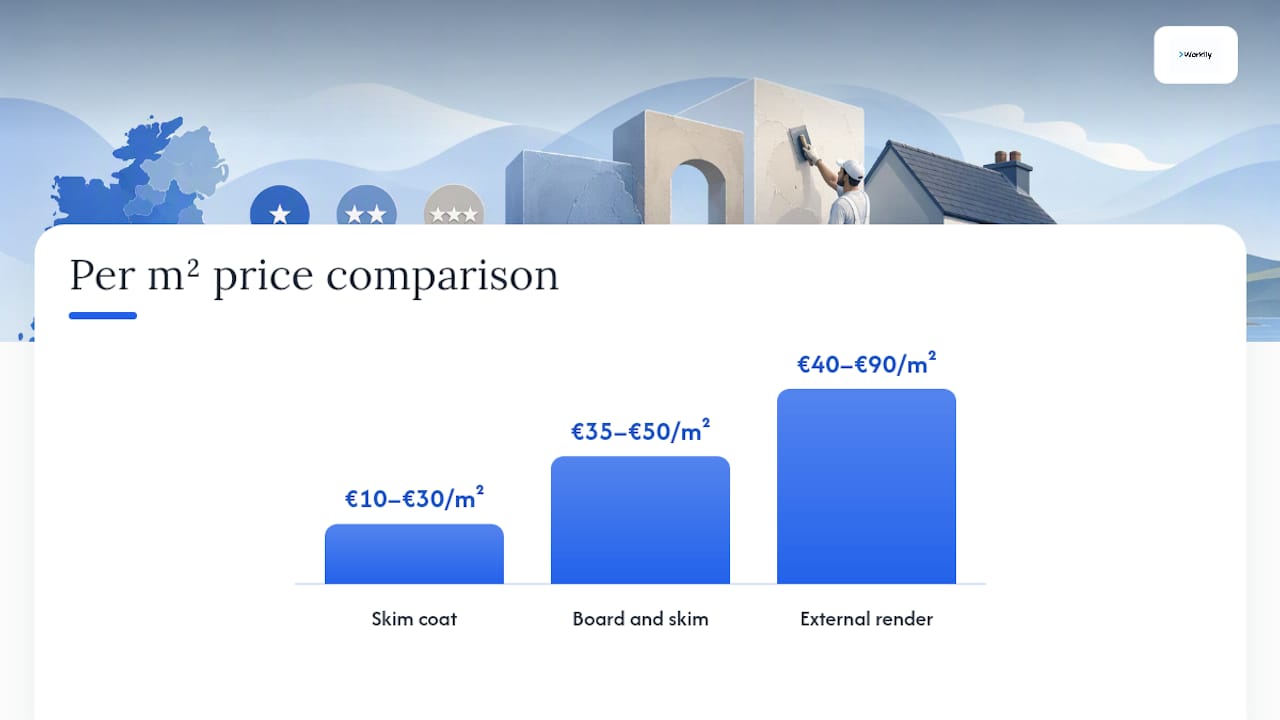
Board-and-skim work, where new plasterboard goes up before the finish coat, typically costs €35 to €50 per m² once labour and boards are included. External render is a different animal again: expect €40 to €90 per m² depending on the render system (sand and cement, monocouche, or a silicone-based finish) and whether scaffolding is needed.
On day rates, Tradesmarket puts a skilled plasterer’s day rate at roughly €200 to €450, with per-room skim jobs often priced at €300 to €700 depending on how much prep is involved. That range is broadly consistent with PayScale’s data showing average hourly pay for plasterers in Ireland around €19.00, with a typical spread of €13 to €25 an hour. The Workplace Relations Commission’s Construction Sector sectoral order sets baseline craftsperson hourly rates that help explain why the labour component of a quote rarely falls below a certain floor.
| Job type | Typical price |
|---|---|
| Skim coat (per m²) | €10–€30 |
| Skim coat (per room) | €300–€600 |
| Board and skim (per m²) | €35–€50 |
| External render (per m²) | €40–€90 |
| Full re-plaster, 3-bed house | €3,000–€6,000 |
| Plasterer day rate | €200–€450 |
| Average hourly pay | ~€19.00 |
What makes a plastering quote higher than the average plastering prices Ireland shows?
The per m² figure is only ever a starting point. What actually moves a quote up or down is everything around the plastering itself.
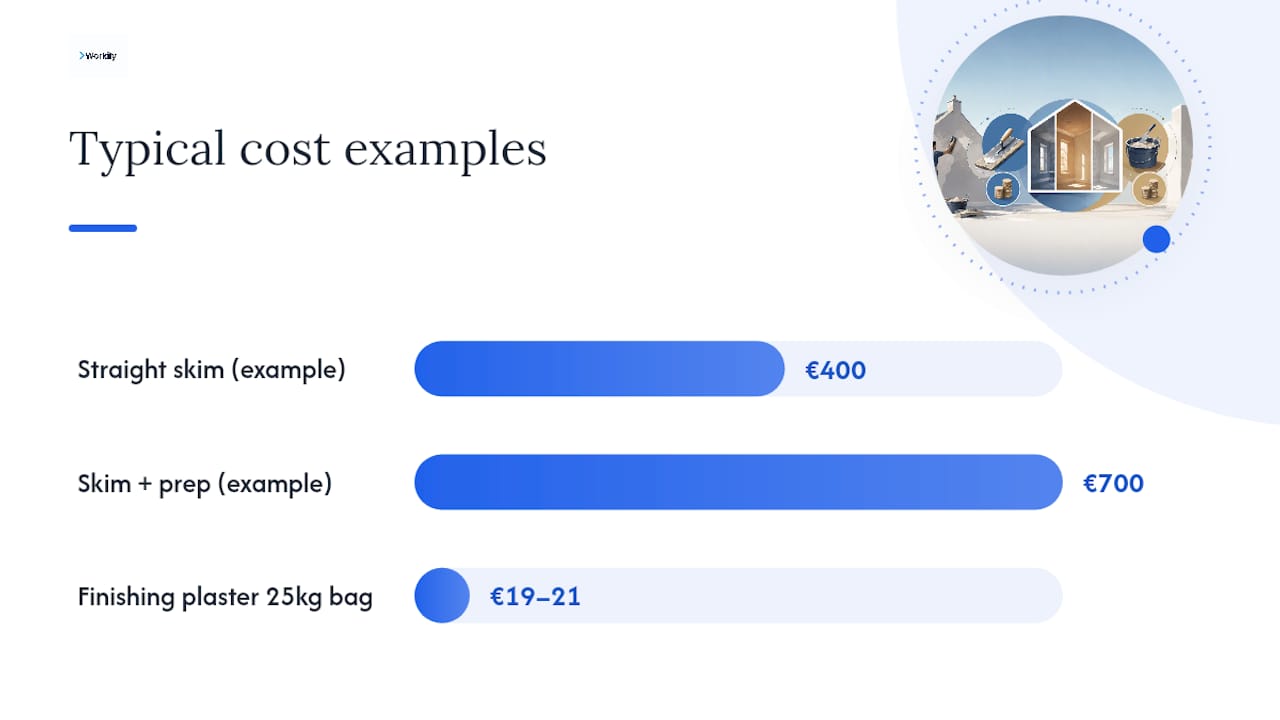
Preparation is the biggest variable. Stripping old wallpaper, hacking back damaged plaster, treating damp patches, or boarding out stud walls before skimming can multiply the labour time on what looked like a simple job. A room quoted at €400 for a straight skim can easily hit €700 or more once a plasterer has to deal with crumbling lath and plaster underneath.
Access matters more than most homeowners expect. High ceilings, stairwells, and awkward landings all slow the work down and sometimes require scaffold hire, which adds a separate cost on top of labour.
Materials and waste play a smaller but real role. A 25kg bag of finishing plaster like Gyproc Skimcoat costs around €18 to €21 in Irish merchants and covers roughly 9.4m², so material cost is usually modest compared with labour on internal skimming jobs. Skip hire for a full re-plaster, however, can add several hundred euro.
Key factors that push quotes above the headline rate:
- Hacking back old plaster or removing wallpaper before skimming
- Scaffolding or extended access equipment for high ceilings and stairwells
- Damp proofing or remedial work discovered mid-job
- Skip hire and rubble removal on larger re-plaster jobs
- Call-out minimums on small patch or repair jobs
Pro Tip: Ask your plasterer to separate the quote into labour, materials, and waste disposal. A quote that lumps everything into one number is much harder to challenge if the final bill comes in higher than expected.
Small jobs often carry a proportionally higher cost per m² because setup and travel time get spread over a smaller area, an effect confirmed by homeowner discussions on Askaboutmoney comparing Dublin day rates for patch repairs versus full rooms.
What should a written plastering quote include?
A proper quote protects both sides. Before agreeing to anything, check it covers these points:
- An itemised scope of works listing which rooms or walls, what preparation is included, and the finish standard expected.
- A VAT-inclusive total. Domestic plastering commonly qualifies for Ireland’s reduced 13.5% VAT rate where applicable, but the quote should state this clearly rather than leaving VAT ambiguous.
- Materials and waste disposal, specifying whether plaster, boards, skip hire and floor protection are included in the price or billed separately.
- A timeline and payment schedule, including start date, expected completion, and how payments are staged.
- A guarantee of finish, covering what happens if cracking or shrinkage appears after the plaster dries.
Red flags worth walking away from include a verbal-only price with no written breakdown, no mention of VAT status, no proof of insurance, and vague wording like “plastering as required” instead of a defined scope.
How to choose a plasterer and when to insist on a site visit
Checking a tradesperson properly before they start takes twenty minutes and saves considerably more time later. Verify public liability insurance, ask for two or three references from recent jobs, and request photos of similar work, ideally in a house of comparable age to yours.
Ask directly whether the plasterer supplies materials themselves or expects you to buy them, and whether waste removal is included in the price. For anything bigger than a single room, insist on an on-site visit rather than a phone or photo quote. Damp, uneven walls, and old lath-and-plaster surfaces are easy to miss remotely and hard to price accurately without seeing them.
Useful questions to ask on-site:
- How many coats will this need, and what’s the drying time between them?
- Will you hack back the existing surface or skim over it?
- What happens if you find damp or structural issues once work starts?
- Can I see photos of a job you finished in the last month?
Pro Tip: Pay in stages rather than upfront in full. A common structure is a small deposit, a payment at the halfway point, and the balance once you’re satisfied with the finish. Get a receipt for every payment.
Before committing, it’s worth checking how to verify a tradesperson is legitimate in Ireland, which covers insurance checks and how to spot a fly-by-night operator.
Why trust this plastering cost guide?
This guide draws on published Irish trade pricing data, sectoral pay orders, and retail material costs rather than a single quote or anecdote, and it’s written by Thomas, who covers home services and trades pricing for Irish homeowners.
Workily was built to solve the exact problem this article addresses: finding a plasterer whose price you can actually trust. Every professional on the platform goes through a vetting process before they can take bookings, and the instant booking feature means urgent jobs, like a leak-damaged ceiling, don’t have to wait days for a callback.
The platform reports a high customer satisfaction rate among homeowners who have booked through it.
If you’re comparing plastering quotes, running two or three through Workily alongside your own research gives you a faster way to spot outliers, whether that’s a suspiciously low price or one padded with vague line items.
Sample plastering job estimates to sanity-check your quote
Real numbers help more than ranges alone. Here’s how a few common jobs typically price out in Ireland, based on the benchmarks above.
Single bedroom skim, 12m² of wall area: at €10 to €30 per m², expect €120 to €360 for materials and labour combined, though most plasterers will quote a flat room price closer to €300 to €500 once setup and finishing are factored in.
Hallway and stairwell skim: access complications push this above a simple per m² calculation. Even a modest hallway can hit €500 to €800 once a plasterer accounts for the awkward angles around a staircase and the need for extra sheeting to protect floors.
Full three-bed semi-detached re-plaster: hacking off old plaster in every room, boarding where needed, and skimming throughout typically lands between €3,000 and €6,000, consistent with figures from LocallyIrish’s cost guide.
Small patch repair, damaged plaster after a leak: expect to pay a minimum call-out charge, often €150 to €250, even though the actual repaired area might be under 1m². This is where the “small jobs cost more per m²” rule shows up most clearly.
If a quote for any of these comes in wildly below these ranges, ask what’s been left out. If it comes in well above, ask what’s driving the difference, whether that’s extensive prep, damp remediation, or simply a premium for a well-reviewed tradesperson.
Average total cost: full house versus single room plastering
Scale changes the maths considerably. A single-room skim job in a typical Irish three-bed house costs €300 to €600, but that same room priced as part of a whole-house job often works out cheaper per square metre, because the plasterer only sets up once.
A full-house re-plaster, covering every room including hallways, typically totals €3,000 to €6,000 for a standard three-bedroom semi, according to ShamFix’s pricing data. That figure assumes a mix of straightforward skim work and some board-and-skim in rooms needing new plasterboard. Larger four and five-bed houses, or period properties with solid wall construction, can push past €7,000 once damp treatment and additional boarding are factored in.
For homeowners renovating in stages, a practical approach is grouping rooms by floor: plastering the whole upstairs in one visit, then the downstairs separately, rather than spreading single-room jobs over several months. This reduces the number of call-outs and setup charges you pay for overall.
If you’re weighing plastering against other renovation costs in the same project, it’s worth reading a broader renovation cost guide for Ireland to see how plastering fits into total project budgets and where contingency funds typically go.
How long does a plastering job take from quote to completion?
Timelines vary more by drying time than by the actual plastering work itself. A single room skim usually takes a plasterer one full day to apply, but the surface needs one to two days to dry before painting, so budget two to three days total from start to a paintable finish.
A full-house re-plaster is a bigger commitment. Expect a plasterer to spend anywhere from five to ten working days on site for a standard three-bed house, depending on how much hacking back and boarding is required, plus additional drying time before decorating can begin. Getting from an initial enquiry to a booked start date typically takes one to two weeks, mainly because good plasterers are often booked several weeks ahead, especially in Dublin and other cities during spring and autumn when renovation demand peaks.
External render jobs take longer still, since weather conditions affect both application and curing. A render job might sit on a schedule for several weeks if scaffolding needs to go up and come down, and most plasterers won’t render in frost or heavy rain.
Pro Tip: Book your plasterer at least three to four weeks ahead of when you actually need the work done, particularly if you’re planning to paint or move furniture back in on a specific date.
Getting the budget right without the guesswork
Verbal-only quotes are where budgets go wrong. Always get the price in writing, broken down by labour, materials and any extras like skip hire, before work starts. Grouping prep-heavy rooms together in one visit cuts down on repeated setup costs, and if you’re already having electrical or plumbing work done, ask whether the plasterer can follow straight after to save a separate call-out charge.
— Thomas
How Workily helps you book a vetted plasterer without the back-and-forth
Workily is the direct route to a checked, available plasterer in your area, without spending an evening ringing around for callbacks that never come. Every professional listed goes through a vetting process before they can accept jobs, and the instant booking feature means you can secure a same-day visit for urgent repairs rather than waiting on a diary slot.

For a full re-plaster or a room skim, request quotes from two or three plasterers through Workily and insist on an on-site visit before agreeing a price, exactly as this guide recommends. That gives you a real scope of works to compare rather than a rough guess over the phone. Anyone weighing up decorative finishes as an alternative to a full re-plaster might also find SelfDezign’s comparison of microcement versus tiling costs useful for budgeting a wider renovation. If you’re also planning to paint once the plaster’s dry, Workily’s guide to interior painter costs in Ireland is worth a read before you book.
Ready to compare vetted plasterers near you? Book a professional through Workily and get quotes moving today.
Sources
- Plastering Cost Ireland: Real 2026 Prices Per M² | ShamFix
- Construction Sector – Workplace Relations Commission
- Plasterer Hourly Pay in Ireland in 2026 | PayScale
- Locallyirish
- Gyproc Gyproc Skimcoat Final Coat Plaster 25KG Bag | Homevalue
FAQ
How much should I pay a plasterer per day in Ireland?
A skilled plasterer’s day rate in Ireland typically runs €200 to €450, depending on location, the complexity of the job, and whether materials are included in that figure.
How much does a plasterer get paid in Ireland?
Average hourly pay for a plasterer in Ireland is around €19.00, with a typical range of €13 to €25 depending on experience and location, according to PayScale.
What does a plasterer charge per hour?
Most plasterers price jobs by the room or by the day rather than strictly by the hour, but hourly equivalents typically fall between €19 and €35 once you factor in a standard day rate and working hours.
How do I calculate plastering costs for my project?
Measure the wall and ceiling area in square metres, multiply by €10 to €30 for a skim coat or €35 to €50 for board-and-skim, then add a margin for preparation, access, and any damp or structural repairs found on site.
Is plastering subject to VAT in Ireland?
Domestic plastering work commonly qualifies for Ireland’s reduced 13.5% VAT rate where applicable, though the exact treatment depends on the nature of the contract, so always confirm the VAT position before agreeing a quote.
Why do plastering quotes vary so much between tradespeople?
Preparation work, access difficulties, and whether old plaster needs hacking back before re-skimming usually explain quote differences more than the headline per m² rate does.
Can I get a plasterer to visit the same day through Workily?
Yes, Workily’s instant booking feature is designed for exactly this kind of urgent request, connecting you with a vetted plasterer for same-day visits where availability allows.