

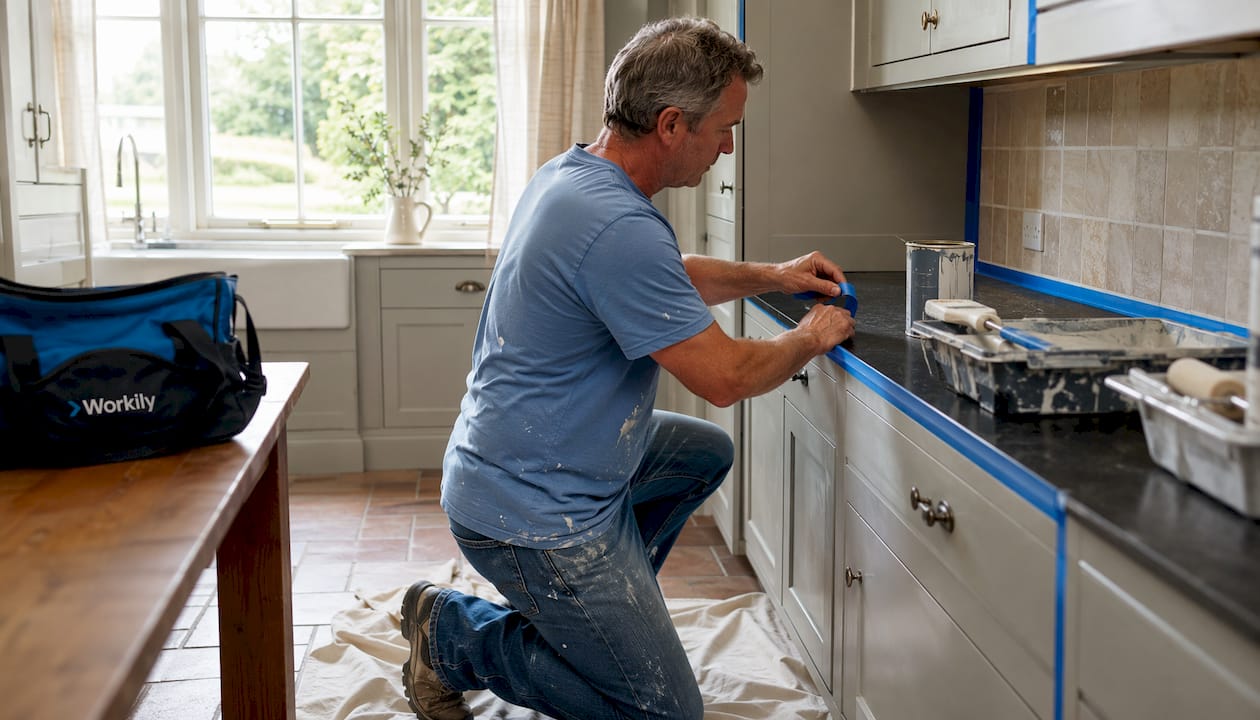
Hiring a professional interior painter in Ireland typically costs an amount within the general price range for a standard repaint per room, or a mid-range to higher-end cost to repaint the interior of a typical 3-bed house, including labour and trade paint. Dublin tends to run 20–30% above national averages, mirroring the London uplift seen in UK benchmarks. Before you fix a budget, note this: prep work is the single biggest wildcard. Damp treatment, crack filling, or skim plastering can add hundreds to a quote that looked reasonable on paper.
Key things to know before you request a single quote:
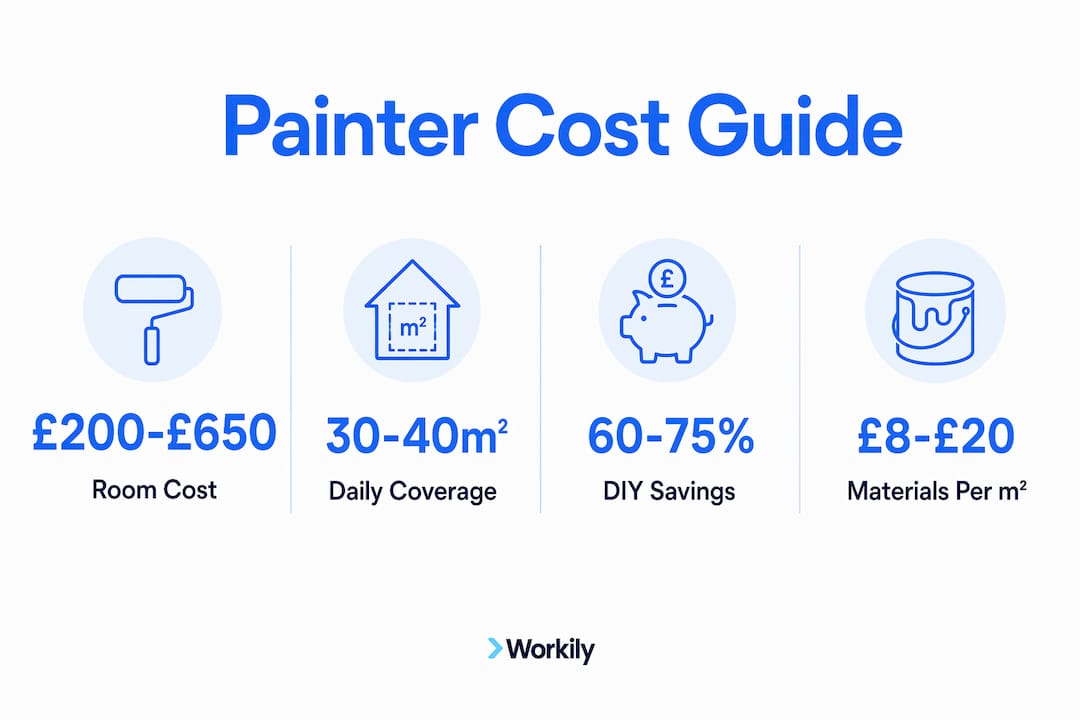
- A standard 18m² room (walls + ceiling, two coats) typically costs €200–€650 nationally; expect higher quotes in Dublin, often €400–€800.
- Whole-house repaints for a 3-bed property vary widely at national rates; expect Dublin quotes at the higher end or above.
- Surface preparation must be listed as a separate line item on any written quote — never bundled into a vague “painting” total.
- Ceilings and woodwork (skirting boards, door frames, architraves) are often priced separately and can add a significant percentage on top of the base room cost.
Note: The figures in this guide are adapted from 2026 UK industry benchmarks. Ireland does not publish a centralised painting cost database, so treat these as reliable proxies and verify with at least two local quotes.
Table of Contents
- How much does interior painter cost? Room-by-room breakdown
- What drives the price up (and what you can control)
- How paint and material choices change your quote
- How long does a typical interior painting job take?
- DIY vs hiring a professional: what does it actually cost?
- How to get accurate quotes and what to ask painters
- Sample quote breakdown for an 18m² room
- Practical ways to reduce cost without cutting corners
- Key takeaways
- Why most homeowners still hire a professional
- Get instant quotes from vetted painters in Ireland
- Useful sources and further reading
How much does interior painter cost? Room-by-room breakdown
The table below shows typical ranges for common rooms, including labour and standard trade paint. These are national Ireland estimates adapted from UK 2026 benchmarks; Dublin and other cities will sit toward the upper end or above.
| Room type | Typical size | Cost range | Typical duration |
|---|---|---|---|
| Small bedroom | 10 m² | €200–€500 | 1 day |
| Medium bedroom | 15 m² | — | 1–1.5 days |
| Large living room | 20 m² | — | 1.5–2 days |
| Kitchen | 12–15 m² | — | 1.5 days |
| Bathroom | 5–8 m² | €200–€400 | 0.5–1 day |
| Hallway, stairs & landing | Varies | — | 2–3 days |
Prices include walls, ceiling, and standard trade emulsion. Woodwork (skirting, door frames) is often quoted separately.
Per m² and day-rate pricing
A professional painter covers roughly 30–40m² of wall area per day when applying two coats. That gives you a useful cross-check: if a painter quotes a day rate of €180–€280 and your room has 40m² of paintable wall area, you should expect roughly one to one-and-a-half days of labour. The per-m² total cost including labour and materials typically runs €8–€20 in the UK; for Dublin, budget €10–€25/m².

Day rates nationally (Ireland, using UK benchmarks as proxy) generally range within a moderate band per day. Dublin and the greater Dublin area mirror the London/South East premium, so experienced tradespeople there charge noticeably more.
Whole-house costs
| Property size | National range | Dublin estimate | Typical duration |
|---|---|---|---|
| 2-bed flat/house | — | €1,100–€3,500 | 3–5 days |
| 3-bed semi-detached | €1,100–€3,500 | €2,000–€4,500 | 5–8 days |
Full interior repaints work out cheaper per room than individual rooms because the painter saves on setup and travel time. A 3-bed interior at the national average runs roughly €2,000, with the low end around €1,100 and the high end at €3,500 before Dublin uplift.
Ceilings and woodwork add up fast. Detailed woodwork and ceilings are typically priced at 20–35% on top of the base wall-painting cost. A hallway with a staircase and multiple door frames can easily add €300–€600 to a whole-house quote.
What drives the price up (and what you can control)
Surface condition is the single factor that most frequently blows a painting budget. What looks like a straightforward repaint can hide damp patches, hairline cracks, or loose plaster that a painter cannot simply paint over. Hidden prep issues are the primary cause of budget overruns on interior painting jobs.
The main cost drivers to watch:
- Surface condition: Filling cracks, sanding, and cleaning walls before painting takes time. A room in poor condition can double the prep hours.
- Damp and staining: Active damp requires treatment before any paint goes on. Stain-blocking primer adds both materials cost and drying time.
- Artex and textured ceilings: Removing or overcoating Artex is labour-intensive and may require specialist products.
- Number of coats: Going from a dark colour to a light one, or painting new plaster, typically requires an extra coat, adding 30–50% to labour time.
- Paint type and quality: Premium paints cost more per litre but often cover in fewer coats. Trade emulsions sit in the middle.
- Woodwork: Gloss or satinwood on skirting boards, door frames, and window reveals is slow, fiddly work. Expect a separate line item.
- Ceiling height and access: Rooms over 2.7m may require scaffolding towers, which adds hire cost and time.
- Location: Dublin and other urban centres carry a labour premium over rural rates.
- Timing: Booking during peak spring/summer periods can push quotes higher; January–March is typically quieter.
Pro Tip: Ask every painter to split the quote into three separate lines: surface preparation, paint application, and materials. A quote that bundles all three into one figure makes it impossible to compare bids or spot where costs are coming from.
Loose plaster, damp, and Artex removal deserve special mention because they are consistently underestimated. A single wall with active damp can require a specialist damp-proof membrane, a scratch coat, and a skim before any emulsion goes on. That can add €200–€500 to a job that was quoted as a simple repaint.
How paint and material choices change your quote
Labour accounts for 70–80% of the total cost of most interior painting projects, so paint choice has less impact on the final bill than most homeowners expect. That said, it still matters.
Typical paint costs per litre:
- Budget trade emulsion: €20–€40/litre (covers approximately 12m² per coat)
- Mid-range trade emulsion (e.g. Dulux Trade): €25–€35 per 2.5L tin
- Premium retail paint (e.g. Farrow & Ball, Little Greene): €50–€100/litre
Premium paints often require fewer coats and last longer, which can partially offset their higher price. For a standard bedroom, switching from mid-range to Farrow & Ball can add €50–€150 to the materials line.
When upgrading paint quality makes sense:
- High-traffic areas (hallways, kitchens): a washable or scrubbable emulsion holds up far better and reduces redecoration frequency.
- Bathrooms and kitchens: anti-mould formulations are worth the extra cost in condensation-prone spaces.
- Colour changes on woodwork: a quality primer/undercoat on bare wood or previously gloss-painted surfaces is not optional. Skipping it leads to peeling within a year.
New plaster always needs a mist coat (heavily diluted emulsion) before any standard emulsion is applied. Bare wood and previously stained surfaces need a suitable primer. Both add labour time and materials cost, so flag these conditions when requesting quotes.
A note on satin and gloss: Satinwood and gloss finishes on woodwork take longer to apply than emulsion on walls because they require thorough sanding between coats. Expect this to be priced separately, typically at €80–€200 for a standard room’s worth of woodwork.
How long does a typical interior painting job take?
Duration matters because painters charge by the day, and drying times between coats mean some jobs require two visits rather than one continuous stretch.
Typical time estimates:
- Small bedroom (10m²), walls only: half a day to one full day
- Medium bedroom with woodwork: 1.5–2 days
- Kitchen or bathroom: 1–1.5 days (more prep, less wall area)
- Large living room with ceiling and woodwork: 2–3 days
- Hallway, stairs and landing: 2–3 days (access is the challenge)
- Full 3-bed interior: 5–8 working days
Drying times extend the schedule more than most people anticipate. Two coats of emulsion with adequate drying time between them often means a painter returns the following morning rather than applying the second coat the same afternoon. For a whole-house repaint, this can stretch a 5-day job to 7–8 days across two weeks.
Calendar planning is worth thinking about. January through March is typically the quietest period for decorators in Ireland, which means more availability and occasionally lower rates. Spring and early summer (April–June) are peak booking periods; leaving it until then can mean a 4–6 week wait for a good painter. If you have a fixed move-in date or a rental void period to fill, book at least 6–8 weeks ahead during busy months.
DIY vs hiring a professional: what does it actually cost?
DIY painting can save roughly 60–75% of the total project cost, since you eliminate the labour charge entirely. For a single room, that means spending €50–€120 on materials versus €200–€500 for a professional. Over a whole house, the saving is substantial.
| Factor | DIY | Professional |
|---|---|---|
| Cost per room | €50–€120 (materials only) | €200–€500 (labour + materials) |
| Time per room | 1–2 days | Half day–1 day |
| Finish quality | Good if careful | Professional standard |
| Cutting in | Takes practice | Clean, sharp lines |
| Woodwork finish | Often uneven | Smooth and consistent |
| Preparation | Often skipped | Thorough as standard |
The savings are real, but so are the risks. Areas where DIY frequently goes wrong:
- Ceilings: Professionals charge about 30% more for ceilings because the work is physically demanding and mistakes are highly visible. DIY ceiling painting is one of the most common sources of patchy, drip-marked results.
- Detailed woodwork: Achieving a smooth gloss finish on skirting boards and door frames without brush marks requires preparation, patience, and technique that takes years to develop.
- High ceilings: Without proper access equipment, the result is unsafe and usually uneven.
- Damp repairs: Painting over damp without treating the source is money wasted. A professional will identify it; a DIYer often misses it.
Hiring a professional makes clear financial sense when the job involves new plaster, significant prep work, or rooms where a poor finish will be immediately obvious. Getting written quotes after an in-person inspection is the only reliable way to know whether the professional cost is justified for your specific situation.
How to get accurate quotes and what to ask painters
A vague quote is almost always a problem waiting to happen. The checklist below gives you a solid foundation before you contact anyone.
Before you request quotes:
- Measure each room: wall area (perimeter × height, minus doors and windows), ceiling area, and linear metres of woodwork.
- Photograph any damage, staining, damp marks, or areas of concern.
- List every surface you want painted: walls, ceiling, skirting, door frames, window reveals, radiators.
- Decide on paint: are you supplying it, or should the painter include it in the quote?
- Note access issues: high ceilings, tight staircases, furniture that cannot be moved.
Questions to ask every painter:
- Is the quote fixed price or day rate? If day rate, what is the estimated number of days?
- Does the quote include materials, or is paint charged separately?
- What surface preparation is included? Is filling, sanding, and priming itemised?
- How many coats are quoted, and what paint brand/grade?
- Is VAT included? (Relevant if the painter is VAT-registered.)
- Do you carry public liability insurance?
- Can you provide references or photos of recent similar work?
- What is your payment schedule, and do you require a deposit?
Red flags to watch for:
- A quote given without an in-person visit or at least a detailed photo review.
- No written breakdown — just a single total figure.
- A price significantly below every other quote without explanation.
- No mention of prep work in the scope.
- Pressure to pay a large deposit upfront before work begins.
Sample quote breakdown for an 18m² room

The worked example below shows how costs stack up for a standard medium bedroom. Two scenarios: minimal prep (recently plastered, good condition) and prep-heavy (cracks, staining, older walls).
Scenario A: minimal prep
| Item | Quantity | Unit cost | Subtotal |
|---|---|---|---|
| Initial inspection/visit | 1 | Included | — |
| Minor filling and sanding | 1 session | €30–€50 | €40 |
| Mist coat / primer (new plaster) | 18m² | —.80/m² | €15 |
| Two coats trade emulsion (walls) | 30–40m² | €8–€20/m² nationally | — |
| Ceiling paint, two coats | 15m² | €8–€20/m² nationally | €30 |
| Materials (paint, filler, tape, sheets) | — | — | €60 |
| Labour (1.5 days at €200/day) | 1.5 days | €200/day | €300 |
| Total | €488 |
Scenario B: prep-heavy
| Item | Quantity | Unit cost | Subtotal |
|---|---|---|---|
| Crack filling, sanding, damp stain treatment | 1 session | €80–€150 | €120 |
| Stain-blocking primer | 18m² | €8–€20/m² nationally | €27 |
| Two coats trade emulsion (walls) | 30–40m² | €8–€20/m² nationally | — |
| Ceiling paint, two coats | 15m² | €8–€20/m² nationally | €30 |
| Skirting and door frames (satinwood, 2 coats) | 12 linear m | €8/m | — |
| Labour (2.5 days at €200/day) | 2.5 days | €200/day | €500 |
| Total | €906 |
The gap between these two scenarios is €418 on a single room. That is why prep work must be itemised on every quote. A painter who quotes €400 for a prep-heavy room is either cutting corners or will raise the price once they start.
Quick calculation: Multiply your room’s wall area (m²) by €8–€20 to get a rough materials-plus-labour range, which matches typical price tables for a standard room. Cross-check against the day rate: at €180–€280/day, how many days does the quote imply? If the maths does not add up, ask why.
Practical ways to reduce cost without cutting corners
Reducing spend on a painting job does not mean accepting a worse finish. Most of the savings below come from reducing the painter’s time, not the quality of the work.
- Book multiple rooms at once. Painters save on setup and travel when working through a whole property; most will offer a 10–15% discount for a multi-room or whole-house job.
- Do simple prep yourself. Moving furniture, laying dust sheets, and masking sockets and switches can save €30–€80 per room in labour time.
- Choose mid-range trade paint. Dulux Trade or equivalent at €25–€35 per 2.5L tin delivers a durable finish without the premium brand price tag. Save the Farrow & Ball for one feature wall.
- Schedule off-peak. January through March is quieter; painters are more likely to negotiate on rate and more likely to be available quickly.
- Get bundled quotes. Ask for a single quote covering all rooms rather than pricing room by room. The per-room cost almost always drops.
- Supply your own paint. If you have a trade discount card or can buy through a trade account, you can cut materials costs by 20–40% and supply the paint directly.
Pro Tip: When negotiating a multi-room discount, frame it around the painter’s efficiency rather than their rate. “I’d like to give you the whole house in one go — what would the total look like?” works better than asking for a percentage off, and it lets the painter offer a figure they are comfortable with.
One false economy worth naming: skimping on prep or using cheap paint to save €50–€100 on a room typically means redecorating 2–3 years earlier. A properly prepared room with mid-range trade paint should last 5–8 years before it needs attention.
Key takeaways
Hiring a professional interior painter in Ireland typically costs an amount consistent with UK benchmarks, with higher prices in Dublin; surface preparation is the single biggest risk to your budget.
| Point | Details |
|---|---|
| Budget per room | Expect around €200–€650 nationally for a standard room; Dublin quotes run higher, often €400–€800. |
| Whole-house cost | A 3-bed interior repaint ranges from €1,100–€3,500 nationally, or €2,000–€4,500 in Dublin. |
| Biggest cost risk | Surface prep (damp, cracks, loose plaster) is the primary cause of budget overruns — always get it itemised. |
| Get written quotes | Request 2–3 itemised quotes after an in-person inspection; compare prep, coats, and materials separately. |
| Find vetted painters | Workily connects you with verified painters in Ireland for instant quote requests and secure bookings. |
Why most homeowners still hire a professional
The DIY saving is real — 60–75% of the total cost, as the numbers above show. But the finish gap is also real, and it tends to show up in exactly the places that matter most: the ceiling line where it meets the wall, the skirting boards, the door frames. Those are the details visitors notice.
What most homeowners are actually buying when they hire a professional is not paint on walls. It is the prep work they would have skipped, the second coat they would have rushed, and the guarantee that if something looks wrong in a week, someone will come back and fix it. For a rental property, that guarantee has direct financial value. For a family home you are planning to sell, a professional finish photographs better and holds up to a surveyor’s eye.
Workily’s vetting process means the painters you find through the platform carry verified reviews and confirmed insurance, which removes the most common source of anxiety in hiring a tradesperson: not knowing whether they will actually show up and do the job properly.
Get instant quotes from vetted painters in Ireland
Finding a reliable painter used to mean asking neighbours, scrolling through social media groups, and hoping the person who showed up matched the recommendation. Workily cuts that process down significantly.

The platform connects Irish homeowners and renters with verified, insured painters who have real reviews from completed jobs. You can request quotes from multiple tradespeople at once, compare itemised bids, and book securely through the platform with no cash-in-hand uncertainty.
- Verified reviews: every painter on Workily has a confirmed track record from previous customers.
- Instant quote requests: submit your job details once and receive responses from available local painters.
Head to Workily to request quotes from vetted painters near you and compare itemised bids before committing to anyone.
Useful sources and further reading
The figures in this guide are adapted from UK 2026 industry benchmarks. Ireland does not publish a centralised painting cost database, so these sources are the closest reliable proxies available. Dublin and other Irish cities tend to follow the London/South East uplift pattern; use that as your calibration point when comparing local quotes.
- Painter & Decorator Costs UK 2026 | What to Charge — Day-rate ranges by region and specialism, updated for 2026/27. Useful for cross-checking whether a quoted day rate is reasonable.
- Painting & Decorating Cost UK 2026 | How Much Should It Cost — Per-room price tables (low/average/high), whole-house examples, and guidance on what a fair quote should include.
- House Painting Costs 2026 | BuilderQuote Blog — Per-m² pricing, 2-bed and 3-bed whole-house ranges, and paint quality cost impact.
- Painting Cost Calculator 2026 | Less — Interactive calculator for estimating labour and materials; useful for cross-checking a quote’s day-rate logic.
- Painter & Decorator Cost UK 2026 | Less — Regional cost tables, DIY vs professional comparison, and ceiling/woodwork pricing.
- Interior Decorating Costs UK 2026 | Facade Colorizer — Room-by-room breakdown with duration estimates and labour vs materials split.
- How Much to Paint a Room UK 2026 | Taskdrop — Regional range table and a clear explanation of what affects the price.
- DIY vs Hiring a Professional Painter | Heiler Painting — Practical breakdown of when DIY makes sense and when a professional delivers better value.
All figures are indicative. Verify current local rates with at least two in-person quotes from painters operating in your area of Ireland. Some sources above are UK-focused; expect Dublin to follow a similar uplift pattern to London, and regional Irish towns to sit closer to UK national averages.