

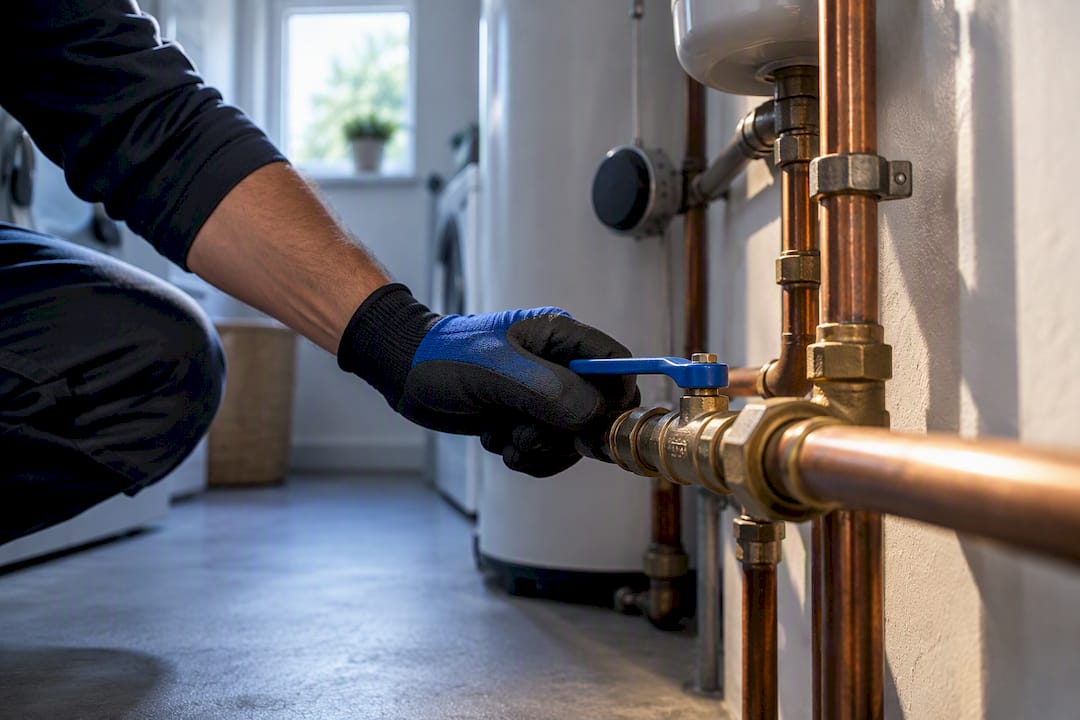
A call-out fee is a fixed charge for a tradesperson to travel to your property and diagnose a problem, kept separate from the cost of the actual repair. It usually covers travel time, the visit itself, and a first look at the fault. Before you agree to anything, ask whether that fee gets deducted from the final bill and whether VAT is already included in the figure you’re quoted.
TL;DR:
- Standard call-out fees in Ireland typically range from €50 to €150, depending on trade, location, and whether the first hour of labour is included.
- The fee generally covers travel, diagnosis, initial labour, and basic tools, but excludes parts, materials, and follow-up visits if needed.
- Some trades apply the call-out fee against repair costs if the work proceeds, while others keep it non-refundable, so clarify these terms beforehand.
- Emergency, after-hours, weekend, or long-distance call-outs usually carry a premium of about 1.5 to 2 times the standard fee.
- Customers should always request an itemised quote before work begins to understand what is included and to avoid hidden charges.
Table of Contents
- What is a call out fee and what do trades call it?
- What’s included in a call out charge and what isn’t?
- How much is a typical call out fee in Ireland?
- How do you calculate a fair call out fee?
- When do call out fees go up and how do premiums work?
- What are your consumer rights around call out fees in Ireland?
- What should you ask before booking a tradesperson?
- Weighing cost against reliability when a call out fee applies
- Compare quotes and book vetted trades through Workily
- Sources
- FAQ
What is a call out fee and what do trades call it?
A call-out fee is the amount you pay simply for a tradesperson to show up and assess the job, regardless of whether they end up fixing anything. Collins English Dictionary defines it as exactly that: a set charge for sending someone to your home, distinct from repair costs. In Ireland you’ll hear it under a few different names, and they don’t all mean the same thing.
- Call-out fee or attendance charge: covers the visit itself, whether or not work follows.
- Diagnostic fee: sometimes used interchangeably, but occasionally billed separately from the attendance charge if diagnosis takes real time.
- Trip charge: an older term, more common with appliance repair firms, meaning much the same as a call-out fee.
- Minimum charge: the least you’ll pay for a job, even if the repair itself takes five minutes.
The fee exists because a tradesperson has blocked out time in their diary, driven to your address, used fuel and a vehicle, and often ruled out other jobs that day. That’s overhead a business has to recover whether or not the job goes ahead, and it’s why the charge stands apart from labour on the repair itself.
What’s included in a call out charge and what isn’t?
A call-out fee rarely covers everything, so knowing where the line sits saves an argument later. Most trades in Ireland structure it the same broad way.
- Travel to and from your property, including fuel and time on the road.
- The diagnostic visit, meaning the time spent identifying the fault.
- A first block of labour, often the initial 30 to 60 minutes, though this varies by trade.
- Basic tools and equipment carried for standard jobs.
What it typically excludes is just as important: parts and materials, any certification or compliance paperwork (such as an RGI safety cert for gas work), and a second visit if one is needed. If a part has to be ordered, don’t assume the original call-out fee covers the return trip.
Pro Tip: Ask for a written breakdown showing call-out fee, labour, parts, and VAT as separate lines before you agree to the job. An itemised quote is the single fastest way to spot a fee that’s been quietly folded into an inflated labour rate.
How much is a typical call out fee in Ireland?
Expect most call-out fees in Ireland to sit somewhere between €50 and €150, with the exact figure shaped by trade, location, and whether the visit includes the first hour of labour. Irish trade surveys put typical electrical call-out charges in roughly that same band, with wide variation depending on whether the first hour is bundled in or billed on top.
Survey responses from tradespeople across Ireland show call-out fees commonly landing between €60 and €120, with the spread driven largely by whether the first hour of labour is included in that figure.
Here’s roughly what to expect by trade during standard daytime hours:
- Plumbers: often €60 to €100 for a call-out, sometimes rolled into an hourly rate of €50 to €80.
- Electricians: broadly similar, with call-outs around €60 to €120 depending on area and whether the first hour is included.
- Locksmiths: typically €50 to €90 for a standard callout, rising sharply for emergency lockouts.
- Appliance repair technicians: usually €60 to €100, often applied against the repair if you go ahead.
- General handymen: frequently the lowest of the group, from €40 to €80, though this depends heavily on the job type.
Regional demand matters too. Practitioner surveys note that urban call-outs can carry a lower cost per mile travelled but a higher absolute fee, simply because wage levels and demand in cities like Dublin, Cork, or Galway push prices up even when the tradesperson isn’t driving far. If you’re quoted something well outside these ranges with no explanation, ask why. A €200 daytime call-out fee for a routine plumbing check, with no unusual travel distance or urgency, is worth querying rather than accepting.
How do you calculate a fair call out fee?
Tradespeople who price properly work backwards from the true cost of sending someone out, not from a number they’ve seen a competitor charge. The method used by pricing frameworks like Spytec’s service call guide breaks it into five components:
- Time the full door-to-door dispatch: drive there, set up, diagnose, write up notes, drive back.
- Apply a fully burdened labour rate, meaning wages plus insurance, tax, and other employment costs, not just take-home pay.
- Add vehicle cost: fuel, wear, and depreciation for that trip.
- Add a share of overheads: tools, phone, admin, insurance spread across the working week.
- Add a margin, because a call-out fee that only breaks even leaves no room for a bad week.
Add those together and you get the floor price a tradesperson needs just to justify showing up. Many small operators underestimate this by roughly a third, mostly because they forget to cost the write-up and admin time at the end of a job.
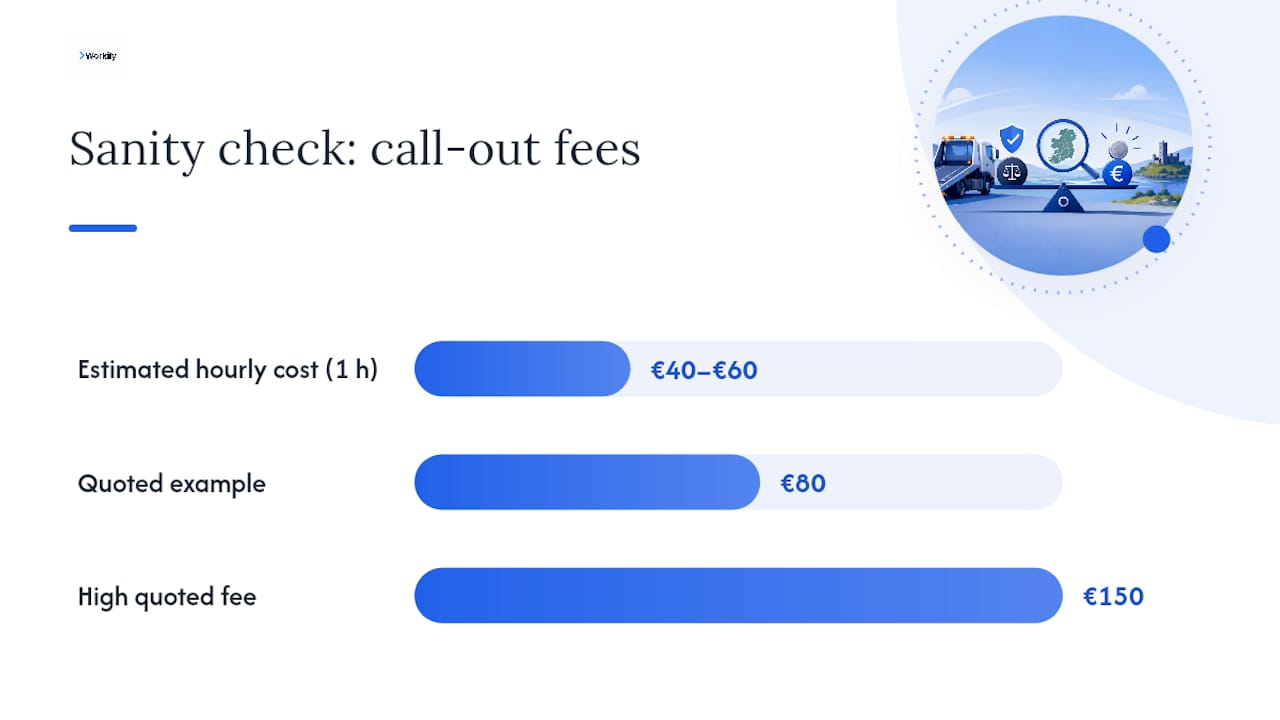
As a customer, you can run a rough sanity check the other way. Say a plumber quotes €80 for the call-out and it’s a 20-minute drive each way. That’s 40 minutes of travel plus, say, 20 minutes of diagnosis: roughly an hour of their time, plus fuel and vehicle wear. At a reasonable hourly cost of €40 to €60 once overheads are factored in, €80 is comfortably within a fair range. If someone quotes €150 for the same short trip with no stated reason, ask what’s driving the difference.
Two policy choices matter most for you as the customer. Some trades apply the call-out fee against the repair cost if you approve the work on the spot, which is common practice and worth asking about directly. Others waive it entirely if you proceed, or keep it non-refundable regardless, usually stated upfront in their terms. None of these approaches is wrong, but you should know which one you’re agreeing to before the visit, not after.
When do call out fees go up and how do premiums work?
Call-out fees rise predictably around three things: time of day, urgency, and distance. Knowing the pattern helps you judge whether a premium is reasonable or opportunistic.
- After-hours and emergency call-outs commonly carry a premium of roughly 1.5 to 2 times the standard daytime fee, reflecting disrupted schedules and unsociable hours.
- Weekend and bank holiday visits often sit somewhere between standard and full emergency pricing.
- Distance bands are used by some trades instead of a flat fee, meaning a call-out 40km outside a base rate charges more than one five minutes down the road.
- Flat fees are simpler for you to budget against but occasionally mean nearby customers subsidise those further out.
If you’re facing an urgent issue like a burst pipe or exposed wiring, ask specifically for a “make safe” visit rather than a full repair out of hours. Sending photos of the problem beforehand also helps a tradesperson quote more accurately and can sometimes avoid an unnecessary emergency call-out altogether. Confirm the follow-up policy too: will the emergency fee be credited against a scheduled repair visit during normal hours, or is it a separate charge entirely?
What are your consumer rights around call out fees in Ireland?
Irish consumer protection doesn’t hinge on what a charge is called. Whether a business labels it a call-out fee, an attendance charge, or a diagnostic fee, Citizens Information’s pricing guidance makes clear the total price and how it’s calculated should be disclosed before you agree to the work. That’s the core protection: transparency, not terminology.
- You’re entitled to know the price, or how it will be calculated, before the visit goes ahead.
- Services must be carried out in line with what was agreed, and the CCPC has written directly to tradespeople reinforcing that consumers have remedies where work isn’t delivered as promised.
- If a job doesn’t match what you were told, you can request a repair, a price reduction, or in some cases a refund.
- Keep evidence: photos of the work, the original quote, texts or emails confirming the fee, and the final invoice.
- If a complaint goes nowhere with the tradesperson directly, the CCPC is the body to escalate to.
Don’t be talked out of asking for an itemised invoice. That single request, made before work starts, resolves most call-out disputes before they happen.
What should you ask before booking a tradesperson?
A short phone call before you book can save a longer argument afterwards. Run through these before confirming any visit:
- What is the call-out fee, and does it include VAT?
- Does that fee get applied to the final repair cost if I go ahead, or is it separate regardless?
- Is the first hour of labour included in the call-out fee, or billed separately?
- What happens if a part needs to be ordered, does that trigger a second call-out charge?
- What are the payment terms, and can I get an itemised invoice?
Send photos of the fault and a clear written description beforehand wherever possible. It narrows the scope of the job, gives the tradesperson a fairer basis to quote on, and reduces the chance of a “surprise” fee once they’re standing in your kitchen.
Pro Tip: Get two or three quotes for anything beyond a straightforward repair. Comparing call-out fees side by side across several vetted plumbers in Dublin or electricians takes minutes and routinely exposes a €40 to €60 gap between the cheapest and most expensive quote for the same job.
Weighing cost against reliability when a call out fee applies
Paying a call-out fee makes sense whenever safety, a proper diagnosis, or a time-critical fault is on the line: a gas smell, a live wire, a burst pipe at midnight. Chasing the cheapest possible fee in those moments usually costs more later, either in damage or in a second visit to fix a rushed job.
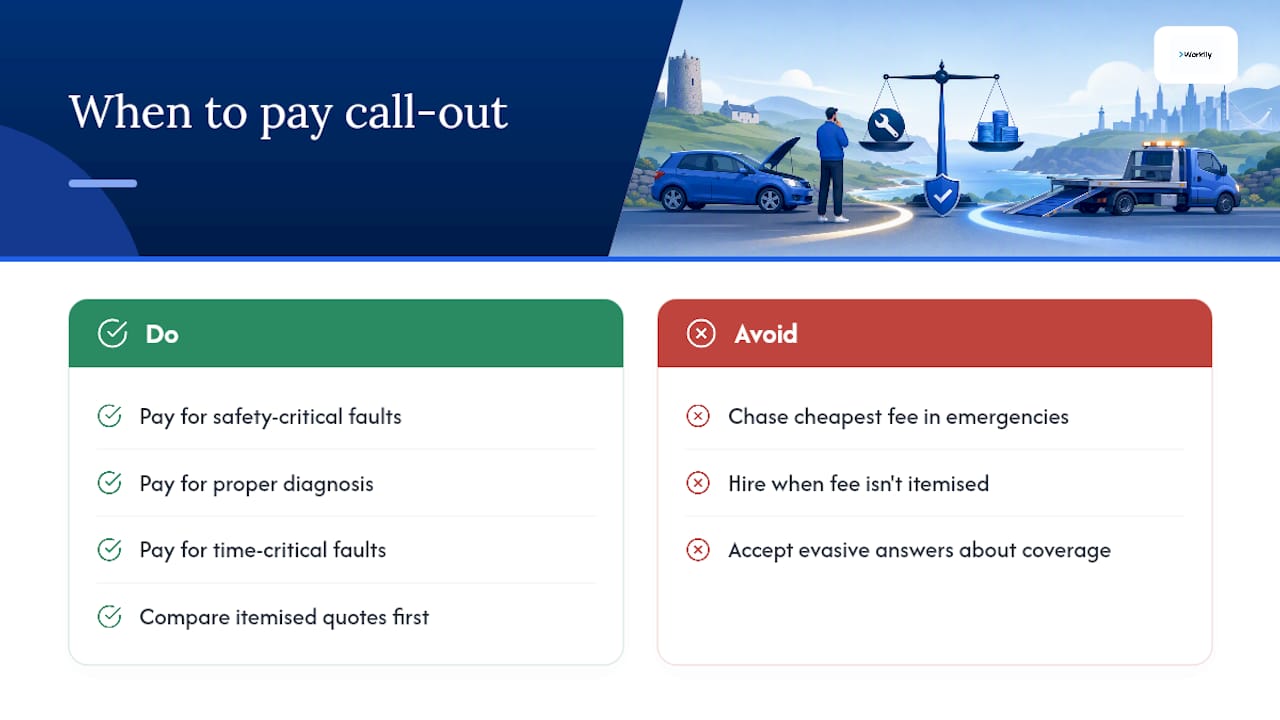
Hesitate, though, the moment a tradesperson won’t itemise the fee or dodges a direct question about what it covers. That refusal tells you more than the number itself does.
A platform like Workily helps here by letting you compare vetted professionals and request clear, itemised quotes side by side before you commit to anyone.
— Thomas
Compare quotes and book vetted trades through Workily
Workily gives Irish homeowners a faster route to price certainty than ringing round for quotes one call at a time. Every professional on the platform is vetted, pricing is shown upfront, and instant booking means you can lock in same-day attendance without wondering whether the call-out fee you were told on the phone matches what lands on the invoice.

For anything from a burst pipe to an appliance that’s stopped working, the instant booking page lets you secure same-day service from a verified professional with the price shown before you confirm. If your query is less urgent and you’d rather get an expert opinion before committing to a call-out at all, Ask a Pro connects you with a professional for a paid consultation, so you know exactly what you’re dealing with first. Curious how the vetting and quote process actually works? The how it works page walks through it in full. Whichever route suits your situation, book your next tradesperson through Workily and see the price before you agree to anything.
Sources
- Citizens Information – Pricing and transparency guidance
- Tradesmen.ie – Electrical call-out charges and prices (survey)
- Spytec – What to charge for a service call (pricing framework)
Always check a tradesperson’s own terms and request an itemised invoice before booking.
FAQ
What is a reasonable call out fee?
A reasonable call-out fee in Ireland generally falls between €50 and €150, depending on the trade and area, with Irish electrical trade surveys reporting figures commonly around €60 to €120. Anything well outside that range without a clear reason, such as long-distance travel or emergency hours, is worth questioning.
How does a call out fee work?
A call-out fee is charged for the tradesperson’s attendance and diagnosis, separate from the cost of any repair. Some businesses apply the fee against your final bill if you approve the work on the spot, while others keep it as a standalone, non-refundable charge regardless of outcome.
How much should a plumber charge for a call out?
Most plumbers in Ireland charge somewhere between €60 and €100 for a standard daytime call-out, sometimes bundled with the first hour of labour; exploring effective plumber SEO services can help tradespeople grow their customer base and justify pricing. Emergency or after-hours visits typically carry a premium of roughly 1.5 to 2 times that standard rate.
What is the typical call out fee for a plumber in Ireland?
Trade survey data puts typical plumbing call-out fees in Ireland in the same broad €50 to €150 band seen across other trades, with the Tradesmen.ie survey showing most responses clustering around €60 to €120. The exact figure depends on whether the first hour of labour is included and how far the plumber has to travel.
Is a call out fee the same as an attendance charge?
Yes, in practice the two terms are used interchangeably by most Irish tradespeople. Both describe the fixed charge for showing up and diagnosing a problem, kept separate from the cost of parts or repair labour.
Can a tradesperson refuse to itemise a call out fee?
No business is obliged to break every cost down line by line, but Citizens Information’s pricing guidance makes clear the total price and how it’s calculated must be disclosed before you buy. A flat refusal to explain what a fee covers is a reasonable reason to look elsewhere.
Does the platform charge a call out fee?
Workily itself doesn’t charge homeowners a call-out fee; individual tradespeople set and disclose their own pricing, shown upfront before you book through instant booking. If you’d rather get expert advice before committing to any visit, a paid session through Ask a Pro starts from €39, depending on the category.