


A virtual assistant is a remote professional who handles administrative, customer-facing and specialist execution work so you can reclaim hours each week. The role typically spans five to seven categories: administration, customer support, marketing, sales support, bookkeeping, research and technical or niche specialisms. Delegating just inbox and calendar management alone can reclaim around 16 hours a week) for a busy owner.
TL;DR:
- Virtual assistants in Ireland typically charge €20–€30 per hour for entry-level support, rising to €30–€40 for experienced generalists, and over €40 for niche experts.
- Starting tasks with documented, repeatable work like email triage, calendar management, or data entry reduces risk and builds trust before expanding to complex responsibilities.
- Marketplace platforms that pre-vet professionals offer faster access to verified VA help, especially for same-day or short-term needs, compared to lengthy independent hiring.
- Small businesses and solo founders see the quickest ROI from VAs by outsourcing routine admin and customer support tasks, freeing up time for revenue-generating activities.
- Clear, goal-oriented briefs and limited access controls are essential for effective onboarding and managing first VA tasks efficiently.
Table of Contents
- What are the common categories of virtual assistant tasks?
- What are examples of tasks you can delegate right away?
- How do you choose what to delegate first and onboard a VA properly?
- What do virtual assistant rates in Ireland typically look like?
- When does a marketplace beat hiring an independent VA?
- Which businesses see the fastest return from a virtual assistant?
- Ready to hand off the tasks eating your week?
- Sources
- FAQ
What are the common categories of virtual assistant tasks?
The term “virtual assistant” covers a wide spread of work, and most people who hire one for the first time underestimate just how much can move off their own plate. Investopedia defines a VA as a remote administrative professional working as an independent contractor, able to stretch into specialised territory like social media, bookkeeping and website support once the basics are covered. That breadth is exactly why so many owners struggle to know where to start.
Administration is the entry point for most VA relationships, because it’s repetitive, low-risk and easy to document.
- Email triage, folder labelling and canned response creation
- Calendar management and meeting scheduling across time zones
- Data entry into spreadsheets, CRMs or booking systems
- Travel booking and itinerary building
- Document formatting, filing and template creation
- Diary reminders and simple project tracking
Customer service tasks tend to follow once trust is established, since they touch clients directly.
- Answering live chat and email queries using a script
- Logging and routing support tickets
- Sending order updates and follow-up satisfaction checks
- Managing simple refund or return requests within set limits
Marketing support is where a VA starts adding visible commercial value, including tasks covered by services like social scheduling and simple automations.
- Scheduling social posts and replying to comments
- Drafting newsletter copy from bullet notes
- Basic keyword research and competitor scans
- Updating blog posts with images and formatting
Sales support, bookkeeping and research round out the middle tier, covering CRM updates, invoice chasing, expense logging, and pulling together supplier or pricing comparisons. Technical and niche specialists handle website edits, basic automations, or platform-specific admin such as Xero reconciliation or HubSpot list management.
Administration and customer service scripts are the safest starting point, because errors are cheap to catch and the work is fully documented before it ever reaches the VA.
What are examples of tasks you can delegate right away?
Vague instructions produce vague results. The fix is writing a brief the way you’d brief a new hire on day one: goal, input, output, deadline.
Here are task examples spanning the categories above:
- Sort and label the last 200 unread emails by priority
- Build a recurring weekly content calendar template
- Reconcile last month’s bank statement against invoices in Xero
- Research five local competitors’ pricing pages and summarise in a table
- Draft 10 canned responses for common support queries
- Update 40 CRM contact records with missing phone numbers
- Schedule three months of Instagram posts from a supplied content bank
- Chase four overdue invoices with a polite follow-up email sequence
- Format a 20-page report into a branded PDF template
- Set up an out-of-office autoresponder with escalation instructions
- Compile a supplier comparison for office equipment under €500
- Transcribe and summarise a 45-minute client call
- Build a simple onboarding checklist for new customers
- Audit and fix broken links on a five-page website
- Create a spreadsheet tracker for monthly recurring expenses
- Draft job ad copy for a part-time hire
- Log customer complaints into a shared tracker with tags
- Book flights and a hotel for a two-day business trip
- Set up a basic email automation for abandoned cart follow-ups
- Prepare a one-page competitor SWOT summary
A sample brief might read: “Goal: clear the support inbox backlog. Input: access to the shared inbox and our three response templates. Output: every email older than 48 hours answered or flagged. Deadline: end of day Friday.” That single sentence removes almost all ambiguity about scope.
Before handing work back, check it against three things: did it match the brief’s stated output, is the formatting consistent with your existing templates, and would a customer reading it think it came from your own team? If all three pass, the task is done.
How do you choose what to delegate first and onboard a VA properly?
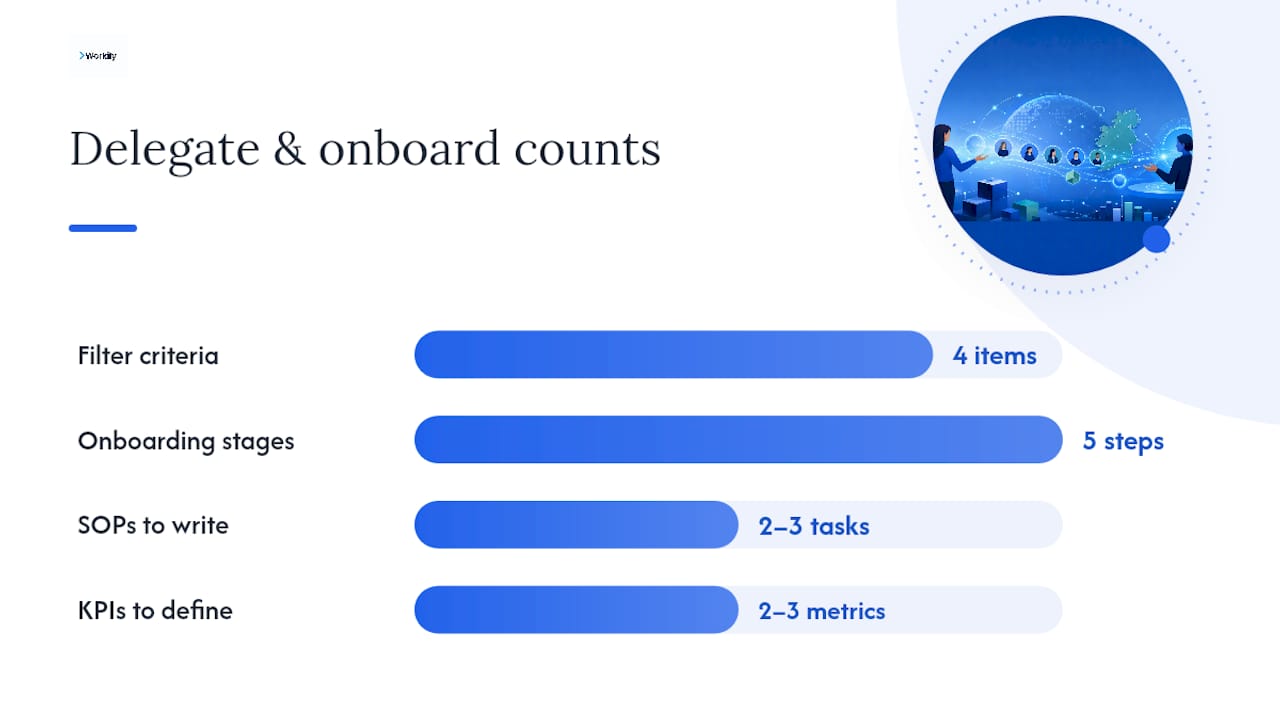
Run every candidate task through a short filter before assigning it. Ask: is it repeatable, is it documented (or documentable in ten minutes), is the risk of a mistake low, and is it eating hours you’d rather spend elsewhere? Anything answering yes to all four goes to a VA first; anything touching contracts, payroll or legal filings stays with you or a licensed professional.
Onboarding then follows a straightforward sequence:
- Write short SOPs for the first two or three tasks you’re handing over, even rough bullet points beat nothing
- Set access rights narrowly, shared logins with limited permissions rather than full account handover
- Agree communication tools upfront, whether that’s Slack, Trello, or simple email threads with clear subject lines
- Schedule a short check-in at the end of week one to catch misunderstandings early
- Define two or three measurable KPIs, response time, tasks closed, or accuracy rate, so both sides know what “good” looks like
Treating a VA as a genuine business partner rather than a pair of hands pays off quickly: once trust builds, they can move into higher-value coordination work like CRM management and lead follow-up, not just repetitive admin.
Pro Tip: Keep a running “exceptions log” for the first month, every time a task doesn’t fit the SOP, write down what happened and how it was resolved. That log becomes your onboarding manual for the next hire.
What do virtual assistant rates in Ireland typically look like?
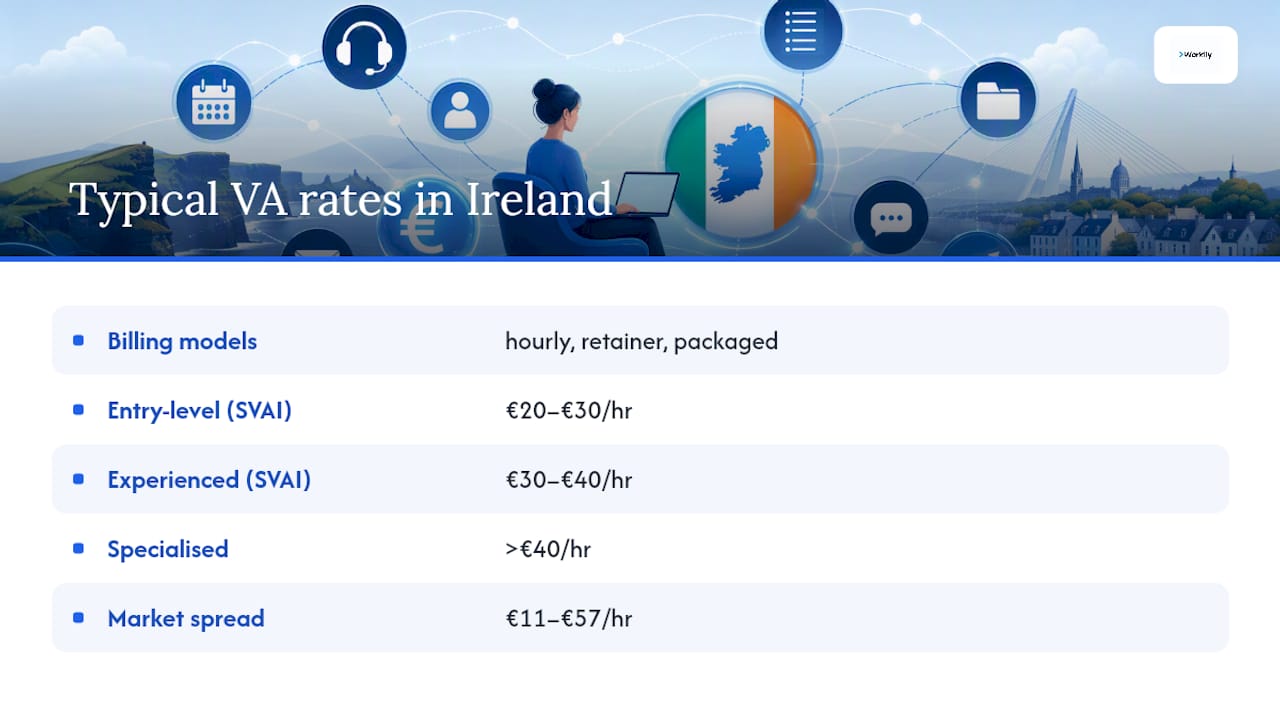
Billing usually takes one of three shapes: hourly (pay only for time logged), retainer (a fixed monthly block of hours), or packaged (a flat fee for a defined deliverable, such as a content calendar).
The Society of Virtual Assistants Ireland recommends starting rates of €20–€30/hr for entry-level VAs, rising to €30–€40/hr for experienced generalists and above €40/hr for specialised skills. Broader market research shows a wider spread of €11–€57/hr depending on seniority, with realistic mid-level rates clustering around €19–€30/hr.
A VA charging €25/hr who saves you 16 hours a week costs roughly €400 weekly, against hours that would otherwise interrupt billable or strategic work.
When does a marketplace beat hiring an independent VA?
Vetting a stranger, checking references and negotiating rates takes time most owners don’t have. Platforms that pre-screen professionals and offer instant booking for verified help suit anyone needing same-day cover rather than a lengthy independent search. Workily’s own vetting and booking claims sit alongside its published case studies as evidence of that approach, useful context when comparing routes rather than a guarantee of fit for every task.
Which businesses see the fastest return from a virtual assistant?
Solo founders and small teams under ten staff typically see ROI fastest, since admin hours saved convert straight into billable time. Specialists suit finance or technical tasks; generalists suit everything else. Never skip proper legal or financial sign-off before delegating anything with compliance exposure.
— Thomas
Ready to hand off the tasks eating your week?
This platform offers a faster route to vetted help than sourcing an independent VA cold, with no lengthy reference checks or guessing at rates, connecting you to verified professionals you can compare side by side. Whether you need ongoing admin support or a one-off task handled today, the platform lets you request a quote and compare providers before committing to anyone.
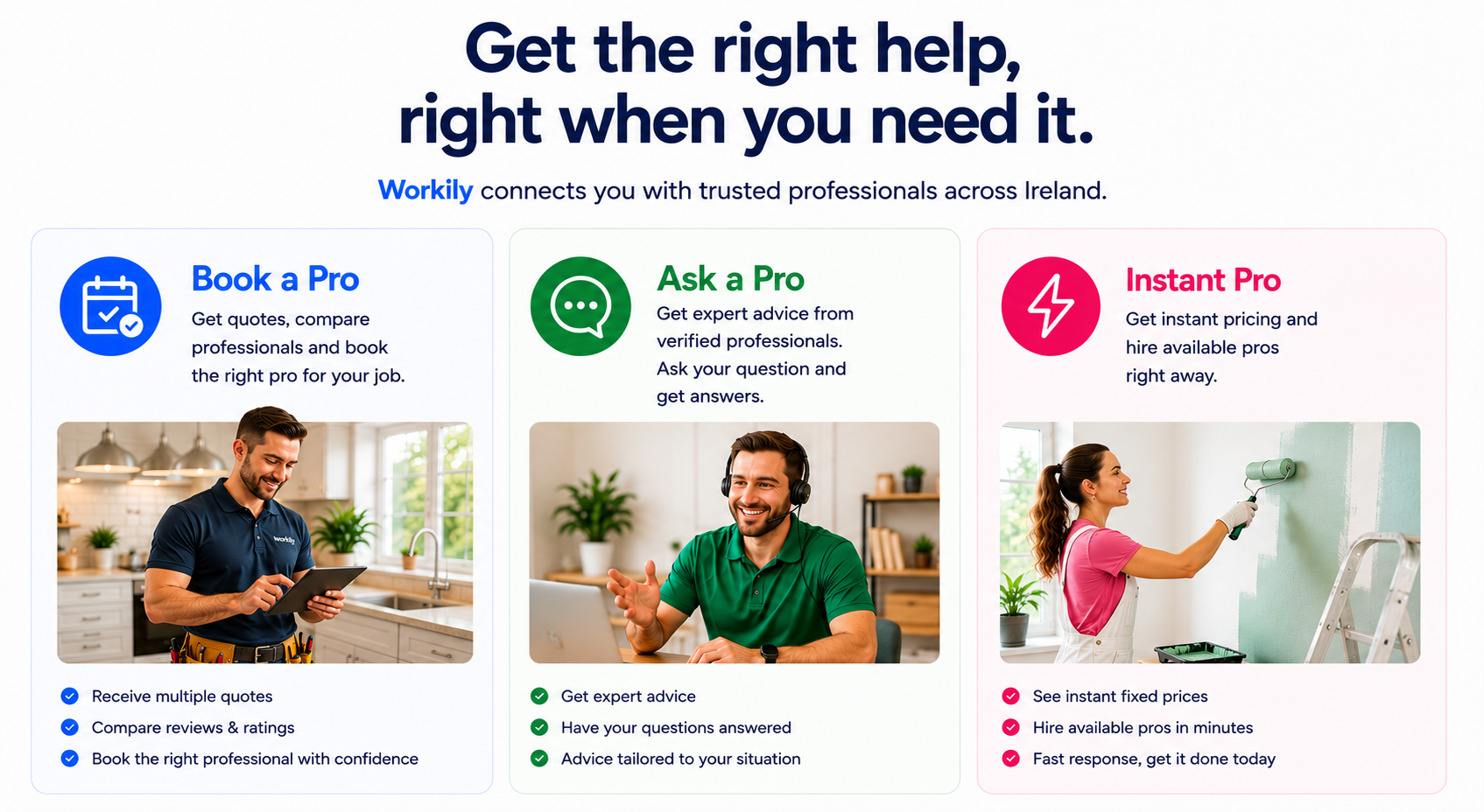
For recurring categories like admin, marketing or finance coordination, the Business & Admin session format connects you with a vetted professional for €49 one-off, while same-day needs run through the Instant Booking page. If you’re weighing a marketplace against hiring independently, the How It Works page breaks down verification and plan options, including a Free Trial. Whatever the task, comparing two or three professionals before booking gives you a far better read on fit than taking the first reply that lands in your inbox.
Sources
- Virtual Assistant: What One Is and What One Does — Investopedia
- Recommended Rates – Society of Virtual Assistants Ireland
- Freelance Virtual Assistant Rates in Ireland (2026) — soloHourly
FAQ
What are the main tasks of a virtual assistant?
A VA typically handles administration, customer service, marketing support, sales support, bookkeeping, research and technical or niche specialist work. Most VAs focus on three to five recurring categories rather than trying to cover everything at once.
What are some tasks a virtual assistant can do straight away?
Email triage, calendar scheduling, data entry, invoice chasing and social post scheduling are all safe first assignments because they’re repeatable and easy to check. As trust builds, tasks like CRM management, customer support and simple technical edits usually follow.
What are common VA tasks businesses outsource first?
Advice guides consistently point to repetitive, documented work first, email management, calendar scheduling, data entry and travel planning, before expanding into customer support or marketing coordination. Starting small with a trial project protects against scope creep.
What are the top skills needed for a virtual assistant?
Strong tech literacy, clear written communication, organisation and comfort with common business tools top most lists, according to career and dictionary resources. Specialised VAs also bring tool-specific skills, such as Xero for bookkeeping or HubSpot for CRM administration.
What is the typical virtual assistant hourly rate in Ireland?
Industry guidance from the Society of Virtual Assistants Ireland recommends €20–€30/hr for entry-level VAs and €30–€40/hr for experienced generalists, with specialists charging above €40/hr. Broader market data shows a wider range of €11–€57/hr depending on seniority.
How do I hire a virtual assistant without wasting time on the wrong fit?
Start with a small, well-documented trial task before committing to an ongoing retainer, and check references or platform verification before handing over sensitive access. Comparing two or three candidates side by side, whether independent VAs or professionals through a vetted marketplace, gives a clearer picture of fit than accepting the first offer.
Should I hire a virtual assistant or use a service marketplace like Workily?
An independent VA suits long-term, deeply integrated work once you know exactly what you need. A marketplace with instant booking and pre-screened professionals suits time-pressed businesses needing verified help quickly, without running a full hiring process themselves.