
Expect to pay roughly €30–€50 for a 30-minute massage, €45–€80 for 45 minutes and €60–€120 for a 60-minute session in Ireland, depending on treatment and location. Ninety-minute sessions typically run €90–€150. Specialist treatments and Dublin city centre clinics sit at the higher end. The examples below show exactly where your money goes.
TL;DR:
- Massage prices in Ireland vary significantly based on treatment type, location, and therapist qualifications, with Dublin clinics generally charging higher rates than rural areas.
- Specialist treatments like pregnancy massage, lymphatic drainage, and hot stone therapy typically cost more due to extra training, equipment, or certification requirements.
- Therapists with recognized qualifications and professional association membership usually set higher prices to reflect their expertise and insurance acceptance.
- Booking through verified platforms with transparent prices and credentials helps ensure fair value and can save time compared to contacting clinics individually.
- Insurance reimbursement depends on the therapist’s recognition and policy terms, so confirming eligibility beforehand can reduce out-of-pocket costs.
Table of Contents
- Massage therapist rates in Ireland: typical prices by session length
- What determines a massage therapist’s price in Ireland
- How do you compare and book a massage therapist in Ireland?
- Can you claim massage therapy on health insurance in Ireland?
- Why does a massage cost more than what the therapist actually earns?
- How Workily helps you find fairly priced massage therapists
- Compare massage therapists in Ireland before you book
- Sources
- FAQ
Massage therapist rates in Ireland: typical prices by session length
Massage therapist rates in Ireland vary more than most people expect, and treatment type matters almost as much as the clock. A 30-minute back and shoulder rub from a local independent therapist can cost half what the same slot costs at a Dublin clinic offering sports massage from a sports-science graduate.
Real clinic price lists give the clearest picture. Dublin Therapeutic Massage Clinic charges €60 for 30 minutes, €80 for 45 minutes, €90 for 60 minutes and €120 for 90 minutes, with hot stone therapy listed at €150. The Bodywise Clinic prices its 60-minute deep tissue and sports massage at around €85–€110, reflecting the extra training that sports-specific work demands. Senzis massage therapy sits closer to the middle of the market, with 30-minute sessions from about €35–€40 and 60-minute treatments around €65–€75. Meanwhile, Wellness Rooms notes that many of its independent therapists set fees typically between €50 and €80 per treatment, since practitioners working outside a branded clinic often have lower overheads to cover.
| Session length | Typical Ireland-wide range | Example clinic price |
|---|---|---|
| 30 minutes | €30–€50 | €60 (Dublin Therapeutic Massage Clinic) |
| 45 minutes | €45–€80 | €80 (Dublin Therapeutic Massage Clinic) |
| 60 minutes | €60–€120 | €90 (Dublin Therapeutic Massage Clinic); €85–€110 (The Bodywise Clinic) |
| 90 minutes | €90–€150 | €120 (Dublin Therapeutic Massage Clinic) |
A few treatment types consistently push prices above these baselines:
- Pregnancy massage often carries a premium because therapists need specific prenatal training and positioning equipment.
- Lymphatic drainage requires a distinct certification and tends to be priced closer to physiotherapy-adjacent rates.
- Hot stone therapy adds equipment and preparation time, which shows up directly in the bill, as with Dublin Therapeutic Massage Clinic’s €150 rate.
What determines a massage therapist’s price in Ireland
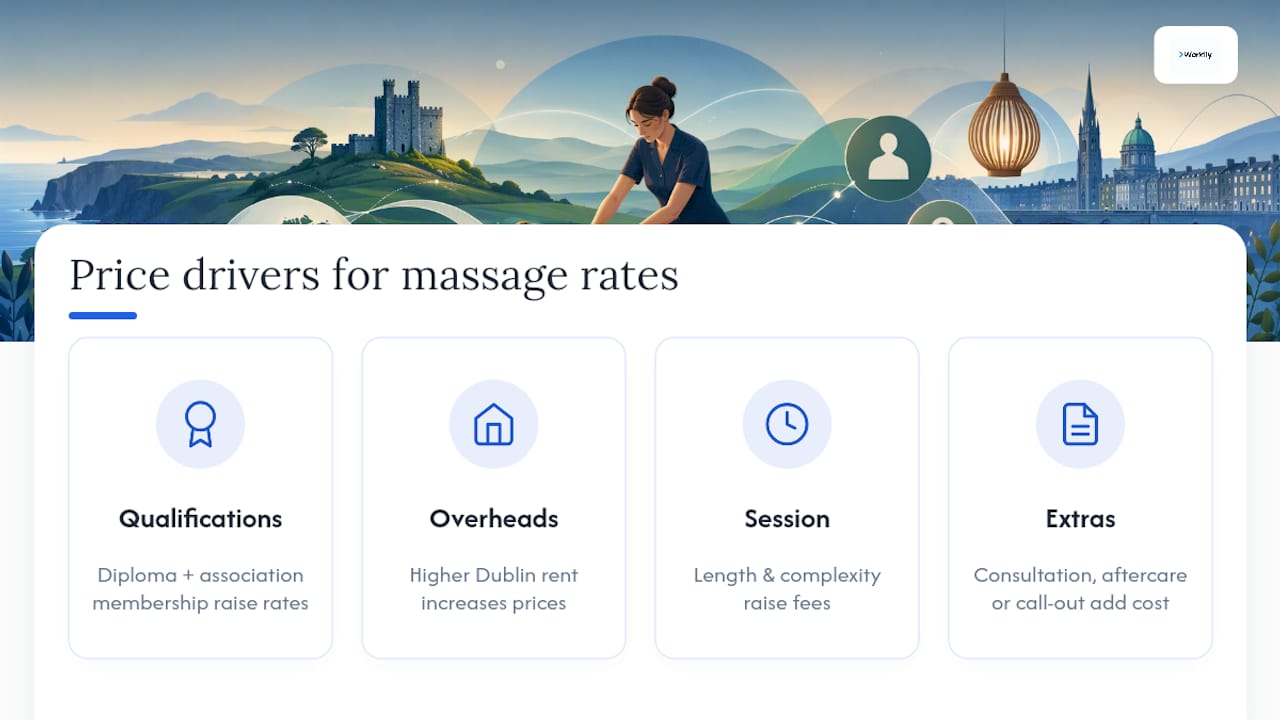
There is no single standard rate across the country. Higher prices generally reflect more training, specialist skills, or higher premises costs rather than an arbitrary markup.
Qualifications sit at the top of that list. A therapist with an ITEC or CIBTAC diploma and membership of a recognised professional association (such as the Irish Massage Therapists Association) will usually price above someone with a shorter certificate course, partly because insurers only recognise registered practitioners for reimbursement purposes.
Overheads matter just as much. A therapist renting treatment room space in Dublin 2 pays substantially more in rent than one working from a converted room in rural Leitrim or Donegal, and that gap flows straight into the price list. Mobile therapists who travel to a client’s home often add a call-out fee to cover fuel and time, which can push an otherwise mid-range 60-minute session above €100.
Session length and complexity scale price too, but not always in a straight line. A 90-minute deep tissue session on a chronic back issue takes more physical effort than 90 minutes of light relaxation massage, and many therapists price accordingly rather than simply doubling their 45-minute rate. Some clinics also raise rates for therapists who invest in visible professional profiles and marketing, since strong online visibility tends to bring in a steadier stream of higher-value bookings.
Pro Tip: If two therapists quote very different prices for the same treatment, ask what’s included. A higher rate sometimes covers a consultation, aftercare advice and a longer changeover time between clients, not just the massage itself.
How do you compare and book a massage therapist in Ireland?
Booking blind rarely goes well. Before committing to a session, work through a short checklist:
- Confirm qualifications — ask which body they trained with and whether they hold current insurance.
- Check association membership — recognised membership often affects whether your health insurer will reimburse the session.
- Ask about scope — some therapists specialise in sports recovery, others in relaxation or pregnancy work, and the wrong match wastes your money.
- Clarify cancellation terms — many Irish clinics charge a fee for late cancellations, so know the policy upfront.
- Compare published price lists — treatment descriptions vary, so match session length and technique before comparing €-per-hour.
Watch for a few warning signs too. A therapist with no published prices anywhere, vague claims about “years of experience” with no named qualification, or a rate well below the local market with no explanation are all worth questioning before you book. On the savings side, it’s worth asking directly about package discounts, seasonal clinic specials, or concession rates for students and older clients, since several Dublin clinics offer these but don’t always advertise them prominently.
Can you claim massage therapy on health insurance in Ireland?
Private insurers such as Irish Life, VHI and Laya commonly provide reimbursement for massage therapy sessions if the therapist is formally recognised. Recognition usually depends on the therapist’s qualifications and professional association membership, so it’s worth confirming eligibility with your own policy before booking rather than assuming cover applies.
Reimbursement practices differ between providers and even between policy tiers within the same insurer. Some plans cap the number of sessions you can claim per year or set a maximum reimbursement per visit, so a quick call to your insurer before your first appointment saves confusion later.
Beyond insurance, a few practical tactics cut your net cost:
- Multi-session packages — The Bodywise Clinic’s package pricing can lower the per-session cost by roughly €10–€20 compared with booking single visits.
- Clinic specials — off-peak slots or midweek bookings are frequently discounted.
- Concession rates — students, older adults and sometimes healthcare workers can access reduced pricing at many clinics.
Why does a massage cost more than what the therapist actually earns?
Client-facing prices and therapist take-home pay are two very different numbers. Indeed’s salary data puts average hourly earnings for massage therapists in Ireland at roughly €20–€22, well below the €60–€120 a client typically pays for an hour-long session.
The gap covers real business costs, not profit padding:
- Professional insurance and annual association fees
- Treatment room rent or clinic commission
- Equipment, oils, linens and laundering
- Ongoing training and certification renewal
- Income tax, PRSI and administrative overheads
Once those costs come out, the retail price and the therapist’s actual wage look far less far apart than they first appear.
How Workily helps you find fairly priced massage therapists
Comparing rates by hand across multiple clinic websites takes time you probably don’t have. Workily’s verification and booking process lets you check a professional’s credentials and published pricing before you commit, and instant booking means you’re not left waiting days for a reply. Look at two or three profiles side by side, check what’s included at each price point, and book the one that actually matches what you need.
— Thomas
Compare massage therapists in Ireland before you book
Workily gives you a faster, more transparent alternative to ringing around individual clinics one by one. Every professional listed goes through Workily’s trust and safety verification process, so you’re comparing genuine credentials rather than guessing from a website photo.

If you want a session booked today rather than next week, Workily’s instant booking feature connects you with available professionals for same-day appointments. For something less urgent, such as a one-off consultation about which treatment suits a specific injury or condition, you can ask a pro directly for personal and wellness guidance. Either way, the sensible move is to pull up two or three therapist profiles, compare their published prices and specialities, and request a quote before you pick one.
Sources
- Massage therapist salary in Ireland
- Price List – Dublin Therapeutic Massage Clinic
- Prices & Specials – The Bodywise Clinic
- Prices – Wellness Rooms
- Can you claim massage on health insurance in Ireland? — Painsolution
FAQ
How much do massage therapists earn in Ireland?
Massage therapists in Ireland earn an average of roughly €20–€22 per hour, according to Indeed’s salary data, though this varies by region and specialism. That figure covers wages before business costs like insurance, rent and training are factored in, which is why client-facing session prices sit considerably higher.
How much does a massage cost in Ireland?
A standard massage in Ireland typically costs €60–€120 for a one-hour session, depending on the clinic, treatment type and location. Shorter 30-minute sessions run from around €30 up to €60, as shown by Dublin Therapeutic Massage Clinic’s published prices.
How much does a therapy session cost in Ireland?
Massage therapy session costs in Ireland depend on length and technique, with moderate price ranges for 45-minute sessions. Specialist sessions, such as sports massage or lymphatic drainage, often cost more, as seen in The Bodywise Clinic’s pricing for deep tissue treatments.
What type of massage pays the most?
Specialist techniques generally command higher rates due to additional certification requirements beyond standard massage qualifications. Hot stone therapy often is priced higher due to extra equipment and preparation time.
Are massage prices higher in Dublin than elsewhere in Ireland?
Yes, Dublin clinics generally charge more than practices in smaller towns or rural counties, largely due to higher rent and overheads in the capital. A therapist working from home in a county like Leitrim or Donegal can often offer lower rates than a city centre Dublin clinic for the same treatment.
Can I claim massage therapy back on health insurance in Ireland?
Insurers such as Irish Life, VHI and Laya often reimburse massage sessions, but only when the therapist is formally recognised by that specific insurer. Always check your own policy terms before booking, since caps on session numbers and reimbursement amounts vary between plans.
How can I find affordable massage services in Ireland?
Comparing published price lists across a few clinics or independent therapists is the fastest way to spot fair value, and platforms like Workily let you check verified professional profiles side by side. Multi-session packages, midweek specials and concession rates are also worth asking about directly, since many clinics offer them without advertising them heavily.