


Before you sign a contract, ask for at least three recent, similar-project references and phone each one using the same six questions. This exposes patterns a written testimonial never will. Cross-check what you hear against permits, photos and insurance documents, and pause the moment two or more references describe the same problem.
TL;DR:
- Request three to five recent references for projects similar in scope within the last 18 months to identify consistent patterns of performance.
- Ask every reference the same six questions, especially about problem handling, to compare answers effectively and uncover true reliability.
- Verify key documents such as insurance certificates, trade licenses, and permits to ensure legal entitlement and proper coverage before proceeding.
- Be cautious if two or more references report the same issues like delays, defects, or surprise charges, and consider rejecting the contractor.
- Use verified platforms like Workily to streamline reference checks, licensing, insurance verification, and to compare quotes efficiently.
Table of Contents
- How do you check references for a contractor?
- How should you contact and run reference calls?
- What documents should you verify alongside references?
- When should you walk away? Red flags and the decision rule
- Weighing references against site visits and quotes
- Skip the manual vetting with Workily
- Sources
- FAQ
How do you check references for a contractor?
Checking references properly means asking every referee the identical set of questions, so you can line up the answers side by side rather than trusting a general impression. Most homeowners skip this step or ask vague questions like “were you happy with the work?”, which invites a polite non-answer. A tighter script gets you comparable, useful data.
Ask for three to five references from jobs completed in the last 18 months, ideally similar in scope to yours, to improve your chances by using Electrician SEO Services insights on selecting verified contractors. A contractor who fitted one bathroom two years ago tells you little about their ability to manage a full extension. The CCPC’s guidance on home improvement disputes treats references as a way to anticipate disputes before they happen, not just a box to tick.
Use these six questions with every reference:
- Problem handling: describe one moment during the job when you were worried, and how the contractor responded. This single question tends to be the most revealing one you can ask because it tests judgement under pressure rather than rehearsed praise.
If you’re managing a rental or commercial property, add a few operational questions the average homeowner never thinks to ask: site access arrangements, disruption to tenants, how variations and invoices were handled, and how quickly defects got fixed after handover. Property managers care about reliability as much as workmanship, and those details rarely surface unless you ask directly.
How should you contact and run reference calls?
Ask the contractor for three to five recent contacts and be specific: you want people whose jobs match yours in scale and recent enough to reflect current standards, ideally within 18 months. Vague requests get you the contractor’s favourite two clients, not a representative sample.
Favour a phone or video call over email every time. Written answers get polished; spoken ones reveal hesitation, tone and detail that a two-line email reply never will. A 10 to 15 minute call is usually enough, and it works better scheduled in advance than fired off as a cold call during someone’s dinner.
- Book the call ahead, mention roughly how long it will take, and confirm it’s fine to ask a few direct questions.
- Open with something like: “Hi, I’m getting quotes for [type of project] and [contractor] gave your name as a reference. Do you have ten minutes to talk about your experience?”
- Work through the same six questions every time and write the answers down immediately, using a simple template so you can compare calls later.
- Ask for evidence you can check independently: before-and-after photos, receipts, or the name of the subcontractor who did specialist work.
- Follow up with two prompts if answers feel thin: “What would you do differently if you were hiring again?” and “Is there anything you wish you’d asked before hiring?”
Pro Tip: Keep your notes in a simple spreadsheet with one row per reference and one column per question. Patterns jump out in seconds once you can scan five answers to the same question in a single glance.
Practical hiring guidance from Jacobian’s reference-check advice also suggests running reference calls in parallel with your final negotiation rather than after you’ve mentally committed. It saves time when you’re comparing several contractors through a platform like Workily’s quote-to-hire guide and it stops you anchoring on the first positive call you get.
What documents should you verify alongside references?
References tell you how a job felt to a past customer. Documents tell you whether the contractor is legally entitled to be on your property doing that work. Both matter and a glowing reference means little if the paperwork behind it doesn’t hold up.
- Ask for a certificate of insurance sent directly by the insurer, not forwarded by the contractor, and check the cover limits and expiry date against your project’s risk and timeline.
- Verify any trade licence or registration directly with the issuing body, and confirm the classification actually matches the work you’re hiring for. A guide on checking a contractor’s licence walks through this in more detail.
- Check whether your project falls under building-control rules. Extensions and material alterations often carry statutory notification or certification duties, and Gov sets out when these apply.
- If the job qualifies for an SEAI grant, confirm the contractor’s SEAI-registered status or One Stop Shop approval, and insist on a written contract covering scope, price, timescale and warranty, exactly as SEAI-linked guidance from Citizens Information recommends. A reference does not replace that contract.
- Cross-check what a reference told you against permits, invoices and receipts. Coached references happen more often than you’d think, and paperwork rarely lies.
One detail worth remembering: a contractor who managed a small kitchen refit brilliantly may not have the systems to run a multi-trade refurbishment. Ask which tasks the contractor personally oversaw and which were handed to subcontractors before you assume last year’s happy client tells you anything about this year’s bigger job.
When should you walk away? Red flags and the decision rule
Pause or reject a contractor outright if two or more references independently describe surprise charges, unresolved defects, or repeated delays. One awkward story might be a one-off. Two identical complaints from unconnected clients is a pattern, and the CCPC’s dispute guidance treats that repetition as the clearest signal available before you sign anything.
Treat these as serious warnings on their own, even without a repeated pattern:
- The contractor can’t produce recent, relevant references, or keeps deflecting the request.
- They push for unusual payment methods, especially large upfront cash sums with no contract.
- Insurance or licence documentation is missing, expired, or doesn’t match the work being quoted.
If the signals are mixed rather than clearly bad, don’t force a decision. Get one more reference, request a second written quote, and hold off signing until every document checks out. Workily’s piece on spotting a legitimate tradesperson in Ireland is a useful second opinion if you’re still unsure.
Weighing references against site visits and quotes
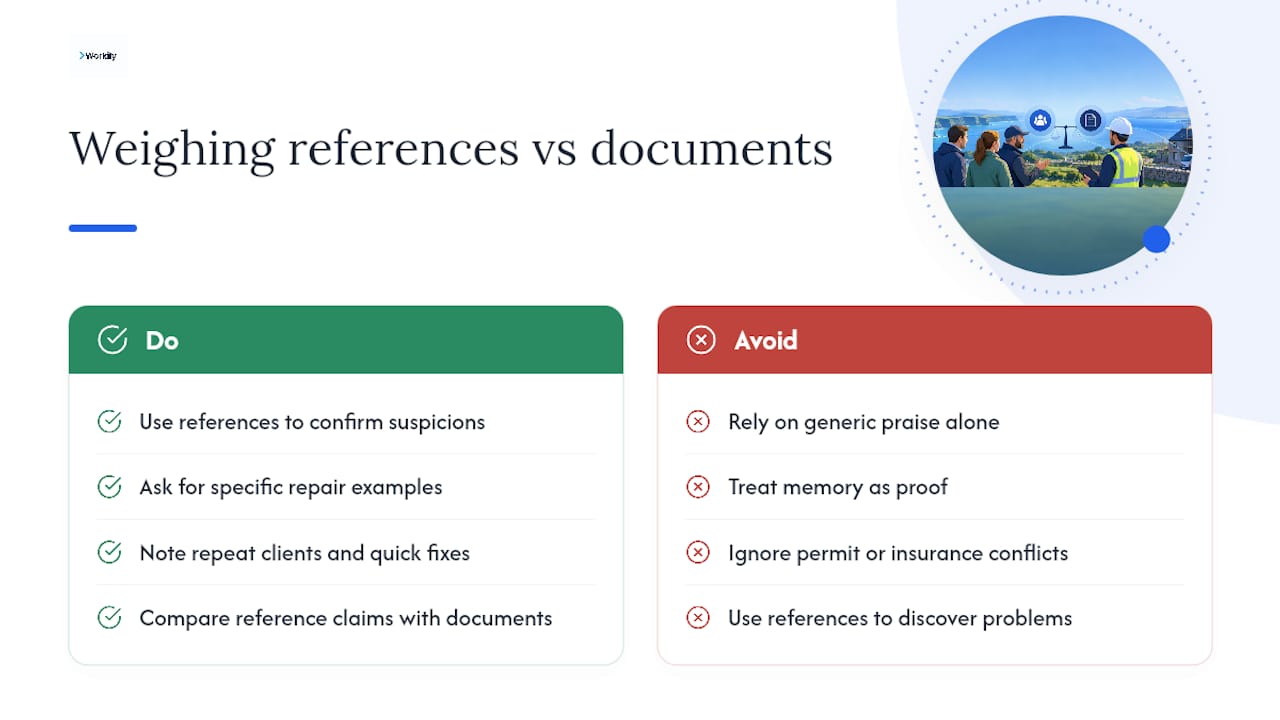
References work best as confirmation, not discovery. If a contractor’s quote felt vague or a site visit raised questions about how they’d sequence the job, a reference that describes the same vagueness or the same scheduling slip isn’t a coincidence. It’s the pattern showing up twice.
Generic praise (“lovely lads, no complaints”) tells you almost nothing. A specific story about a leak that got fixed within a day, or a repeat client who hired the same crew for a second extension, tells you a great deal. When a reference and your own paperwork disagree, trust the documents. A reference is memory and goodwill; a permit or insurance certificate is fact.
— Thomas
Skip the manual vetting with Workily
A platform exists so you don’t have to build this checklist from scratch for every job. Professionals appearing there go through a vetting process before appearing in search results, which cuts down the initial legwork of checking licences and insurance yourself. You still get to compare, but the starting pool is already screened.

Instant booking means you can contact several verified professionals the same day, request quotes side by side, and only run your own reference calls on the shortlist rather than a long list of unknowns. For quick advice before you commit to a full hire, Workily’s Ask a Pro service connects you with an expert for a fixed one-off session, useful if you want a second opinion on a quote or a contract clause. If you’re ready to move, book a professional directly or read how the platform’s verification process works before you start comparing quotes.
Sources
Insurance certificates, trade licences or registrations, and building-control or SEAI paperwork for grant-funded work all matter as much as a good reference. A strong reference with missing insurance still leaves you exposed if something goes wrong on site.
- Consumer guidance: home improvement and building work disputes | CCPC
- Gov
- How to check contractor references: 2026 guide!
- How to check references (practical hiring guidance) | Jacobian
FAQ
Does checking references mean you’re hired?
No. A reference check is usually one of the last steps before a contractor confirms availability and price, not a guarantee of the job. Treat it as final verification alongside your written quote and contract, not as confirmation that the deal is done.
Do contractors check references before offering a start date?
Reputable contractors expect you to ask for references and shouldn’t hesitate to provide them; you’re the one doing the checking here, not the other way round. If a contractor resists giving out recent, relevant contacts, that reluctance is itself worth noting.
What shouldn’t you ask during a reference check?
Avoid closed yes/no questions like “were you happy?”, which invite automatic positive answers. Stick to open questions about scope, cost, timeline and how problems were handled, since these produce answers you can actually compare across references.
How likely are you to hire someone after a positive reference check?
There’s no fixed rule, but a clean set of references combined with verified insurance, correct licensing and a written contract puts a contractor firmly in your shortlist. A single glowing call means far less than three consistent ones describing the same reliable pattern.
How many references should you request from a contractor?
Ask for three to five references from projects completed in the last 18 months, ideally similar in scope to your own job. Two to three is workable for smaller jobs, but more references give you a clearer pattern before you sign.