


The fastest safe route to hiring tradespeople is to get at least three quotes through a vetted platform, check licence and insurance on first contact, and never hand over full payment before work starts. That single sequence prevents most of the disputes that land on the Competition and Consumer Protection Commission’s desk.
Two things to do right now:
- Post your job on a platform that verifies professionals and offers instant booking, so you can compare quotes and book same-day if the work is urgent.
- On first contact, ask directly for a licence or registration number and proof of public liability insurance. A tradesperson with nothing to hide will send this without hesitation.
Run these two checks before you accept anything: confirm the quote is itemised (not a vague total), and confirm the deposit requested is a small fraction of the job cost, not the full amount.
Key takeaways
Hiring tradespeople safely comes down to verifying licence and insurance before price, comparing at least three itemised quotes, and never paying in full before work starts.
| Point | Details |
|---|---|
| Verify before you compare | Check licence, registration number and insurance proof on first contact, before comparing prices. |
| Get three quotes minimum | Multiple itemised quotes expose outlier pricing and clarify what’s genuinely included. |
| Cap the deposit | Keep deposits to roughly 10% or less; full upfront payment is a recognised red flag. |
| Put it in writing | A contract with scope, milestones and variation sign-off prevents most on-site disputes. |
| Use a vetted platform | Workily verifies professionals in advance and offers instant booking, cutting the manual checking time this guide describes. |
Where to check further
- CCPC guidance on home improvement complaints and deposits
- How to check if a tradesperson is legitimate
- Workily trust and safety
Table of Contents
- How does hiring tradespeople actually work, step by step?
- Which trade do you actually need?
- What should you check before hiring a tradesperson?
- What should a quote include, and how do deposits work?
- What belongs in the contract, and how do you manage the job on site?
- What should you ask at quote stage, and check on the day?
- Why the vetting behind a booking platform matters
- What actually determines whether a hire goes well?
- Ready to hire? Here’s the quickest safe path
- Sources
How does hiring tradespeople actually work, step by step?
Getting quotes is not complicated, but doing it in the right order saves you from comparing apples to oranges later.
- Post the job with real detail. Include the room or area, rough dimensions, materials preference, and any access issues (parking in Dublin city centre, a narrow lane in a Cork terrace). Vague briefs get vague quotes.
- Expect a mix of estimate types. Small jobs (a leaking tap, a socket replacement) often get a phone or photo-based quote within a day. Bigger jobs, an extension, a full rewire, need a site visit before anyone commits to a number.
- Arrange the site visit properly. A good tradesperson measures, asks about your timeline, and flags likely complications, old wiring, damp, access, before quoting. If someone quotes a kitchen extension without ever seeing the kitchen, treat that as a warning sign, not efficiency.
Response times vary by trade and season. Electricians and plumbers in Galway or Limerick can be booked out for weeks during winter storm season, while quieter trades like painting have more slack.
Which trade do you actually need?
Matching the job to the right professional the first time avoids wasted callouts and irrelevant quotes.
- Plumber: leaks, blocked drains, bathroom fit-outs, boiler issues.
- Electrician: rewiring, socket and consumer unit work, EV charger installs.
- Builder or general contractor: extensions, structural changes, multi-trade renovations.
- Carpenter: built-in storage, doors, stairs, decking.
- Roofer: slate or tile repairs, guttering, flat roof leaks.
- Heating engineer: boiler servicing, central heating, heat pump installs.
- Tiler: bathroom and kitchen tiling.
- Landscaper: paving, fencing, garden clearance.
- Handyman: small, low-risk jobs, shelving, minor repairs, flat-pack assembly.
For anything spanning several trades, a general contractor coordinates the job for you, and that coordination saves you the hassle of managing sub-contractors directly on larger renovations. Electrical and gas work always needs a licensed specialist, never a general handyman, because the risk of fire or structural damage is too high to leave to guesswork, and a licence is also what lets you escalate a complaint to a regulator if something goes wrong, as Consumer Reports notes.
What should you check before hiring a tradesperson?
This is the part most homeowners rush, and it’s the part that actually protects your money.
- Ask for a licence or registration number and note it down. Cross-check it rather than taking a verbal claim on trust.
- Ask for proof of public liability insurance. If they employ staff on site, ask about employer’s liability cover too.
- Request recent photos of finished work and at least two references. Ask who specifically will be on your job, not just who runs the business.
- Get the scope of work in writing before anyone starts.
A structured check like this typically takes two to three hours per candidate, covering licence, references and portfolio, and that small time cost protects what is often a five-figure spend.
Watch for red flags: a tradesperson who won’t provide paperwork, who pushes for full payment upfront, who gives a vague “a few weeks, maybe” timeline, or whose references are unreachable or non-existent.
Pro Tip: Save every quote, photo and message thread in one folder as you go. If a dispute ever arises, having a dated paper trail is worth more than any verbal promise.
What should a quote include, and how do deposits work?
Quotes generally arrive in one of three shapes: a fixed price for the whole job, a fixed price with provisional sums for items that can’t be confirmed until walls are opened up, or an hourly rate plus a call-out fee for smaller jobs.
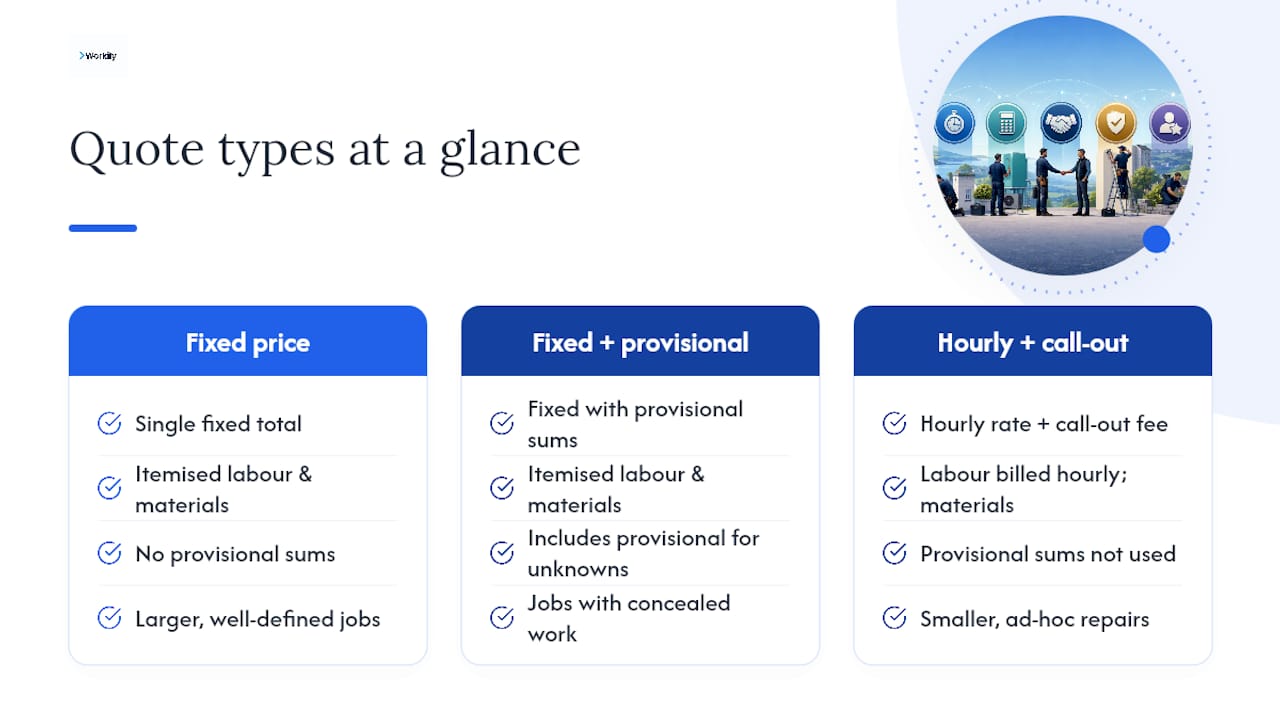
A proper itemised quote lists labour separately from materials, states clearly what’s excluded, and shows VAT where it applies. If a quote is just one lump number with no breakdown, ask for it to be split out before you compare it against anything else.
On deposits: a modest amount to secure your slot in the schedule or buy materials upfront is standard practice. The CCPC flags home building and improvement as one of the top drivers of consumer complaint calls, and deposit disputes feature heavily. A deposit above roughly 10% of the job total, or any demand for full payment before work begins, is a signal to walk away, not negotiate.

When you’re comparing quotes side by side, don’t stop at the bottom-line figure. Check the warranty period, the stated timeline, and whether fittings or finishes are actually included, because a cheaper quote missing three line items can end up costlier. For a sense of realistic local rates before you start comparing, our handyman rates guide is a useful benchmark.
What belongs in the contract, and how do you manage the job on site?
A written contract earns its keep the moment anything deviates from plan, and on a renovation, something usually does.
- Set out the essentials up front: full scope of works, payment milestones tied to progress (not calendar dates), warranty terms, and how defects will be remedied after handover. Government building guidance consistently points to contract clarity as the single biggest predictor of a smooth renovation.
- Put every variation in writing before work continues. If the tradesperson finds rot behind a wall or you decide to upgrade a fitting halfway through, get the extra cost signed off first, not discovered on the final invoice.
- Walk the job at completion. Note snags, agree a fix-by date, and consider holding a small retention, often 5%, until snagging is done.
- If the work is genuinely unsatisfactory, document it with photos and dated notes, raise it in writing with the tradesperson first, and only escalate to a formal complaint if that gets no response.
What should you ask at quote stage, and check on the day?
Bring the same short list to every quote call so answers are genuinely comparable; for more help, see this essential contractor selection criteria.
- “Can you send your licence number and insurance certificate by email today?”
- “Who exactly will be doing the work, you or a subcontractor?”
- “What’s your realistic start date and how long will it take?”
- “What warranty do you offer on labour and materials?”
- “Can I ring one recent customer directly?”
On the day the job starts, check the van or vehicle has identifiable signage, ask to see the insurance certificate in person if you haven’t already, and confirm the person on site matches who you interviewed.
Pro Tip: Print your question list and quote comparison side by side. Reading three quotes off separate phone screens a week apart is how homeowners miss the details that actually matter.
Why the vetting behind a booking platform matters
Instant booking means you can request and secure a verified professional the same day a problem appears, rather than waiting days for callbacks that may never come.
That vetting layer does the licence and background legwork that this guide has just walked you through manually, which is exactly why platform checks and your own checks should work together, not one instead of the other. Thomas, who researches Ireland’s home services market for Workily, has tracked how consumer complaint patterns from bodies like the CCPC map almost directly onto the checklist in this article: unclear contracts, oversized deposits, unverifiable references. The proof points reduce friction, but they don’t remove your job of asking the direct questions.
What actually determines whether a hire goes well?
Most guides to hiring tradespeople bury the important part under generic checklists. The evidence points somewhere sharper: the single highest-leverage move is getting three comparable quotes, because it’s what exposes an outlier price or an outlier promise before you’ve committed to either.
Conventional advice tends to obsess over finding the “best” tradesperson, as if there’s one perfect match out there. In practice, most licensed, insured professionals in a given trade produce broadly similar quality. What separates a good hire from a bad one is almost always process: was the scope written down, was the deposit reasonable, did the timeline match reality. Homeowners who skip the paperwork stage because a tradesperson “seemed sound” are the ones who end up calling the CCPC.
If you take one thing from this guide, prioritise the licence and insurance check over the price comparison. A quote that’s €800 cheaper means nothing if the person doing the work has no cover when something goes wrong on your property.
— Thomas
Ready to hire? Here’s the quickest safe path
Workily gets you past the callback-and-wait cycle that swallows most renovation timelines. Post your job once, and you’re comparing quotes from verified professionals instead of chasing three separate tradespeople for three separate call-backs.

For anything urgent, a burst pipe, a heating failure in January, instant booking connects you with a vetted, available professional the same day, without the usual wait for a callback that might not come. Every professional listed goes through the same verification described in our trust and safety process, so the licence and insurance checks this guide walks through are already done before you ever see a quote. Still, request at least three quotes, keep the written scope, and log every message. Head to Workily to post your job and start comparing.
Sources
- Issues with the home building and improvement sector were the second biggest call driver to the CCPC in first half of 2025
- How to Hire a Contractor: 10-Step Vetting Guide for 2026
- How to find a great handyman