


To verify a contractor’s registration in Ireland right now, search the Voluntary Construction Register by business name, registration number, or county. For electrical work, check Safe Electric. For gas, check the Registered Gas Installers of Ireland (RGII). Then confirm current public liability insurance and, for larger jobs, request a Tax Clearance Access Number (TCAN) from Revenue.

There is no single universal “contractor licence” in Ireland. The sector uses a mix of voluntary registers, trade-specific regulators, and the new statutory Construction Industry Register Ireland (CIRI), being phased in under the Regulation of Providers of Building Works Act 2022. Knowing which register applies to your job is the first step.
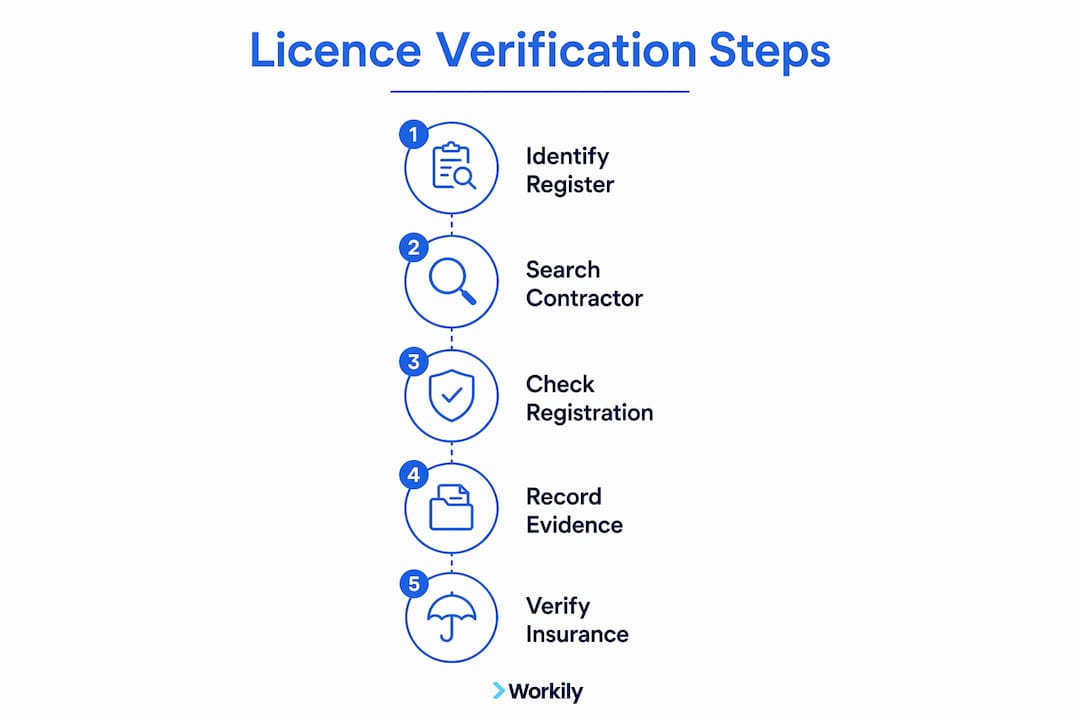
Quick verification checklist:
- Search the contractor’s name or registration number on the relevant register (VCR, Safe Electric, or RGII).
- Confirm the registration status is current and note the date.
- Request the insurance certificate and, for commercial projects, a TCAN.
- Sign a written contract specifying scope, price, and timelines before any payment.
Pro Tip: Take a screenshot of the register listing with the date visible. If a dispute arises later, a timestamped lookup is far stronger evidence than a verbal assurance.
Table of Contents
- Why does checking registration protect your project?
- Where can you check a contractor’s registration right now?
- What documents should you ask for, and what are the red flags?
- What should you do if you cannot verify a contractor?
- How does Workily reduce the verification burden?
- Key takeaways
- The thing most homeowners get wrong about contractor verification
- Workily: verified professionals, booked in minutes
- Official registers and primary sources
Why does checking registration protect your project?
Hiring an unregistered contractor is not just a paperwork risk. If something goes wrong — a structural fault, an electrical fire, a gas leak — your ability to claim on the contractor’s insurance depends entirely on whether that insurance exists and is valid. An unregistered tradesperson may carry no public liability cover at all, leaving you personally exposed.
Registration on a recognised register signals more than compliance. As the CIRI guidance makes clear, it means the contractor has been assessed for technical competence and regulatory compliance under national building standards. That assessment process is what separates a registered professional from someone who simply owns a van and a drill.
Registrations can lapse or be suspended between projects. Industry guidance is explicit: always perform a live status check immediately before signing, not weeks earlier when you first received a quote. A contractor who was registered last year may not be registered today.
The practical consequence is simple. A registration check done on the day you sign is a trust signal. One done a month earlier is almost worthless.
Where can you check a contractor’s registration right now?
The Voluntary Construction Register (VCR)
The VCR search tool lets you search by business name, VCR registration number, or county. It covers 30+ registration categories and returns a company profile page for registered businesses, showing the registration number, competence division, and current status. Copy the registration number and status directly from the listing, and note the date of your search.
Safe Electric (electricians)
For any electrical work, the contractor must appear on the Safe Electric register. Search by company name or registration number at the Safe Electric website. A valid entry will show the contractor’s authorisation status and the categories of work they are permitted to carry out.
Registered Gas Installers of Ireland (RGII)
Gas installation, servicing, and repair work must only be carried out by an RGII-registered installer. Search the RGII public register by name or registration number. An active listing confirms the installer is authorised to work on gas systems in Ireland.
Revenue TCAN check
For larger domestic projects or any commercial contract, ask the contractor for their Tax Clearance Access Number. You can verify it directly with Revenue. This confirms the contractor is tax-compliant and protects you from potential liability under Relevant Contracts Tax rules.
| Register | Covers | Search by |
|---|---|---|
| Voluntary Construction Register (VCR) | General construction, building, trades | Name, VCR number, county |
| Safe Electric | Electrical installation and testing | Name, registration number |
| RGII | Gas installation, servicing, repair | Name, registration number |
Pro Tip: When you find a valid listing, copy the exact registration number into a document alongside the lookup date and URL. If the contractor’s details on the register differ from what they told you verbally — different company name, different category — stop and ask why before proceeding.
What documents should you ask for, and what are the red flags?
Every contractor you hire should hand over the following without hesitation:
- Registration number and profile link from the relevant register (VCR, Safe Electric, or RGII).
- Current public liability insurance certificate, showing the policy period, the named insured, and the level of cover. Being listed on a register does not automatically guarantee suitable insurance for your specific project.
- Tax Clearance Access Number for any project above a modest scale or for business contracts.
- Verifiable references with contact details, plus recent project photos you can cross-check.
- Written contract detailing scope of work, materials, price, payment schedule, and timelines.
“Legitimate professionals expect verification requests and will supply documents promptly. If a contractor hesitates, deflects, or becomes defensive when asked for proof of registration or insurance, treat that behaviour as a substantive red flag.” — Up the Walls, CIRI registration guide
The behaviours that should make you walk away: pressure to pay a large cash deposit before work starts, an inability to produce an insurance certificate on request, business details on the register that do not match the name on the quote, or a refusal to provide a written contract. Any one of these alone is enough reason to pause. Two or more together, and you should find someone else.
Pro Tip: Ask to see the insurance certificate itself, not just a summary. Check that the named insured matches the business name on the register, and confirm the policy has not expired. A policy that lapsed last month covers nothing.
What should you do if you cannot verify a contractor?
Do not sign anything. That is the first rule. Then take these steps in order:
- Request proof directly. Ask the contractor in writing (email is fine) to provide their registration number and insurance certificate within 24 hours. A legitimate professional will respond promptly.
- Re-check the register. Search again using the business name, any alternative trading names, and the owner’s personal name. Some sole traders register under their own name rather than a company name.
- Contact the register owner. If you believe a contractor is falsely claiming registration, contact the VCR, Safe Electric, or RGII directly. CIRI, once fully operational, will have its own complaints process.
- Report tax compliance concerns to Revenue. If you suspect a contractor is operating outside the tax system, Revenue has a reporting mechanism for undeclared work.
- File a consumer complaint. The Competition and Consumer Protection Commission (CCPC) handles complaints about traders operating in Ireland. Keep all written communications as evidence.
- Use a pre-vetted platform. If the verification process has broken down, the fastest safe alternative is to search verified professionals on Workily, where credentials are checked before a contractor appears on the platform.
How does Workily reduce the verification burden?
Workily is the fastest route to a verified, bookable professional in Ireland. Every contractor on the platform has passed identity checks, business registration confirmation, insurance verification, and reference checks before their profile goes live. That maps directly to the VCR, Safe Electric, and RGII checks a homeowner would otherwise run manually.
The workflow is straightforward: search by service type and location, view the verified profile with credential details, and book instantly or request a quote. For homeowners who need same-day service, that matters. Workily reports a high satisfaction rate across many completed bookings, which reflects a vetting process that actually filters out the contractors who would fail a manual register check.
Key verification checks Workily applies to every professional:
- Identity and business registration confirmation.
- Public liability insurance verification.
- Trade-specific registration (electricians, gas installers, and other regulated trades).
- Reference checks and project history review.
For anyone who wants to check if a tradesperson is legitimate but does not want to spend an hour cross-referencing three separate registers, Workily does that work in advance.
Key takeaways
Verifying a contractor’s registration in Ireland requires checking the right register for the trade, confirming live insurance, and timestamping the lookup before you sign anything.
| Point | Details |
|---|---|
| Check the correct register | Use VCR for general construction, Safe Electric for electricians, RGII for gas installers. |
| Confirm insurance independently | A register listing does not guarantee suitable insurance; always request the certificate. |
| Timestamp every lookup | Screenshot the register listing with the date; registrations can lapse between projects. |
| Request a TCAN for larger jobs | A Tax Clearance Access Number from Revenue confirms tax compliance on commercial contracts. |
| Workily pre-vets for you | Workily verifies credentials before listing any professional, enabling instant, safe booking. |
The thing most homeowners get wrong about contractor verification
The conventional advice is to “check the register before you hire.” That is correct but incomplete. The part people skip is checking it again, on the day they sign. A contractor who was fully registered when they quoted in February may have had their registration suspended by the time you are ready to proceed in April. Registrations lapse. Insurance policies expire. The gap between quote and contract can be weeks.
The second thing people underestimate is the insurance certificate itself. A registration number is not proof of cover. The certificate tells you the named insured, the policy period, and the scope of cover. A policy that covers general building work may explicitly exclude certain specialist trades. If your job involves both general construction and electrical work, you need to confirm the policy covers both, or that two separate insured contractors are involved.
The single question worth asking every tradesperson before you sign: “Can I see the current insurance certificate and confirm the named insured matches your registration?” A professional who finds that question unreasonable is telling you something important.
Workily: verified professionals, booked in minutes
Spending an afternoon cross-referencing the VCR, Safe Electric, and RGII is not how most people want to spend their time before a home repair. Workily is the alternative: a platform where every professional has already been through identity, registration, and insurance checks before you see their profile.

Search by service and location, compare verified profiles, and book instantly. Same-day availability is standard for many trades. Whether you need an electrician in Dublin, a gas installer in Cork, or a builder in Galway, Workily’s pre-vetted shortlist means you skip the manual checks and go straight to booking. The hiring a licensed and insured contractor decision becomes straightforward when the verification is already done.
Find and book a verified professional on Workily today, or browse the interior painter cost guide to compare quotes before you commit.
Official registers and primary sources
Use these authoritative sources to verify contractor credentials directly. Screenshot any listing and record the date.
- Voluntary Construction Register (VCR) — search by name, registration number, or county for general construction and building trades.
- CIRI (Construction Industry Register Ireland) — the statutory register being phased in under the 2022 Act; check for your contractor’s division as CIRI rolls out through 2026.
- Safe Electric — mandatory register for electricians carrying out installation and testing work in Ireland.
- RGII (Registered Gas Installers of Ireland) — mandatory register for all gas installation, servicing, and repair work.
- Revenue — verify a Tax Clearance Access Number for larger or commercial projects to confirm tax compliance.
Always timestamp your lookup. A dated screenshot is the simplest proof that a contractor’s registration was active on the day you signed.