


Public liability insurance covers physical injury to third parties or damage to their property. Professional indemnity covers financial loss a client suffers because of negligent advice or a mistake in your work. Most tradespeople need public liability; most consultants and regulated professionals need professional indemnity; businesses that both build things and advise on them often need both.
TL;DR:
- Public liability insurance covers physical injuries and property damage caused to third parties, while professional indemnity covers financial losses from negligent advice or mistakes.
- Many firms need both policies if they perform both physical work and professional advice, especially in complex or mixed-risk projects.
- Insurance policies are claims-made for PI, requiring careful attention to retroactive dates and run-off cover, unlike the occurrence basis of public liability.
- Irish legal and financial professionals must meet statutory minimums, such as €1.5 million for legal indemnity, but actual coverage should exceed minimum levels due to defense costs and policy specifics.
- Verifying insurance coverage before hiring can be simplified using platforms that display valid certificates and detailed policy wording, preventing gaps and misunderstandings.
Table of Contents
- Public liability vs professional indemnity: the core difference
- Who actually needs public liability, PI, or both?
- Ireland’s regulatory minimums and what shapes your cover
- How to choose the right cover (a practical checklist)
- How Workily helps you check cover before you hire
- What the conventional advice gets wrong
- Find insured, vetted professionals through Workily
- Where to check the details yourself
- Sources
- FAQ
Public liability vs professional indemnity: the core difference
The split comes down to what kind of loss you caused. Public liability responds when your business activity injures someone or damages property that belongs to someone else, such as a customer, a passer-by, or a client’s premises. It’s bodily injury and property damage cover, and it typically runs on an occurrence basis, meaning the policy in force when the incident happened is the one that pays out, even if the claim surfaces years later.
Professional indemnity works differently. It pays out when a client loses money because your advice, design, or service was negligent, inaccurate, or incomplete. A structural engineer who miscalculates a load, an accountant who misreads a tax return, an architect whose drawings miss a building regulation. None of that is a physical injury claim; it’s a financial one, and it sits squarely in PI territory.
The mechanics matter as much as the definition. PI is almost always written on a claims-made basis, meaning the policy active when the claim is made responds, not the one active when the mistake happened. That’s why the retroactive date on a PI policy matters so much, and why run-off cover becomes essential if you stop trading or change insurer.
Policy wordings from insurers such as AXA typically bundle several components worth knowing:
- Limit of indemnity: the maximum the insurer will pay per claim or in total for the policy year.
- Excess: what you pay before the insurer contributes.
- Defence costs: legal costs defending a claim, which some policies pay within the limit and others pay in addition to it.
- Retroactive date: the earliest date PI cover applies to past work.
- Run-off cover: extended PI protection after you close or sell a practice.
A Dublin plumber who splashes water damage across a client’s kitchen floor needs public liability. A quantity surveyor in Cork whose measurement error costs a developer thousands in reworked concrete needs professional indemnity. A design-and-build contractor doing both jobs on the same site can trigger either type of claim depending on what actually went wrong, which is precisely why so many firms in that position carry both.
Who actually needs public liability, PI, or both?
Trades and contractors, builders, plumbers, electricians, painters, need public liability as standard. If you have employees, employers’ liability sits alongside it as a separate, distinct cover for injuries to staff rather than the public.
Professional advisers face a different set of expectations. Architects, accountants, solicitors, surveyors, and financial advisers are commonly required to carry professional indemnity, sometimes as a condition of their professional body’s membership rather than by general law.
Mixed-risk firms are the group most likely to get caught out. A design-build contractor who both specifies materials and installs them can face a public liability claim over a site accident, or a professional indemnity claim over a design flaw, sometimes both from the same job.
- Trades and contractors: public liability essential; employers’ liability if staff are on the payroll.
- Consultants and regulated professionals: professional indemnity usually mandatory under professional rules.
- Design-build and consult-and-install firms: frequently carry both policies side by side.
- Anyone tendering for contracts: clients, venues, and local authorities routinely request proof of cover as a condition of the job, even when no law demands it.
That last point catches a lot of sole traders off guard. Nobody is going to prosecute you for skipping public liability, but a venue in Galway or a housing association in Limerick will simply refuse to let you on site without a certificate. It’s a de facto requirement long before it’s a legal one.
Ireland’s regulatory minimums and what shapes your cover
Some professions don’t get a choice on minimum levels. Legal practitioners face statutory minimums for professional indemnity under the Legal Services Regulation Act 2015 (Professional Indemnity Insurance) Regulations 2019, which sets qualifying policy features and minimum indemnity levels, commonly cited at €1.5 million for specified legal roles.
Regulated financial intermediaries face a separate framework. The Central Bank of Ireland’s guidance sets supervisory expectations around PII, citing figures such as €1,564,610 per claim and €2,315,610 in the aggregate for certain investment intermediary activities. Other regulated activities carry different minima, so the right figure depends entirely on what your firm actually does.
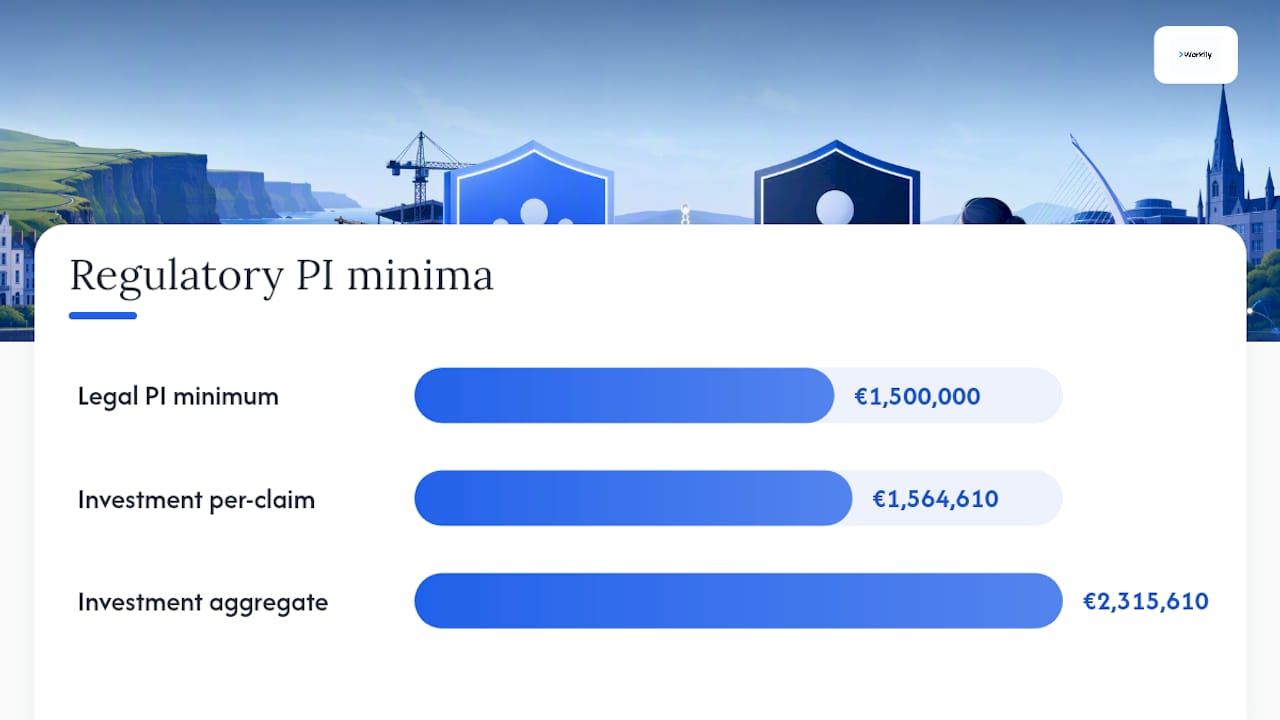
Regulatory floors don’t move with inflation on their own. A minimum set several years ago can lag behind the actual cost of defending a modern professional negligence claim, so treat any statutory minimum as a floor, not a target.
Professional bodies add another layer. Bodies such as CPA Ireland tie practising certificates to holding a qualifying PII policy, including run-off provisions, so compliance is ongoing rather than a one-off box tick at renewal.
Wording detail matters here more than the headline limit. Two policies with identical limits can behave completely differently depending on whether defence costs erode the limit, whether there’s a full retroactive date, and whether a no-admission-of-liability clause restricts what you can say to a client mid-dispute. Tendering bodies generally accept cover that meets the stated minimum from a reputable insurer, but always ask what “adequate” actually means for the specific contract.
How to choose the right cover (a practical checklist)
Buying the right mix of public liability and professional indemnity is less about picking a number and more about mapping your actual exposure. Work through these steps in order:
- List your risk types. Separate activities that could physically hurt someone or damage property from activities that give advice, designs, or professional opinions.
- Check the claims-made mechanics on any PI quote. Confirm the retroactive date covers your full trading history, and ask what run-off costs if you ever close the business.
- Set your limit against real requirements. Many tenders specify a floor, commonly €1 million to €6.5 million for public liability depending on the contract size; scale up if you work on larger commercial sites.
- Request full certificate detail, not a summary: insurer name, policy number, period of cover, retroactive date, limits, and any specific exclusions attached to your trade.
- Get written clarification on exclusions, particularly around dishonesty, contractual liabilities, and fines or penalties, none of which a standard PI policy typically covers.
- If you’re tendering, ask the client in writing whether your insurer and limit are acceptable before you submit, rather than finding out after you’ve won the job.
Pro Tip: Ask your broker for the specific policy wording document, not just the certificate. The certificate proves cover exists; the wording tells you what actually gets paid when something goes wrong.
Read the contractual liabilities exclusion carefully if you sign contracts with penalty clauses. Standard PI won’t necessarily cover liability you’ve taken on purely by contract that goes beyond what you’d owe under general negligence law.
How Workily helps you check cover before you hire
Verifying someone’s insurance before you hire them shouldn’t require a phone call to their broker. Some service platforms verify professionals and display credentials so you can confirm cover exists before booking, rather than discovering gaps after the job starts.
The Ask a Pro feature and instant booking through Instant Pro both speed up getting multiple quotes side by side, which makes it far easier to ask each candidate for written proof of cover as part of the comparison.
What the conventional advice gets wrong
Most guides on this subject treat public liability and professional indemnity as a binary choice, pick the one that matches your job title and move on. That’s backwards for a lot of Irish businesses. The riskiest position isn’t the tradesperson who forgets PI; it’s the mixed-risk firm, the electrician who also does energy consultancy, the builder who also draws up specs, who assumes their public liability policy quietly covers the advice side too. It usually doesn’t.
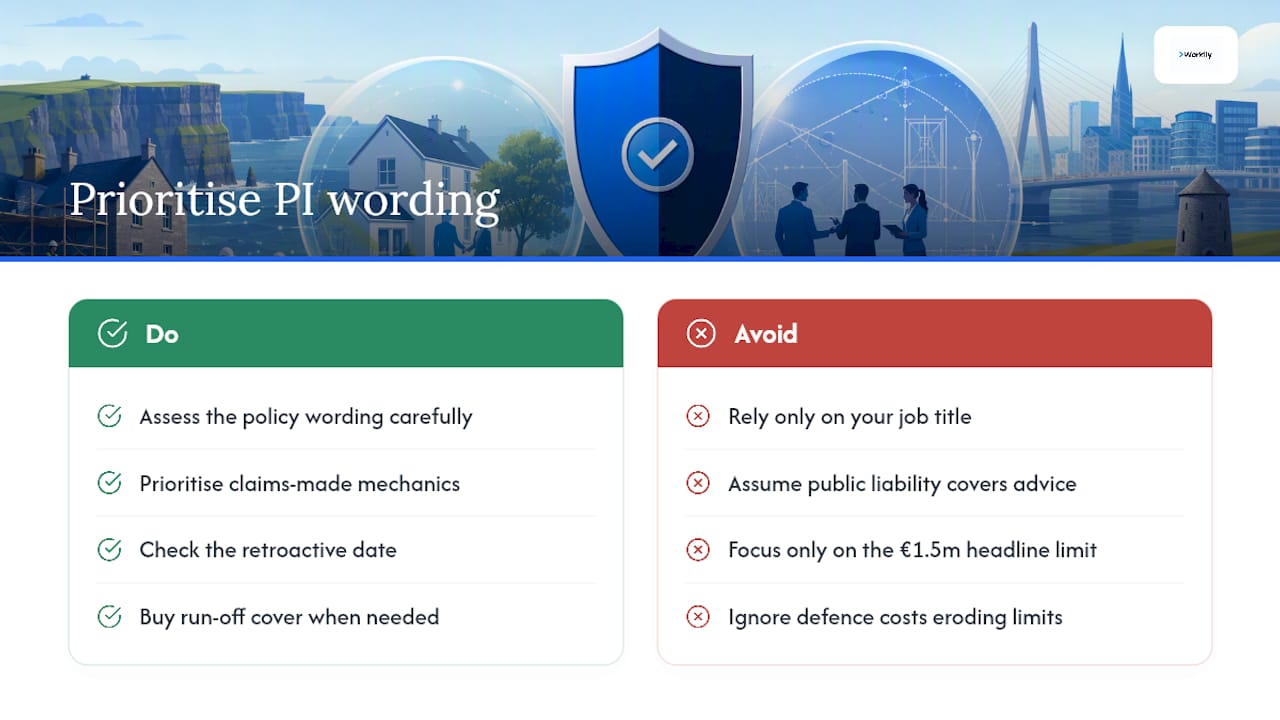
The regulatory minimums get too much attention relative to the wording. A €1.5 million PI limit sounds substantial until you discover defence costs erode it, or that the retroactive date doesn’t reach back far enough to cover the job a client is now suing over. I’d rather see a business carry a slightly lower limit with clean wording than a headline-grabbing limit riddled with exclusions nobody read.
If you take one thing from this, prioritise the claims-made mechanics and run-off cover before you even look at the limit. A policy that lapses the year you need it is worth nothing, however impressive the number on the certificate.
— Thomas
Find insured, vetted professionals through Workily
Using a verified service platform can be a practical alternative to chasing certificates by phone or trusting a business card, with insured professionals generally required to confirm coverage during the hiring process.

Use Ask a Pro when you want a quick consultation on a legal, financial, or technical question before you commit to a hire, or browse Instant Pro when you need a vetted tradesperson booked for the same day. Both let you compare multiple professionals and request proof of cover before you agree to anything. If you’re not sure how verification works on the platform, the how it works page walks through the process step by step. Before booking a professional, it is advisable to request quotes from multiple candidates and compare their credentials side by side, not just their price.
Where to check the details yourself
- The Central Bank of Ireland’s PII guidance sets minimum figures for regulated intermediaries.
- The Legal Services Regulation Act 2015 PII Regulations confirm statutory minimums for legal practitioners.
- The RICS model PI wording for Ireland shows exactly how clauses like retroactive dates and defence costs are drafted.
Before hiring any tradesperson, it’s also worth reading Workily’s guide on how to check if a tradesperson is legitimate in Ireland, which covers licence checks alongside insurance verification.
Sources
- Legalguide
- RICS professional indemnity insurance wording 2021 (Ireland) | RICS
- Legal Services Regulation Act 2015 (Professional Indemnity Insurance) Regulations 2019 | Irish Statute Book
- Professional indemnity insurance guidance | Central Bank of Ireland
FAQ
Do I legally need public liability insurance in Ireland?
No general law forces most businesses to hold public liability insurance in Ireland. In practice, clients, venues, and local authorities routinely require proof of cover before allowing work to start, which makes it a practical necessity for most trades.
What’s the main difference between public liability and professional indemnity?
Public liability covers physical injury or property damage caused to a third party; professional indemnity covers financial loss a client suffers because of negligent advice or a service error. One responds to accidents, the other to mistakes in professional judgement.
Can one policy cover both public liability and professional indemnity?
Some insurers bundle both sections into a single combined policy, particularly for design-build contractors and mixed-risk firms, while others require two separate policies. Check the wording carefully, since a combined policy can still have separate limits and exclusions for each section.
Why is professional indemnity written on a claims-made basis?
Negligent advice often surfaces as a problem years after the work was done, so PI insurers pay based on when the claim is made rather than when the error occurred. This makes the retroactive date and run-off cover critical if you switch insurer or close your business.
How much public liability cover do Irish businesses typically need?
Cover levels depend on the contract, but many tenders and venues in Ireland specify a floor commonly between €1 million and €6.5 million. Larger commercial or public sector contracts often require higher limits than a domestic job.
Do solicitors and barristers have mandatory PI minimums in Ireland?
Yes. The Legal Services Regulation Act 2015 (Professional Indemnity Insurance) Regulations 2019 sets minimum indemnity levels for specified legal roles, commonly cited at €1.5 million, alongside qualifying policy features.
Does professional indemnity cover bodily injury claims?
No. Standard PI policies generally exclude bodily injury and property damage, since those risks belong to public liability cover instead.
How can I check if a tradesperson or professional has valid insurance before hiring?
Ask for a current certificate showing the insurer, policy number, period of cover, and limits, then verify it directly with the insurer if the job is significant. Platforms like Workily verify professionals before listing them, which gives buyers a faster starting point when comparing candidates for a job.