


Four routes cover almost every situation: FLAC for free information and signposting, the Legal Aid Board for means-tested civil legal aid, community law centres like Community Law & Mediation for free clinics on specific topics, and the Law Society directory when you need a private solicitor. If money is tight and your case qualifies, start with the Legal Aid Board. If you just need quick clarity, call FLAC or book a community clinic. If you need a private, immediate opinion, book an online consultation through Workily’s Ask a Pro.
TL;DR:
- Legal Aid Board’s means test considers disposable income and capital, not gross salary, allowing modest-wage earners with expenses to qualify for legal aid.
- Most free clinics, like FLAC and community centers, provide quick, targeted advice but do not offer court representation or document drafting.
- Private solicitors are necessary for court cases, complex disputes, or conveyancing, with costs varying based on scope, and mediation is a growing alternative for some issues.
- Preparing documents, timelines, and key questions beforehand maximizes the value of any legal advice appointment, whether free or paid.
- Paid online consultations with vetted professionals are useful for urgent cases, contract reviews, or when free routes are unavailable or too slow.
Table of Contents
- Where to get free or low-cost legal advice
- How does the Legal Aid Board means test work?
- What happens at a free legal clinic appointment?
- When do you actually need a private solicitor?
- How to prepare for a legal advice appointment
- When does a paid online consultation actually make sense?
- Book a fast expert consultation with Workily
- Sources
Where to get free or low-cost legal advice
Four organisations handle most of what people in Ireland need, and each has a different job.
FLAC (Free Legal Advice Centres) runs a phone information line and a network of evening clinics staffed by volunteer solicitors and barristers. It covers civil matters, mainly debt, housing, employment, social welfare and family law, and every session is free and confidential. Think of FLAC as the first port of call when you’re not sure what your rights actually are.
The Legal Aid Board goes further than information. It provides civil legal aid and advice, including representation in family law and other civil cases, through its network of law centres. Unlike FLAC, it can put a solicitor on your side of a court case, though eligibility depends on a means test.
Community law centres, particularly Community Law & Mediation, run free legal clinics in specific areas such as employment, social welfare, housing, family law and environmental justice. Clinics are bookable in advance, and each one lists exactly which topics it covers, so check before you book rather than turning up with the wrong query.
The Law Society of Ireland doesn’t give advice itself, but its solicitor directory lets you search by county and area of practice when free routes aren’t enough. That matters most for conveyancing, contested probate, or anything needing sustained representation.
A rough way to choose between them:
- Need a fast, free answer to a specific question? Call FLAC or book a community clinic.
- Facing a family law case or court proceedings and on a low income? Apply through the Legal Aid Board.
- Need a private solicitor for property, business or a serious dispute? Search the Law Society directory.
- Considering a dispute with a tradesperson or contractor? Read how to check if a tradesperson is legitimate before it escalates into a legal matter at all.
How does the Legal Aid Board means test work?
The Legal Aid Board looks at disposable income and disposable capital, not your gross salary. That distinction catches people out constantly: someone on a modest wage with a mortgage and childcare costs can qualify, while someone with a higher gross income but few outgoings might not, because the board deducts allowable expenses before assessing what counts.
Passing the means test doesn’t make legal aid free. Most applicants pay a contribution, calculated on a sliding scale according to their disposable income and capital, and the board sets that figure case by case.
Before you apply, it’s worth doing two things:
- Check the current income and capital thresholds on the Legal Aid Board’s own site, since checking your gross income alone can give a misleading picture of eligibility.
- Ask about processing times at your local law centre, as waiting lists vary significantly depending on demand and location.
Quick fact check: legal aid under this scheme can include full representation in court, which puts it well beyond what a FLAC clinic offers, and that’s exactly why the means test exists as a gatekeeper.
What happens at a free legal clinic appointment?
Clinics run on tight timelines. Most sessions last a short time, and the volunteer solicitor or barrister is there to point you in the right direction, not to become your ongoing legal representative.
What a clinic can typically do:
- Explain your general rights in plain terms.
- Tell you which legal process applies to your situation.
- Point you towards the Legal Aid Board, a specific solicitor, or another support service.
What a clinic usually cannot do:
- Represent you in court.
- Draft contracts, wills, or complex legal documents.
- Take on your case for ongoing management.
Pro Tip: Write your single most important question down before the appointment, and bring one page summarising the timeline of events. A clinic volunteer can do far more with “my landlord served this notice on this date” than with a rambling history of every argument you’ve had since 2023.
When do you actually need a private solicitor?
Some situations move past what free advice can cover. Court representation, contested family law matters, conveyancing, and complex commercial disputes generally require a solicitor working on your file directly. The Courts Service itself recommends getting proper advice before representing yourself, since understanding procedure and options reduces the risk of costly mistakes.
Fees vary by solicitor, complexity and how the work is scoped, and there’s no fixed national rate. Common models include:
- Hourly rates, typical for anything with an uncertain scope, like a drawn out dispute.
- Fixed fees for defined tasks, such as reviewing a contract or handling a straightforward conveyancing transaction.
- Limited-scope retainers, where the solicitor only handles one part of the process, such as drafting a letter, while you manage the rest yourself.
If full litigation feels disproportionate to the problem, ask about mediation. The Law Society notes mediation’s growing role as a quicker, cheaper alternative to court for many disputes, and a solicitor can tell you within minutes whether your case is suitable.
How to prepare for a legal advice appointment
Whether you’re heading to a FLAC clinic or paying for a private consultation, preparation decides how useful the session is.
- Gather your documents: ID, all relevant correspondence, contracts, formal notices, and any invoices tied to the dispute.
- Write a simple timeline of events, in date order, on a single page.
- Decide your one or two priority questions before you arrive, and lead with them.
- Take notes during the session, including any deadlines or next steps mentioned.
- Ask directly about costs and what happens next, and request written confirmation of the advice where possible.
If your issue involves a contractor or tradesperson dispute, it’s worth reading up on hiring tradespeople in Ireland beforehand, since contract terms often decide who’s in the right before a solicitor even gets involved.
When does a paid online consultation actually make sense?
Free services in Ireland do a lot of good work, but they’re stretched. Clinic slots fill up, waiting lists for Legal Aid Board appointments can run long, and sometimes a problem simply won’t wait three weeks for the next available session.
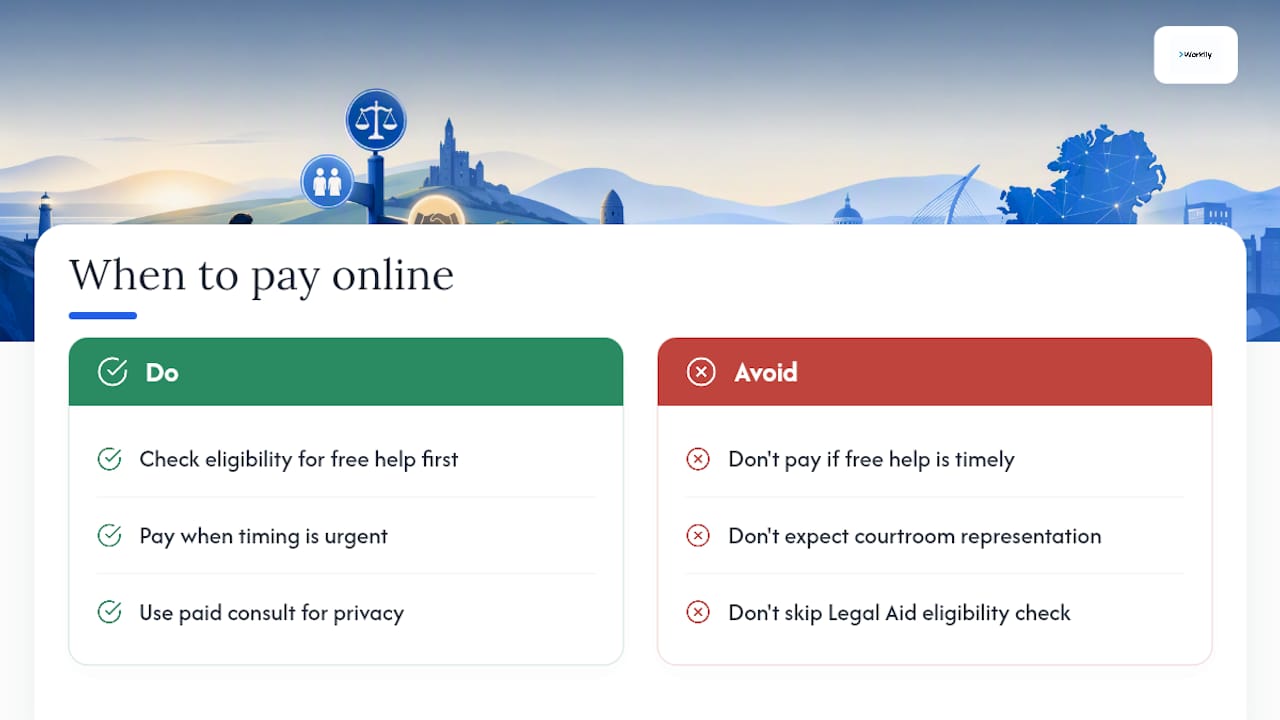
That’s the gap a paid, on-demand option fills. An online consultation service lets you book with a vetted professional, often the same day, when free routes are full or too slow for the urgency of your situation. It’s not a replacement for legal aid if you qualify for it, and it won’t get you courtroom representation. What it does give you is a fast, private opinion you can act on immediately, or bring to a solicitor later as a head start.
The sensible order is: check if you’re eligible for free help first, and only pay if the timing or privacy of your situation genuinely calls for it.
— Thomas
Book a fast expert consultation with Workily
This service is a practical fallback when free clinics are booked out or your question needs a private answer promptly. It offers instant booking with a vetted professional, so instead of waiting on a callback or a clinic slot, you get a proper conversation about your situation the same day.
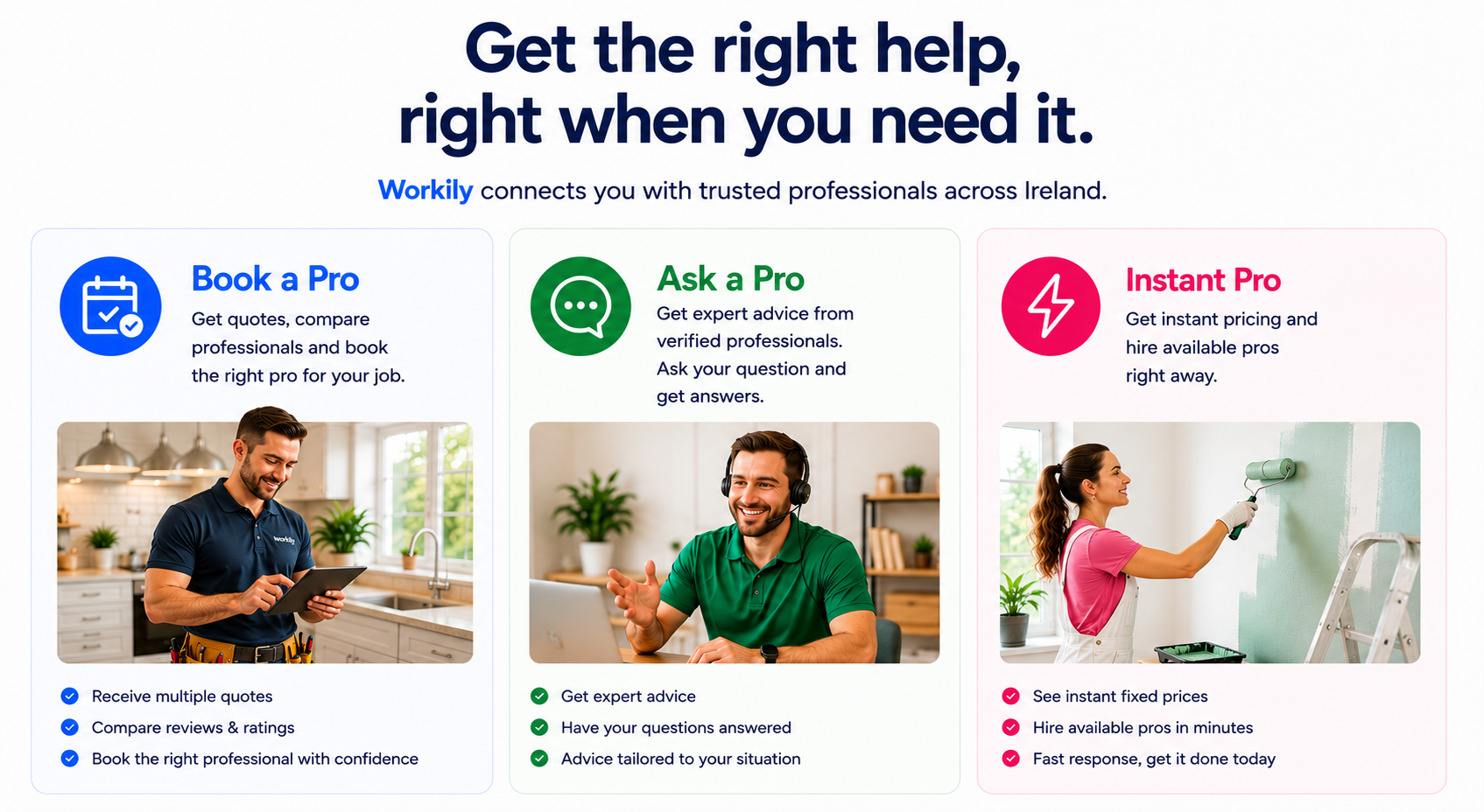
It suits urgent situations: a notice with a tight deadline, a contract you need reviewed before signing, or simply wanting a second opinion before you commit to a solicitor’s fees. Compare it against the free routes covered above, FLAC, the Legal Aid Board, and community clinics, and if none of them fit your timeline, book a consultation through Ask a Pro directly. You can also browse Workily’s full range of vetted professionals if your issue turns out to need a different kind of expert altogether.
This article is general information, not a substitute for advice from a qualified lawyer. Consult a qualified legal professional about your own circumstances before acting on anything here.