

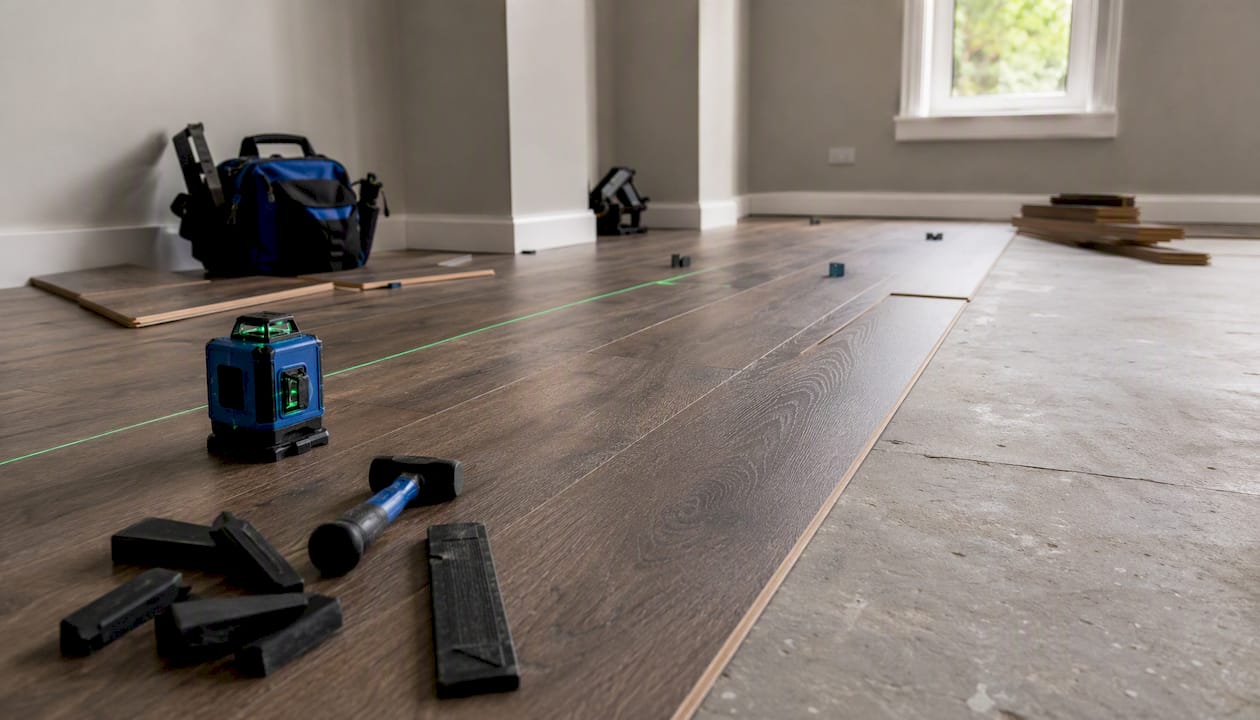
Flooring installation in Ireland typically costs a moderate to high rate per m² in labour alone, with all-in totals (materials, underlay, trims and labour) varying widely depending on floor type and site conditions. A site survey is the only reliable way to pin down your final price. Get itemised quotes from verified installers on Workily before committing to anything.
| Floor type | Labour only | Typical all-in mid-range |
|---|---|---|
| Laminate | Moderate labour cost | Moderate all-in cost |
| LVT (click) | Slightly higher labour cost | Higher all-in cost |
| Engineered wood | Mid-range labour cost | Mid-range all-in cost |
| Solid wood | Higher labour cost | Higher all-in cost |
| Vinyl sheet | Moderate labour cost | Moderate all-in cost |
| Carpet | Lower labour cost | Lower all-in cost |
| Floor tiles | Highest labour cost | Higher all-in cost |
Labour ranges are published by Irish installers and reflect the wide spread between a straightforward floating laminate in a new-build and a glue-down engineered wood job on an uneven Victorian subfloor.
Table of Contents
- What does flooring installation cost by floor type?
- What actually drives the final price up?
- How do you get an accurate, comparable quote?
- What timelines and payment terms should you expect?
- How can you reduce the cost without cutting corners?
- Why use a vetted marketplace to book your installer?
- Key takeaways
- The case for not skipping the survey
- Book vetted flooring installers through Workily
- Useful sources and further reading
What does flooring installation cost by floor type?
The figures above are starting points, not final prices. Here is what each floor type actually involves and where quotes tend to grow.
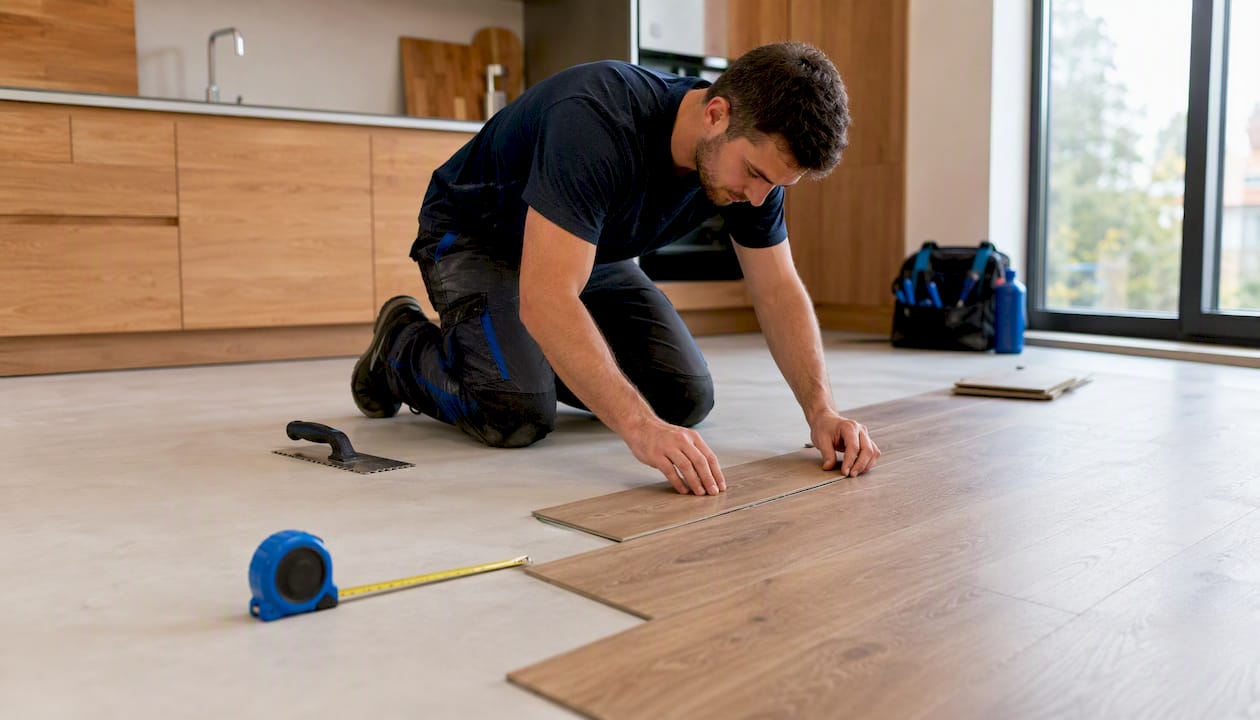
Laminate is the cheapest installed option for most Irish homes. It clicks together without adhesive, so labour is faster. Quotes usually cover labour and underlay; levelling and skirting work are almost always priced separately.
LVT (luxury vinyl tile/plank) comes in click and glue-down formats. Click LVT installs similarly to laminate. Glue-down adds adhesive cost and longer cure time, which pushes labour up by €5–€10 per m² on average.
Engineered wood floated over underlay sits at the lower end of its range; glue-down to concrete adds adhesive, a damp-proof membrane (DPM) and more prep time. Quotes for engineered wood frequently exclude levelling and DPM.
Solid wood demands the most preparation. Subfloor flatness tolerances are tight, acclimatisation time adds days to the schedule, and any moisture issue must be resolved before a board goes down. Expect the highest labour rates and the longest lead times.
Vinyl sheet is fast to install in simple rectangular rooms but wasteful in irregular layouts. Material waste can add 15–20% to the supply cost in awkward spaces.
Carpet has the lowest labour rate, though stair fitting is priced per step, which installers generally quote separately.
Floor tiles carry the widest labour range of any type. A straight grid in a bathroom is straightforward; a large-format tile on an uneven slab, or a herringbone pattern, can more than double the labour time and waste factor.
Common exclusions across all types: subfloor levelling, DPM, acoustic underlay (required in most Irish apartments under building regulations), skirting removal and replacement, door trimming, stair nosings, and waste disposal.
What actually drives the final price up?
Most homeowners focus on the per-m² rate and miss the variables that move the total by hundreds of euros. These are the ones that matter most.
Subfloor condition is the single biggest wildcard. Older Victorian and Georgian properties in Dublin, Cork or Galway frequently need significant levelling work before any floor goes down. Installers price this separately, and it can add €8–€20 per m² on its own.
Room complexity and pattern choice both raise costs. Herringbone layouts increase material waste and slow installation; small rooms with lots of cuts (en suites, utility rooms) cost more per m² than open-plan spaces. Access matters too: a fourth-floor flat in a Dublin city-centre block with no lift adds time and effort that installers factor into their rate.
Moisture and acoustic requirements are non-negotiable in many Irish homes. Ground-floor concrete slabs often need a DPM; apartments in multi-unit developments typically require acoustic underlay to meet building regulations. Both are commonly excluded from simple per-m² estimates.
Waste disposal varies by county and provider. Skip hire in Dublin differs from Limerick or rural Connacht. Some installers include disposal; many do not. Always confirm this in writing before work starts.
Seasonal demand pushes rates up in spring and summer. Irish renovation activity peaks between April and September, which tightens installer availability and can add a premium to labour. Booking in autumn or winter often means faster availability and more competitive pricing.
Pro Tip: A site survey fee of €50–€150 is almost always worth paying. An experienced installer who has walked your floor, checked moisture levels and measured every doorway will give you a price that holds. One who quotes from photos and a rough m² figure often cannot.
How do you get an accurate, comparable quote?
The difference between a quote that holds and one that doubles by day three usually comes down to preparation. Here is a practical approach.
Before the survey, prepare:
- Accurate room measurements (length × width for each space, including alcoves)
- Photographs of the existing floor, subfloor where visible, skirting boards and door thresholds
- Notes on access (stairs only, no lift, parking restrictions in city areas)
- Any known moisture issues, underfloor heating, or previous levelling work
A flooring cost calculator can give you a rough total once you have your measurements, but treat it as a sanity check rather than a final budget.
What an itemised quote should show:
- Floor type, grade and supplier reference
- Supply cost per m² and total m² (including waste allowance)
- Labour rate per m² and total
- Underlay type and cost
- Levelling compound or DPM (if required, quoted separately)
- Skirting removal, replacement or door trimming
- Waste disposal (confirm included or excluded)
- Trims, nosings and threshold strips
- VAT at the applicable rate
- Lead time and estimated duration
- Workmanship warranty period
Any quote that bundles all of this into a single line is not comparable with one that itemises it. Always ask for the breakdown.
What timelines and payment terms should you expect?
| Job size | Typical duration | Common payment structure |
|---|---|---|
| Single room (up to 20 m²) | 1–2 days | 20–30% deposit, balance on completion |
| Open-plan ground floor (30 m²) | 2–4 days | 25–30% deposit, staged or on completion |
| Full flat or house (—) | 5–10 days | 25–30% deposit, staged payments, final on sign-off |
These figures assume the subfloor is ready. Add 1–3 days for levelling compound to cure, and up to a week for solid wood acclimatisation. Worked examples in Irish installer guides show how quickly multi-thousand-euro totals build up once levelling and acoustic underlay are included on larger projects.
On payment terms: a deposit of 25–30% is standard and reasonable. Be cautious about any installer asking for more than 50% upfront. Hold a small retention (5–10%) until you have walked the finished floor and confirmed you are satisfied. Get the warranty terms in writing before work begins, not after.
A reasonable workmanship warranty runs 1–2 years for most floor types. Some installers offer longer guarantees on specific products. Confirm what the warranty covers (lifting, gapping, adhesion failure) and what voids it (moisture ingress, incorrect cleaning products).
How can you reduce the cost without cutting corners?
A few practical moves can trim the final bill without compromising the result.
- Combine rooms in one visit. Minimum call-out charges apply to small jobs. Doing two bedrooms and a hallway together is almost always cheaper per m² than three separate bookings.
- Choose floating systems where suitable. Click LVT or floating engineered wood avoids adhesive costs and is easier to replace later. Not suitable over underfloor heating without checking manufacturer specifications.
- Supply materials yourself. Buying direct from a trade supplier or during a sale can reduce the margin an installer adds on materials. Confirm the installer is willing to work with supplied materials and that it does not void any warranty.
- Book outside peak season. Autumn and winter slots are easier to secure and sometimes priced lower. Refer to the seasonal demand point above.
- Accept the site-survey fee. Paying €50–€150 for a proper survey before committing to a large job is far cheaper than a mid-project dispute over levelling costs that were never quoted.
Watch the trade-offs: supplying your own materials shifts liability for product defects to you. Floating systems may not meet acoustic requirements in apartments. Always check building regulations for your specific situation before choosing the cheapest option.
Why use a vetted marketplace to book your installer?
Finding a flooring installer through a personal recommendation or a quick search is fine until it is not. Unverified tradespeople carry real risk: no insurance, no workmanship guarantee, and no recourse if the job goes wrong. Checking whether a tradesperson is legitimate takes time most homeowners do not have.
Digital-first platforms are changing how Irish homeowners hire tradespeople, shifting the burden of vetting and quote comparison from the homeowner to the platform.
Workily connects you with verified flooring installers across Ireland, shows you itemised quotes side by side, and lets you book instantly with secure online payment. Every professional on the platform has been vetted, and customer reviews are independently verified. With a 98% satisfaction rate and over 100,000 completed bookings, the platform removes the guesswork from hiring.
Workily’s Trust & Safety framework means you are not relying on a Google search and a hope. For businesses managing multiple sites or a commercial fit-out, the enterprise features handle volume bookings and contractor management in one place.
Key takeaways
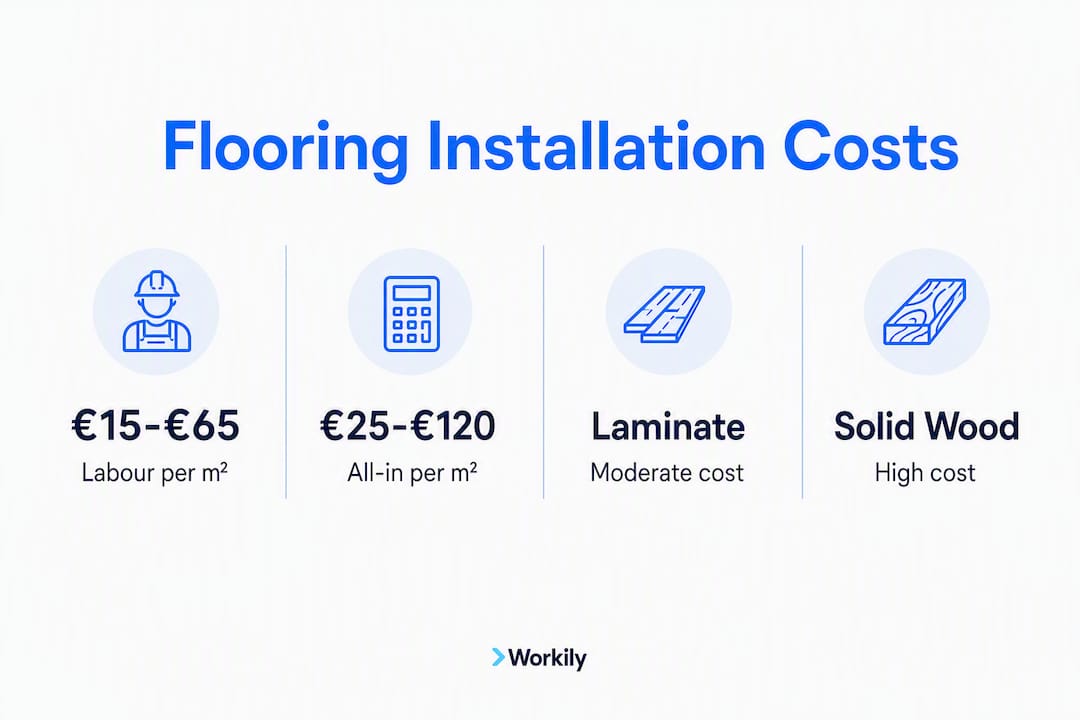
Flooring installation in Ireland costs €15–€65 per m² in labour, with all-in totals of €25–€120 per m² depending on floor type, subfloor condition, and extras that most online estimates exclude.
| Point | Details |
|---|---|
| Labour ranges vary widely | Published Irish rates run €15–€65 per m² depending on floor type and installation method. |
| Extras move the total most | Levelling, DPM, acoustic underlay and disposal are commonly excluded from headline per-m² quotes. |
| Site surveys control the final price | A survey fee of €50–€150 is almost always deductible against the job and prevents mid-project surprises. |
| Get itemised quotes | Any quote must show materials, labour, levelling, disposal, trims, VAT and warranty separately. |
| Workily simplifies booking | Use Workily to compare verified installers, view itemised quotes side by side, and book securely online. |
The case for not skipping the survey
The flooring industry has a pricing transparency problem, and it is not entirely the installer’s fault. A per-m² rate quoted over the phone is not a lie; it is just incomplete. The real cost of a flooring job in an older Irish home, a city-centre apartment with acoustic rules, or a commercial space with heavy subfloor prep is genuinely unknowable without someone standing in the room.
What frustrates homeowners is not the final price. It is discovering that price on day two of a five-day job. The fix is not a better calculator or a lower quote; it is a proper site survey from a professional who will put their name to the number. Platforms that standardise itemised quotes and verify the professionals behind them are not a luxury for large projects. For any job above a single room, they are the sensible starting point.
Book vetted flooring installers through Workily
Getting three comparable quotes used to mean three separate phone calls, three site visits on different days, and three invoices in formats you could not easily compare. Workily cuts that process to a single search.

Search verified flooring installers in your county, request itemised quotes that break out labour, materials, levelling and disposal, and book instantly when you find the right professional. Site-survey fees are visible upfront and can often be offset against the final job cost. For larger commercial projects, Workily Enterprise handles multi-site bookings and contractor management in one place.
Find and book a flooring installer on Workily today.
Useful sources and further reading
| Source | What it covers |
|---|---|
| Irish labour price breakdown — fbsflooring.ie | Per-m² labour ranges and worked cost examples for Irish projects |
| Hidden costs of flooring installation — fbsflooring.ie | Common exclusions: levelling, DPM, disposal, acoustic underlay |
| Herringbone installation cost — fbsflooring.ie | Waste factors, labour complexity and regional price differences |
| Laminate flooring cost guide — Kidd Flooring | Supply and fitted cost comparisons for laminate in Ireland |
| Flooring cost calculator — calcireland.com | Online tool for estimating total cost including materials and wastage |
| Renovation project management guide | Scheduling and staging advice for homeowners managing flooring and wider renovation works |
| Book a flooring installer — Workily | Search, compare and book verified flooring professionals across Ireland |
| Trust & Safety — Workily | How Workily vets professionals and handles guarantees and reviews |
| Workily blog — renovation and trades guides | Further pricing guides, including the interior painter cost guide and related trades |