
Most domestic appliance repairs in Ireland typically cover the call-out fee, labour and basic parts, with common costs falling within a moderate range. For complex faults involving a control board or motor, repair costs can be considerably higher, often reaching several hundred euros. The single most useful rule of thumb: if the repair quote exceeds 50% of what a comparable new appliance costs today, replacement usually makes more financial sense.
A few things to anchor your expectations immediately:
- Which? reports that call-out charges vary by region and can be moderate to quite high before any parts are added.
- AEG’s support guidance describes a flat diagnostic fee plus parts as the standard manufacturer pricing model, with a 12-month warranty on repairs in many cases.
- Workily lets you compare quotes from vetted local engineers instantly, so you are not committing to a single price before you know what the market looks like.
The 50% rule is a starting point, not a verdict. An eight-year-old washing machine with a €90 drain-pump fix is a clear repair. A twelve-year-old fridge needing a €280 compressor replacement, when a new equivalent costs €450, is a much closer call once you factor in energy ratings and the likelihood of another fault arriving soon.
Table of Contents
- Quick facts: averages, call-out norms and appliance lifespans
- Typical repair costs broken down by appliance type
- How call-out fees, labour and parts combine into your final bill
- The most common appliance faults and what they typically cost to fix
- How to decide: the 50% rule, age and energy efficiency
- Manufacturer engineer vs independent technician: who should you call?
- Three worked examples: the repair-vs-replace arithmetic in euro
- How to get reliable quotes quickly
- Does your location in Ireland affect what you pay?
- Key takeaways
- The pragmatic case for calling a local engineer first
- Workily: compare vetted engineers and book same-day in Ireland
Quick facts: averages, call-out norms and appliance lifespans
Before you ring anyone, these numbers give you a working budget and a sense of whether your appliance is worth fixing at all.
- Typical first-visit total (simple fault): €60–€150, often covering the call-out fee and a minor fix resolved on the day.
- Mid-range repair (parts required): €120–€300, covering labour plus a common part such as a door seal, heating element or pump.
- Complex repair (board, motor, compressor): €250–€450 or more.
- Call-out/diagnostic fee: typically €59–€95 in Ireland. The Appliance Man in Dublin publishes standard call-out fees from €59 for freestanding appliances, with higher rates for integrated units.
- Hourly labour rate: most independent engineers charge €60–€90 per hour; manufacturer-authorised engineers often sit at the higher end.
- Siemens lists a flat out-of-warranty call-out fee of €95 on their Irish price list, charged even when no fault is found, with a 12-month warranty on labour and parts fitted.
Average appliance lifespans (useful for the repair-vs-replace decision):
| Appliance | Typical lifespan |
|---|---|
| Washing machine | 10 years |
| Dishwasher | 12 years |
| Fridge/freezer | 12–15 years |
| Tumble dryer | 10 years |
| Microwave | 7–10 years |
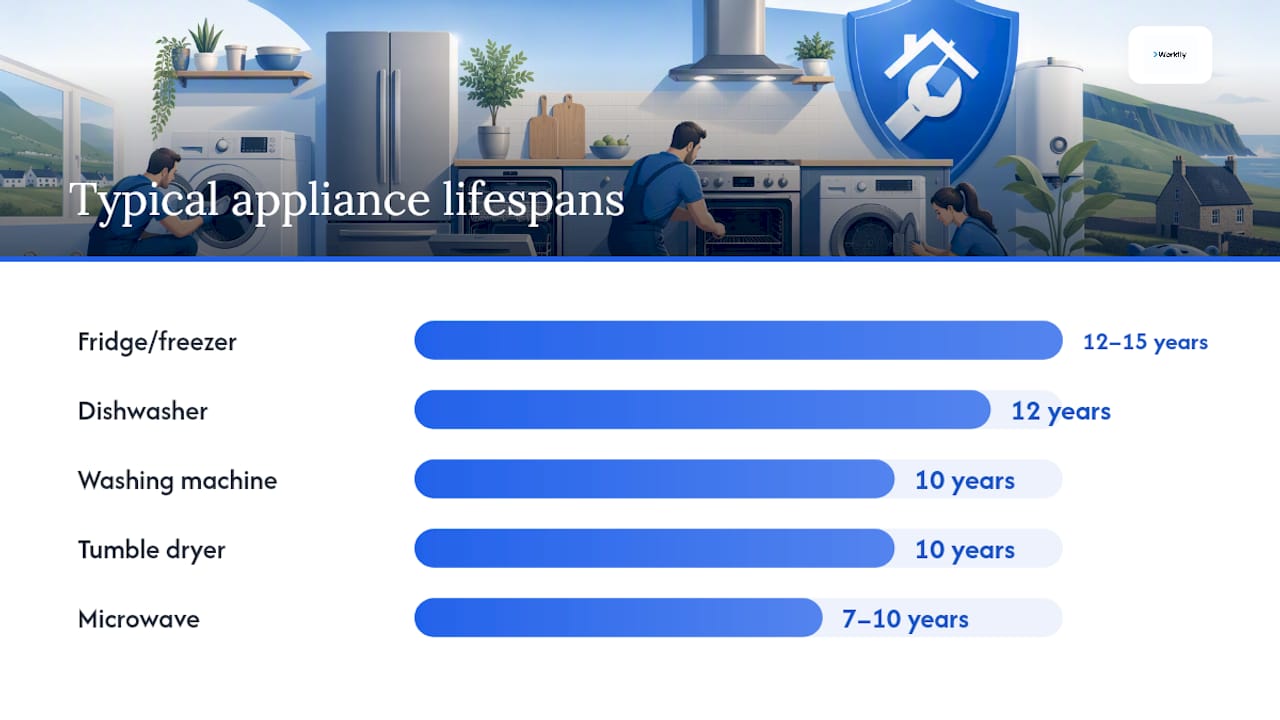
An appliance past two-thirds of its expected lifespan deserves extra scrutiny before you spend on a significant repair.
Typical repair costs broken down by appliance type
The table below gives you a working range for each appliance before you pick up the phone. Figures cover call-out, labour and typical parts for the most common faults.
| Appliance | Typical cost range | Call-out fee | Parts cost band | First-visit fix likely? | Repair cost-effective when… |
|---|---|---|---|---|---|
| Washing machine | €80–€300 | €59–€95 | €20–€150 | Often (pump, filter, seal) | Under 8 years old, fault is mechanical |
| Dishwasher | €80–€280 | €59–€95 | €20–€120 | Often (spray arm, filter) | Under 8 years, not a board fault |
| Fridge/freezer | €90–€300 | €59–€95 | €30–€200 | Sometimes (thermostat, fan) | Under 10 years, compressor intact |
| Oven/cooker | €80–€250 | €59–€95 | €20–€100 | Often (element, thermostat) | Under 10 years, element or thermostat only |
| Tumble dryer | €80–€250 | €59–€95 | €20–€100 | Often (belt, element, sensor) | Under 8 years, not a drum bearing |
| Small appliances | €40–€120 | €40–€60 | €10–€50 | Usually | Only if parts are still available |
Per-appliance notes:
- Washing machine: — Blocked drain pumps and worn door seals are the most common faults and among the cheapest to fix. A failed drum bearing or main PCB board pushes costs toward the upper range.
How call-out fees, labour and parts combine into your final bill
Understanding the billing structure stops you being surprised when the invoice arrives.
The three components of most repair bills:
- Labour: — either a flat fee per repair type or an hourly rate (€60–€90/hour for most independent engineers). Manufacturer-authorised engineers, such as those sent by AEG or Siemens, tend to charge at the higher end and apply a flat diagnostic fee plus parts.
What drives parts costs up:
Older or discontinued models are where repair bills can spiral. When a part is no longer in standard supply, engineers spend additional time sourcing compatible components, and the part itself commands a premium. Control boards and motors for appliances more than ten years old are the most common culprits. Filters, door seals and belts, by contrast, remain cheap and widely available for most brands.
Pro Tip: Ask the engineer whether the call-out fee is deducted from the repair total if you go ahead. Most reputable providers do this as standard, but it is not universal. Confirming upfront avoids a €95 surprise on top of your parts bill.
Understanding unexpected cost drivers is not unique to appliance repair. The same dynamic applies in HVAC emergency repairs, where call-out structure and parts availability shape the final bill just as much as the fault itself.
The most common appliance faults and what they typically cost to fix
Most faults fall into a handful of categories. Knowing which category your problem sits in tells you whether you are looking at a call-out-only bill or a parts-heavy repair.
Washing machine:
- Blocked drain pump or filter: €60–€100 (often cleared at first visit, no parts needed)
- Door lock/interlock failure: €100–€180 (part plus labour)
- Drum bearing failure: €180–€300 (significant labour, usually second visit)
- PCB/control board: €200–€400 (parts cost dominates)
Fridge/freezer:
- Thermostat replacement: €100–€180
- Evaporator fan motor: €120–€200
- Compressor replacement: €250–€450 (often tips toward replacement)
Oven/cooker:
- Heating element: €80–€160 (one of the best-value repairs)
- Thermostat: €100–€180
- Control board: €180–€320
Tumble dryer:
- Drive belt: €80–€140
- Heating element: €90–€160
- Drum bearing: €150–€280
Dishwasher:
- Spray arm or filter blockage: €60–€100 (often first-visit only)
- Door latch: €90–€160
- Circulation pump: €130–€220
A blocked pump filter or a loose hose is frequently resolved in a single visit for little more than the call-out fee. The engineer arrives, clears the blockage, tests the machine and leaves. That scenario keeps the total cost near €60–€95. Parts-heavy repairs, by contrast, almost always require a second visit once the part is ordered, which adds both time and a second labour charge in some billing models.
How to decide: the 50% rule, age and energy efficiency
A common guideline is that when repair costs approach or exceed half the price of a new appliance, replacement is often the better option. Irwins Megastore’s repair-vs-replace guidance applies this rule alongside age, energy rating and repeated-fault history as the key modifiers.
Where the rule works well: a washing machine that cost €600 new, now six years old, with a €90 drain-pump repair quote. The repair is 15% of replacement cost. Fix it.
Where it breaks down: a twelve-year-old fridge needing a €280 compressor repair, when a new A-rated equivalent costs €500. The repair is 56% of replacement cost, the appliance is near end of life, and a new model will cut running costs. Replace it.
The fuller checklist:
- Parts availability: — if the engineer cannot source parts within a week, the appliance may be too old to support economically.
Repair tends to make sense when: the appliance is under eight years old, the fault is mechanical rather than electronic, and the repair cost is below 40% of a new equivalent.
Replacement tends to make sense when: the appliance is past ten years old, the fault involves a compressor, motor or control board, and energy savings from a new model are significant.
Manufacturer engineer vs independent technician: who should you call?
Both routes have genuine merits. The right choice depends on your appliance’s age, warranty status and how quickly you need it fixed.
Manufacturer-authorised engineers (AEG, Siemens, Bosch and similar brands all operate these networks):
- Use genuine OEM parts, which matters for warranty compliance and longevity.
- Typically offer a 12-month warranty on labour and parts fitted, as both AEG and Siemens confirm on their support pages.
- Tend to charge more: flat diagnostic fees of €95 or above are common.
- Wait times can be longer, particularly outside Dublin and other major cities.
Independent engineers:
- Generally charge less, with call-out fees from €59 and hourly rates of €60–€90.
- Often available faster, particularly for same-day or next-day bookings.
- Quality varies, so checking reviews, guarantees and credentials matters more.
- May use compatible (non-OEM) parts, which are usually fine for older appliances but worth clarifying.
Questions to ask before you book any engineer:
- Is the call-out fee deducted if I proceed with the repair?
- Do you provide a written quote before starting work?
- What guarantee do you offer on parts and labour?
- Are you using genuine manufacturer parts or compatible alternatives?
- What happens if the same fault recurs within the guarantee period?
Red flags: no written estimate before work begins; pressure to replace parts without completing a diagnosis first; an unusually low up-front price with vague terms about additional charges.
Three worked examples: the repair-vs-replace arithmetic in euro
These scenarios use realistic Irish pricing to show how the maths plays out.
Example 1: Blocked drain pump, washing machine
- Appliance: 5-year-old freestanding washing machine, replacement cost approximately €550.
- Fault: blocked drain pump filter, cleared on first visit.
- Bill: call-out fee €75, no parts required. Total: €75.
- As a percentage of replacement cost: 14%. Clear repair decision.
Example 2: Door-lock replacement, washing machine
- Appliance: 7-year-old washing machine, replacement cost approximately €550.
- Fault: door interlock failure. Part: €55. Labour (including call-out): €120. Total: €175.
- As a percentage of replacement cost: 32%. Repair makes sense; appliance has years of life remaining.
Example 3: Failed control board, washing machine
- Appliance: 11-year-old washing machine, replacement cost approximately €500 for a comparable new model.
- Fault: main PCB board failure. Part: €180. Labour and call-out: €130. Total: €310.
- As a percentage of replacement cost: 62%. Past the 50% threshold, appliance near end of life. Replacement is the stronger choice.
Assumptions: replacement prices are mid-range new appliance costs in Ireland in 2026. Labour figures use typical independent-engineer rates.
Pro Tip: Always ask the engineer to confirm the fault in writing before ordering parts. A misdiagnosis that leads to an unnecessary part being ordered is more common than it should be, and not all engineers will absorb that cost.
How to get reliable quotes quickly
The headline ranges in this guide draw on manufacturer support pages, consumer-group data and Irish provider pricing. Which?’s domestic appliance repair guidance and RegionalBulletin’s repair cost overview both converge on average first-visit costs in the €60–€150 range for common faults, with more complex repairs pushing into the mid-hundreds.
Practical steps before you book:
- Check whether your appliance is still under manufacturer warranty. If it is, contact the manufacturer directly; the repair is free.
- For out-of-warranty repairs, get at least two written quotes before committing.
- Verify the engineer’s guarantee: a minimum of 12 months on parts and labour is standard from reputable providers.
- Confirm the call-out fee policy in writing before the engineer arrives.
- Check reviews on independent platforms rather than relying solely on the engineer’s own website.
Getting multiple quotes is the single most effective way to avoid overpaying. Price variation between engineers for the same fault can be €50–€100 on a straightforward repair, and more on complex jobs.
Pro Tip: If you are unsure whether a fault is worth diagnosing at all, Workily’s Ask a Pro feature lets you consult a vetted tradesperson by video before committing to an on-site call-out. A ten-minute conversation can tell you whether the repair is likely to be simple or complex.
Does your location in Ireland affect what you pay?
Yes, and sometimes significantly. Engineers in Dublin, Cork, Galway and Limerick operate in competitive markets with many providers, which tends to keep prices closer to the lower end of the ranges in this guide. Rural areas face a different dynamic.
In counties like Donegal, Mayo, Roscommon or Kerry, the pool of local engineers is smaller. Some providers apply a travel surcharge for locations outside their standard service radius, adding €20–€50 to the call-out fee. Parts delivery times can also be longer, which extends the overall repair timeline and occasionally adds a second labour charge for the return visit.
The practical implication: if you are outside a major urban centre, getting three quotes rather than two is worth the extra effort. A vetted platform that shows you local engineers with published pricing and reviews removes most of the guesswork, regardless of where in Ireland you are.
Key takeaways
Most appliance repairs in Ireland cost between €60 and €300, and applying the 50% rule alongside appliance age and energy rating gives you a reliable framework for deciding whether to repair or replace.
| Point | Details |
|---|---|
| Headline cost range | Most Irish appliance repairs fall between €60 and €300; complex faults can reach €250–€450 or more. |
| Call-out fee structure | Typical call-out fees run €59–€95; confirm whether this is deducted from the repair total before booking. |
| 50% rule with caveats | If the repair quote exceeds 50% of a comparable new appliance, factor in age, energy rating and parts availability before deciding. |
| Get multiple quotes | Price variation between engineers for the same fault can be €50–€100; always get at least two written quotes. |
| Use Workily | Workily lets you compare vetted local engineers with published pricing and book instantly, including same-day service. |
The pragmatic case for calling a local engineer first
The repair-vs-replace decision looks complicated on paper, but in practice it almost always starts the same way: get a diagnosis. You cannot apply the 50% rule without knowing what the fault actually is and what it will cost to fix. A written quote from a vetted local engineer gives you that number in an hour, and in a surprising number of cases the fault turns out to be something simple cleared on the first visit.
The mistake most people make is either replacing an appliance that had a €90 fix in it, or committing to a repair on a machine that was already past its useful life. Neither is a good outcome. The diagnosis is cheap relative to both errors.
Checking credentials, guarantee terms and the call-out fee policy before booking takes five minutes and eliminates most of the risk. For anyone outside Dublin or another major city, comparing at least three local engineers before committing is worth the extra step.
Workily: compare vetted engineers and book same-day in Ireland
Spending an afternoon ringing individual engineers, chasing written quotes and checking reviews separately is the slow way to handle an appliance repair. Workily gives you a faster route: compare verified local professionals with published pricing, read genuine customer reviews, and book a pro instantly without the back-and-forth.

Every professional on Workily goes through a vetting process before appearing on the platform, and the trust and safety standards mean you can see guarantees and credentials before you commit. If you want a quick triage before booking an on-site visit, the Ask a Pro video consultation lets you describe the fault to a tradesperson and get an honest steer on whether it is worth repairing.
Whether you need a same-day call-out in Dublin or want to compare quotes across Galway, Cork or Limerick, find a local appliance engineer on Workily and get your first quotes today.