


Stop researching and start testing: pick one realistic career option and commit to an eight-week trial with a defined next step, whether that’s three informational interviews, a short course, or a proof-of-work project. This beats both mass-applying and endless self-reflection because it produces evidence, not opinions. The sections below cover the self-assessment and job-search tactics that make that test worth running.
TL;DR:
- Focusing on short-term experiments, such as informational interviews or small projects, helps clarify career direction more effectively than endless reflection or mass applications.
- Prioritizing targeted job searches through networking, referrals, and a focused shortlist yields higher interview success than submitting many broad, unpersonalized applications.
- Setting specific review points within eight to twenty-four weeks and having clear “switch” indicators increases the chances of a successful career pivot or transition.
- Building career habits with small, trackable actions over 66 days establishes long-term skills and networks that simplify future moves.
- Seeking targeted professional advice through short, focused consultations can clarify uncertainties faster than traditional coaching or extensive research.
Table of Contents
- Career advice for people who don’t know where to start: a quick self-assessment
- Researching career options without drowning in noise
- Turning research into a decision you can act on
- Job search tips that actually produce interviews
- Writing a CV and cover letter that show impact, not just duties
- Interview preparation and negotiating your offer
- Building career habits that actually stick
- When professional career coaching is worth paying for
- Building and leveraging professional mentorship
- Navigating career changes and transitions
- Work-life balance and mental health in career planning
- An author’s checklist for the first 30 days
- Getting a straight answer, fast: what Workily actually does for career decisions
- Sources
Career advice for people who don’t know where to start: a quick self-assessment
Most career confusion comes from skipping the diagnosis and jumping straight to job boards. A useful framework distinguishes three phases: exploration (you’re testing what fits), development (you know the direction and need skills or credentials), and deployment (you have both and need traction). Spotting your phase, a structure 80,000 Hours uses in its own career planning, changes what “good advice” even means for you.
Three exercises help you move fast:
- Skills audit: list five things you’re better at than most colleagues, verified by actual feedback, not guesswork.
- Values filter: rank autonomy, income, security, and impact, then check your current role against that order.
- Constraint map: note money, location, and caring responsibilities that are genuinely fixed for the next year.
Pro Tip: Turn each exercise into one testable action within a week, such as messaging two people in a target field or blocking three hours to trial a task from the job you’re considering.
Researching career options without drowning in noise
Reliable labour-market signals beat vague hunches. Start with sector reports, recruiter job boards showing live vacancy volumes, and salary data from recruitment agencies operating in your sector, then triangulate with people actually doing the job.
- Run three informational interviews. Ask what a typical week looks like and what skill gap catches people out.
- Shadow or volunteer for a day if the sector allows it. A single afternoon often reveals more than ten job descriptions.
- Take one cheap, short course relevant to the role before committing months of study.
- Prioritise by learning speed, skill overlap, and demand. A path that reuses 70% of your current skills and shows steady hiring beats a total reinvention with patchy vacancy data.
Turning research into a decision you can act on
Indecision is the expensive option. Treat career choices the way you’d treat any uncertain investment: list your key uncertainties, rate the factors that matter (income, growth, flexibility, enjoyment), and name a Plan A and a Plan B before you move.
- Score each option out of ten against your top three priorities from the self-assessment.
- Identify the single biggest unknown (Will I enjoy the daily work? Is demand real in my region?) and design a cheap test to resolve it.
- Set a review point eight to twenty-four weeks out, not “eventually.”
- Decide in advance what “switch” looks like: two failed interview loops, a skills gap you can’t close in three months, or a values mismatch that shows up in week one.
Pro Tip: Write your review date in your calendar now, with the question you’re answering. “Have I had three interviews from targeted outreach by 15 April?” is a decision point; “see how things go” is not.
Career planning works better as a loop of short experiments than a single five-year plan, an approach Talentfinder’s Irish hiring data supports when it comes to how long roles actually take to fill. Review, adjust, repeat.
Job search tips that actually produce interviews
Mass-applying to job boards is one of the least efficient uses of your time right now. CNN Business reports that today’s market is among the toughest in decades, and the advice from recruiters is consistent: prioritise fewer, better-matched roles and lean on warm introductions rather than blind applications.
- Build a shortlist of fifteen to twenty target companies, not a spreadsheet of every live vacancy.
- Ask for introductions before you apply. Referrals and targeted networking consistently produce higher interview rates than cold applications.
- Create a short proof-of-work, a one-page case study, a small project, or a portfolio link, and reference it directly in outreach messages.
- Track every application in a simple spreadsheet: channel, date, response, interview, outcome. Drop any channel that isn’t converting after three to four weeks.
Hiring cycles have also lengthened, and AI-driven applicant filtering means generic applications get screened out before a human sees them. Demonstrable skills now carry more weight than a long list of past titles.
Writing a CV and cover letter that show impact, not just duties
Recruiters skim CVs in seconds, and a list of responsibilities tells them nothing about whether you’re good on the job. Every bullet point should follow a situation, action, result structure, with a number attached wherever one exists.
- Weak: “Responsible for managing client accounts.”
- Strong: “Managed 40 client accounts, cutting response time from 48 hours to 6 through a new triage system.”
If your work doesn’t produce obvious metrics, quantify scale or frequency instead. “Trained 12 new starters across two branches” still proves impact without a sales figure attached. For the cover letter, skip the summary of your CV and tell one short story: a specific problem you solved that mirrors what this employer needs solved. One paragraph, one proof point, no padding.
Interview preparation and negotiating your offer
Preparation should map to the actual role, not generic question banks. Pull the job description apart into three or four core responsibilities, then prepare one behavioural story for each using situation, action, result.
- Map the role and match your stories to its named responsibilities, not your career history in general.
- Rehearse out loud, ideally with someone else asking follow-up questions, since reading answers silently hides gaps.
- Verify the vacancy is genuine before investing serious prep time: a real interviewer with a LinkedIn history, a company with an active website, and a role that matches the advertised salary band are basic checks worth thirty seconds each.
- Prepare for technical demos if the role involves one, and bring your own example rather than relying on generic templates.
When an offer lands, don’t accept on the spot. A short script covers it: “Thank you, I’m genuinely interested. Could I have until [date] to review the full package?” Most employers expect this and it costs you nothing.
Building career habits that actually stick
Development goals fail most often because they’re outcome-only: “get better at public speaking” has no obvious Tuesday action. Implementation intentions fix this by tying a behaviour to a specific cue, “after my Monday stand-up, I’ll spend fifteen minutes on X.”
- Pick one starter behaviour small enough that skipping it feels obviously wrong.
- Protect it for roughly 66 days, the rough window habit research suggests a routine needs to become automatic.
- Track it somewhere visible, a wall calendar, an app, a shared note with a colleague who checks in.
Pro Tip: Anchor the habit to something you already do daily. “After lunch” is a stronger trigger than “sometime this week.”
These micro-habits compound into what career researchers call career capital, the skills, network, and reputation that make your next move easier than this one.
When professional career coaching is worth paying for
Paid help earns its cost when you’ve hit a specific wall: you’re stuck between two genuinely viable paths, you’ve had five interviews with no offers and can’t diagnose why, or a transition needs specialist knowledge you can’t get free. If you’re still in general exploration, a paid coach is often premature; the self-assessment steps above cost nothing.
Before booking anyone, ask:
- What will I have by the end of this session, a document, a decision, a referral?
- How do you measure whether this worked?
- Can I book a single trial session before committing to a package?
Workily’s Ask a Pro feature lets you book a short, paid video consultation with a vetted professional for exactly this kind of targeted question, without signing up for a lengthy coaching programme first.
Building and leveraging professional mentorship
A mentor isn’t someone senior who occasionally has coffee with you. The useful version is narrower: someone one or two steps ahead who can answer a specific question you can’t resolve alone, “how do I position a career gap,” “what does the next level actually require,” “who should I be talking to in this sector.”
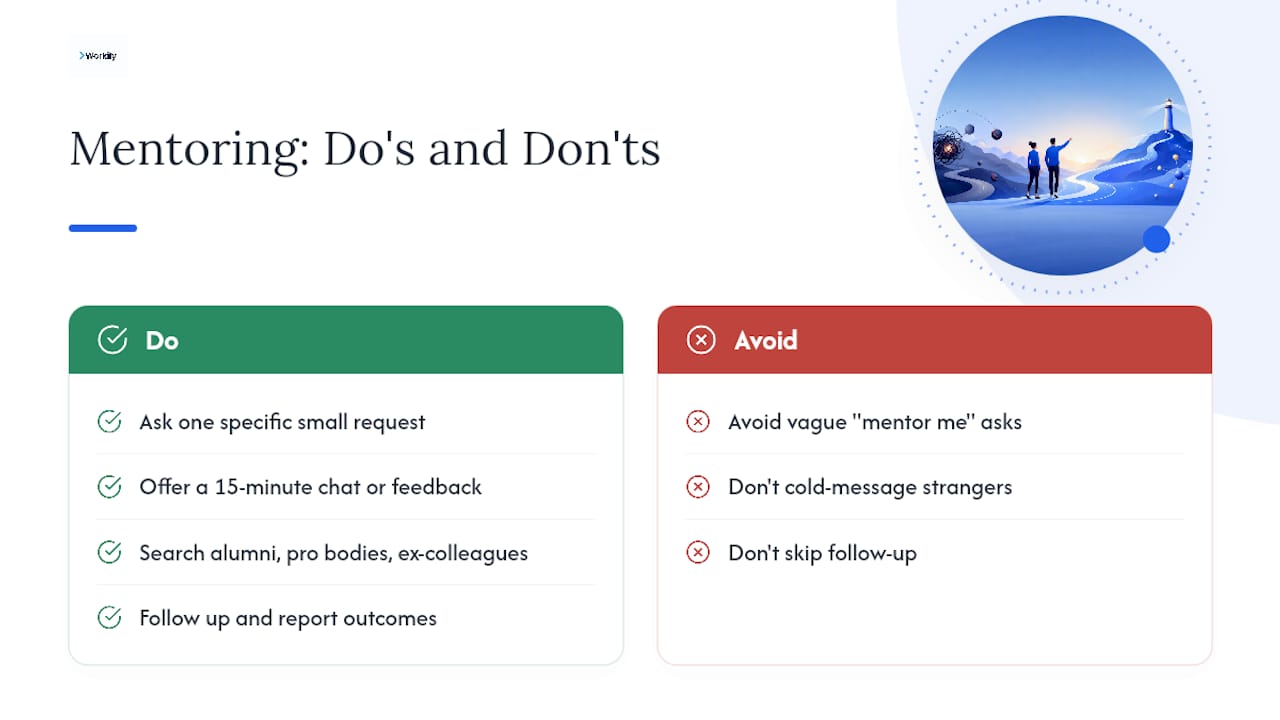
Finding one starts with specificity. Instead of messaging “would you mentor me,” ask for one thing: fifteen minutes to discuss how they made a particular transition, or feedback on a document. A concrete, small ask gets answered far more often than an open-ended one, and it often becomes an ongoing relationship once the first exchange proves useful to both sides.
Look in three places most people overlook: alumni networks from your course or previous employer, professional bodies in your sector (many run formal mentoring schemes at low or no cost), and people you’ve already worked alongside who moved on to where you want to go. LinkedIn works too, but a warm connection through a mutual contact converts into a real conversation far more often than a cold message to a stranger.
Once you have a mentor, the relationship needs maintenance to stay useful. Come to each conversation with one specific question, not a general life update. Follow up on their advice and tell them what happened, since mentors stay engaged when they can see their input mattered. And be willing to reciprocate where you can, an introduction, a piece of information, even just genuine thanks. The best mentoring relationships aren’t transactional, but they aren’t one-way either.
Navigating career changes and transitions
Most people overestimate how much a career change requires starting from zero. IMD’s research on career pivots makes a specific point here: successful transitions usually involve tweaking a path around skills and values you already have, rather than discarding everything and beginning again.
Before you frame a move as a full reinvention, ask what genuinely transfers. Someone leaving retail management for a trades business rarely needs to relearn how to manage staff, budget stock, or handle difficult customers, they need the technical certification layered on top of skills they already have. The mistake is treating the whole self as obsolete when usually only a slice of it is.
Timing matters more than people admit. A transition attempted while you’re burnt out in your current role tends to produce panicked decisions, taking the first offer rather than the right one. Where possible, build the transition alongside your current job: the short course, the informational interviews, the small paid project on the side, before you resign. This also gives you a genuine test of the new direction before you’ve burned your income.
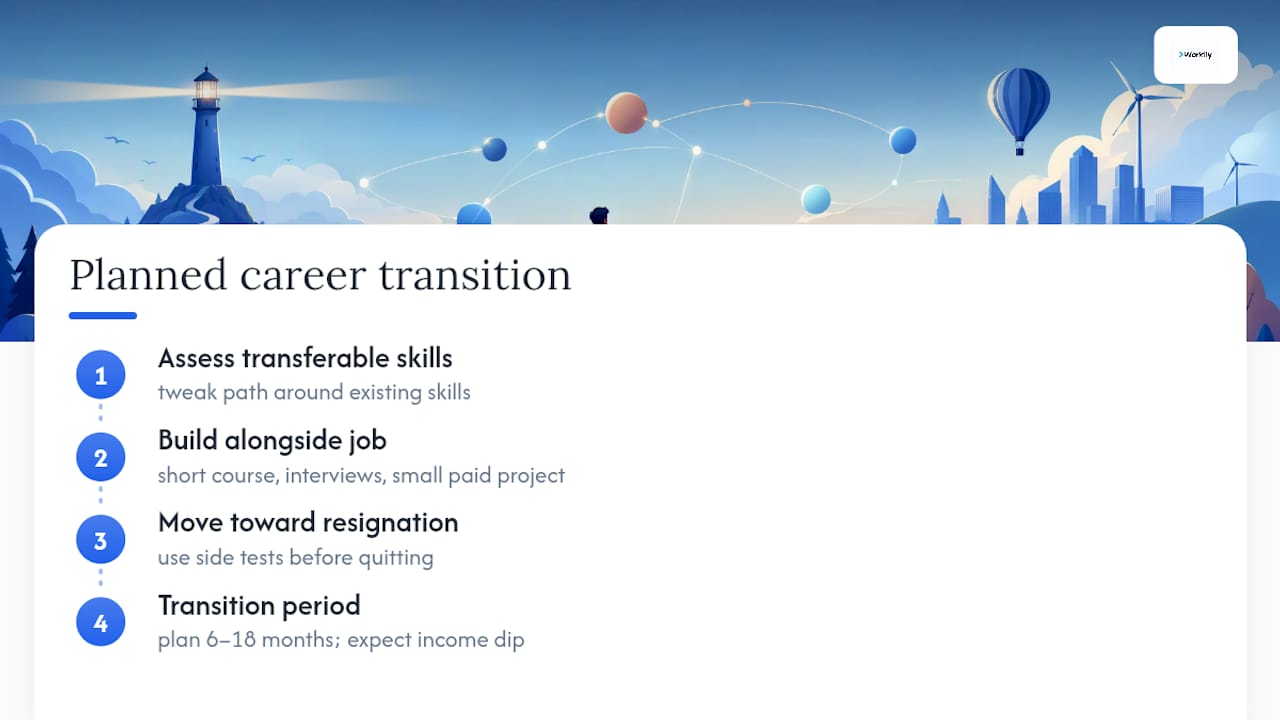
Expect an income or status dip during the switch itself, particularly if you’re moving into a genuinely new sector rather than a lateral shift. Plan for it financially rather than being surprised by it, and set a realistic timeline (six to eighteen months is typical, not six weeks) for the transition to fully land. Rushing this stage is where most transitions stall, not the decision to change in the first place.
Work-life balance and mental health in career planning
Career decisions made from exhaustion tend to be bad ones. If you’re currently burnt out, the honest first step often isn’t a new job at all, it’s addressing the burnout, because the same patterns that caused it will likely follow you into the next role if left unexamined.
That said, a job search itself carries its own strain: rejection, waiting, comparing yourself to peers who seem to be moving faster. Protecting your wellbeing during the process isn’t separate from the career strategy, it’s part of what makes the strategy sustainable. Set boundaries on how much time each week goes to the search, cap it rather than letting it expand into every evening, and protect at least one activity that has nothing to do with your career.
Values matter here as much as tactics. If your self-assessment flagged autonomy or family time as a top priority, don’t take a role that maximises salary at the expense of both and expect satisfaction to follow. Mismatches between stated values and actual choices are a common source of the “I got the job and I’m still unhappy” pattern people report a year into a new role.
If the search is affecting your sleep, mood, or relationships beyond what feels manageable, that’s worth addressing directly, through a GP, a counsellor, or a support line, rather than pushing through and hoping the right offer fixes it. A career move rarely solves a mental health problem on its own, and expecting it to puts unfair pressure on the decision.
An author’s checklist for the first 30 days
Here’s the checklist I actually use with people starting a search or a pivot. Run through it in order:
- Identify your phase (exploration, development, deployment).
- Complete the skills audit, values filter, and constraint map.
- Draft one testable next step for this week.
- Shortlist 15 target companies or roles.
- Book three informational interviews.
- Build one proof-of-work piece.
- Rewrite your top five CV bullets using situation, action, result.
- Set a review date eight weeks out.
- Choose one habit to anchor and track daily.
- Decide your quit/commit rule before you need it.
Pick item one and do it today, not this weekend.
— Thomas
Getting a straight answer, fast: what Workily actually does for career decisions
Most of the advice above works better with a second opinion, and getting one usually means weeks of chasing recommendations or booking a coach you can’t easily cancel on. You can book a vetted professional through Ask a Pro for a focused fifteen to thirty minute video consultation on a specific question, no lengthy sign-up, no ongoing commitment.
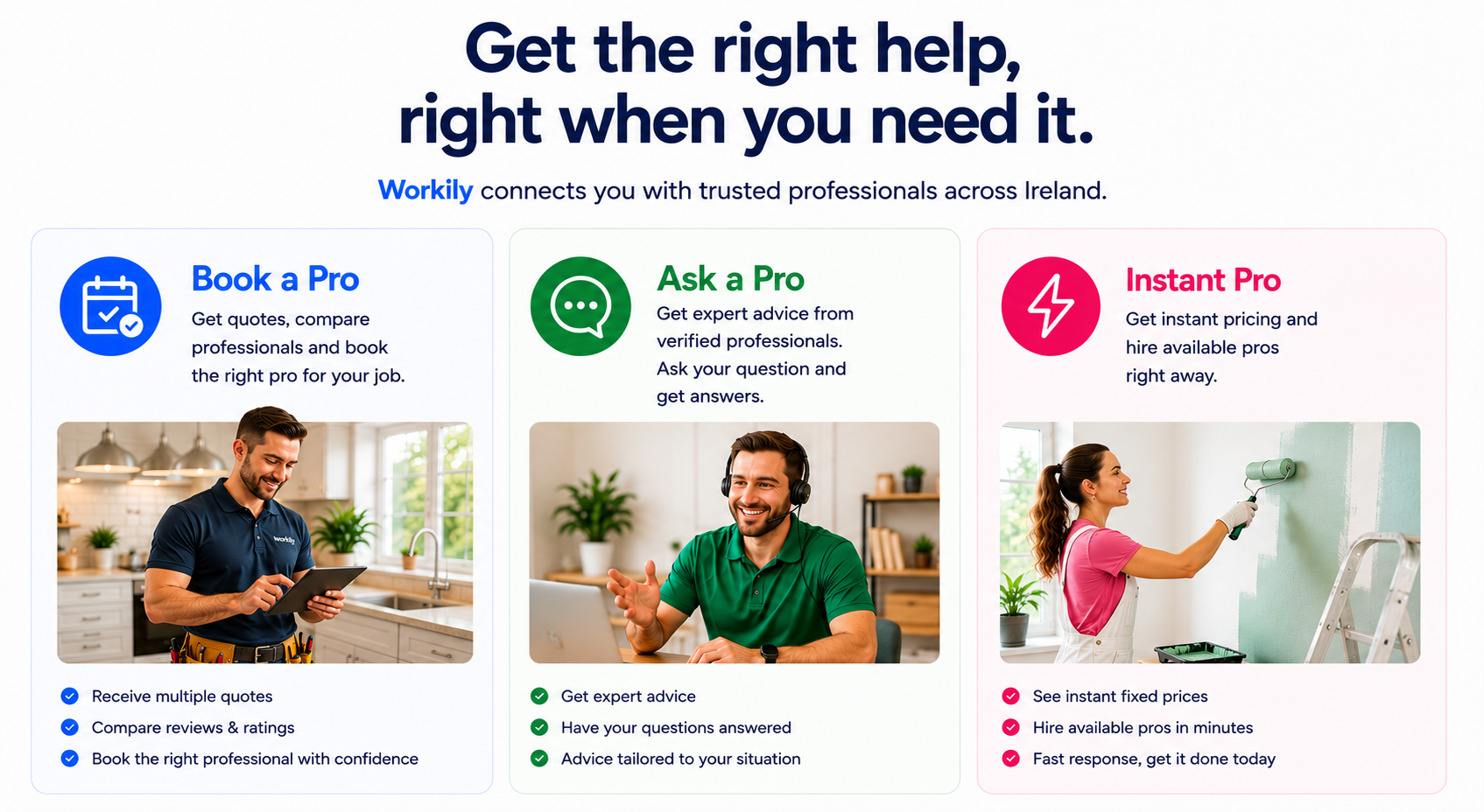
If you’re weighing a transition into trades or home services, comparing quotes from a few professionals before you commit gives you a realistic sense of demand and pricing in your area, useful whether you’re job-hunting in that sector or hiring someone yourself. Professionals considering the switch can also review what joining Workily as a service provider actually involves before deciding it’s the right route.
Start small: book one Ask a Pro session this week, bring your single biggest uncertainty, and use the answer to decide your next concrete step. That’s the whole method; test, review, act.