


A platform service fee is a mandatory commission or charge that an online marketplace adds to a booking or sale to cover payments, vetting, support and insurance. It applies whether the buyer is happy about it or not, unlike a tip, and it either shaves the merchant’s net take or adds to the customer’s final total. Understanding how it’s built matters if you’re pricing a service or budgeting a purchase.
TL;DR:
- Most platform fees are based on a percentage of the sale, a flat rate per booking, or a combination of both, affecting different transaction sizes differently.
- Fees are typically disclosed as separate, itemized charges before payment confirmation, and should never be labeled as tips to ensure legal compliance.
- Settlement can be gross or net, with gross settlement giving the platform more control and responsibility, while net settlement directly transfers payouts to professionals.
- Reducing fees to attract customers often undermines vetting budgets, which are essential for marketplace reputation and safety.
- Choosing and clearly communicating a fee structure that is transparent and aligns with customer understanding is key to long-term trust and compliance.
Table of Contents
- What is a platform service fee, and why does it exist?
- How are platform service fees calculated?
- What are the common platform fee models?
- How does the fee stack work, and who actually pays?
- Why do labelling and disclosure carry legal weight?
- How should merchants set and communicate their fees?
- How does Workily justify its platform fee?
- What decision makers get wrong about fees
- Book vetted professionals through Workily
- Sources
- FAQ
What is a platform service fee, and why does it exist?
A platform service fee funds the infrastructure sitting behind every booking: secure payment handling, background checks on professionals, customer support when something goes wrong, and often a layer of insurance or dispute cover. None of that is free to run, so the fee is how the platform pays for it.
That fee is fundamentally different from a tip. A tip is voluntary and goes to the person who did the work. A service fee is fixed by the platform, applied automatically, and counted as company revenue, which means it’s usually taxable income for the business collecting it, as Toast’s breakdown of service charges explains.
What a typical fee funds:
- Payment processing and fraud protection
- Vetting and background checks on professionals
- Customer support and dispute resolution
- Insurance or guarantee cover on completed jobs
- Platform maintenance, including the booking technology itself
How are platform service fees calculated?
Most fees follow one of three formulas. None of them are complicated once you see the numbers side by side.
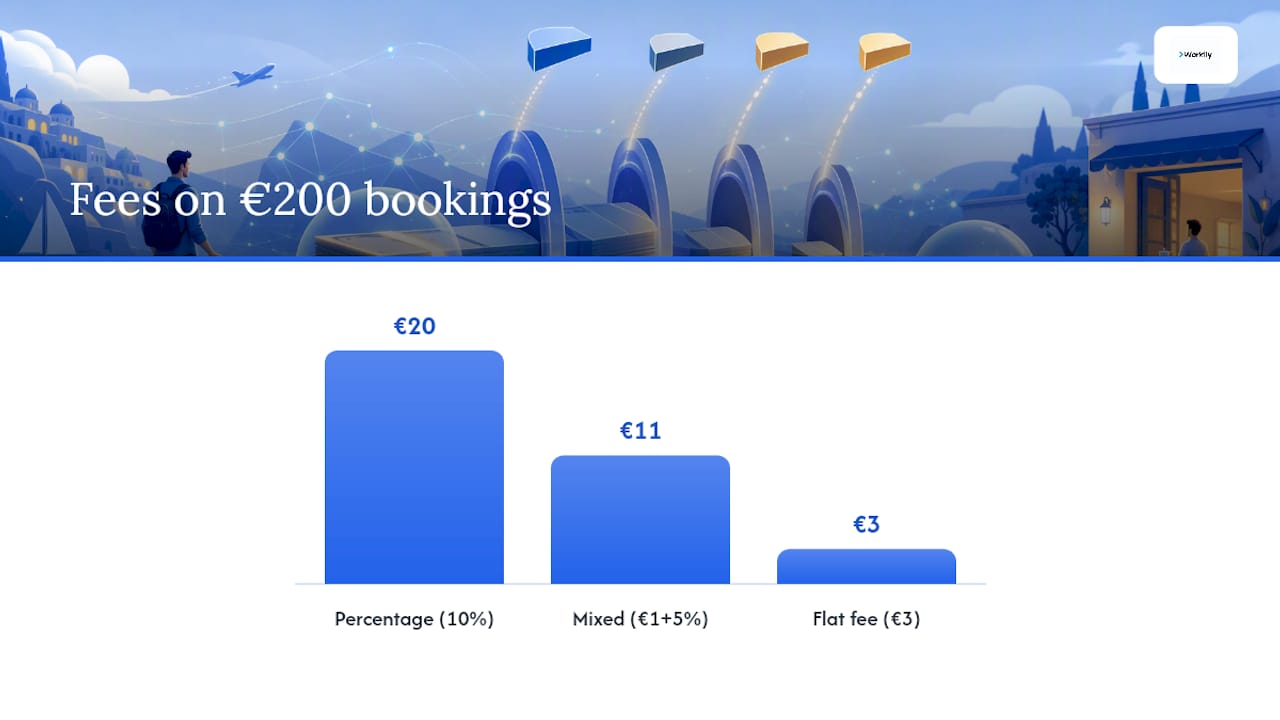
- Percentage of sale. A fee of 10% on a €50 booking is €5; on a €200 booking it’s €20. The fee scales with the job, so bigger transactions cost more in cash terms even though the rate stays fixed.
- Flat fee per booking. A fixed charge, say €3, applies regardless of job size. On a €50 job that’s 6% of the total; on a €200 job it’s just 1.5%, so flat fees favour higher-value transactions.
- Mixed model. A small flat fee plus a lower percentage, for example €1 plus 5%. On €50 that’s €3.50; on €200 that’s €11.
Fee example: Creator platforms such as Patreon charge between 5% and 12% depending on the plan tier, showing how far percentage fees can vary even within one platform.
Whichever model you use, VAT treatment needs sorting before launch: decide whether the displayed fee is VAT inclusive, round consistently (always round the final line, not each component), and show the fee as its own entry on the receipt rather than folding it into the headline price.
What are the common platform fee models?
Marketplaces tend to settle on one of a handful of pricing structures, and each suits a different kind of business.
- Commission on sale. Typically 5% to 20% of the transaction value, common on service marketplaces and creator platforms where the platform actively drives the sale.
- Application fee or markup on processing. The platform adds a small margin on top of raw card processing costs, often 1% to 3%, using tools like Stripe’s platform pricing tools to automate the split between platform and payment processor.
- Subscription or metered tiers. Professionals pay a fixed monthly fee for a set number of leads or features, with usage-based overage charges if they exceed the cap. Intuit’s developer documentation notes these metered programmes often carry hard limits, so overage rules deserve a close read before signing up.
- Per-booking flat charge. A set fee added at checkout, popular with instant-booking services where job values vary widely.
A SaaS tool like Mistree’s tiered pricing page is a useful illustration of how metered plans structure their limits, even outside the home services space.
How does the fee stack work, and who actually pays?
A single checkout total usually hides several separate charges stacked on top of each other. Breaking them apart is the only way to understand who benefits from each line.
- Platform fee — the marketplace’s own commission for running the service.
- Payment processing fee — the cost of moving money securely, paid to a processor like Stripe.
- Delivery or fulfilment fee — covers logistics where physical goods or on-site visits are involved.
- Taxes — VAT or other statutory charges, calculated on top of the net price.
Settlement structure decides who feels these costs first. In gross settlement, the platform collects the full amount and pays the professional afterwards, taking on more control over reporting but also becoming responsible for refunds and tax handling, as Stripe’s Connect documentation sets out. In net settlement, the professional receives their share directly, with the platform’s fee deducted before it lands.
Pro Tip: Show the platform fee, processing fee and taxes as separate lines rather than one bundled “service charge”. Customers dispute fees they can’t see broken down, but rarely question ones they can trace to a specific cost.
Why do labelling and disclosure carry legal weight?
Calling a mandatory charge a “tip” when it isn’t one creates real exposure, not just a wording problem. Regulators and courts generally apply something close to a four-factor test: is the charge optional, is the amount decided by the customer, is it presented separately from the bill, and does the customer control who receives it? A mandatory platform fee fails every one of those tests, which means it cannot legally be marketed as a gratuity.
The consequence goes beyond semantics. Money labelled a tip is usually treated as belonging to the worker; money labelled a service fee is business revenue, which changes payroll obligations and tax treatment, as Toast’s guide to service charges details. Get the label wrong and a platform can face back-payroll liabilities as well as customer complaints.
- Disclose the fee amount before the customer confirms payment, not after
- Use one consistent name for the charge across the app, invoice and receipt
- Never call a mandatory fee a “tip” or “gratuity”
How should merchants set and communicate their fees?
Getting a fee policy right is less about picking the “correct” percentage and more about testing whether customers understand and accept it.
- Choose a model. Decide between percentage, flat, or mixed based on your typical job value and how much variation there is between small and large bookings.
- Model sample pricing. Run the formula against your three or four most common job sizes before locking anything in, using real €50 to €500 examples rather than guesswork.
- Decide who pays. Work out whether the fee sits on top of the price for the customer or comes out of the professional’s payout, and be consistent.
- Disclose and test. Add clear wording at checkout, such as “Includes a €3.50 platform service fee covering payment processing, vetting and support,” then watch for drop-off or complaints and adjust.
Pro Tip: Ask your payments provider three direct questions before signing: is VAT included in the fee I set, when does settlement actually land in the professional’s account, and who’s liable if a payout fails and needs reversing? Stripe’s documentation on application fees notes that fees can be refunded automatically if a payout doesn’t go through, which is worth checking against your own provider’s terms.
A clear checkout page matters here too. Partner examples like HarbourSide Digital’s pricing page show how a business can present tiered charges without burying the customer in fine print.
How does Workily justify its platform fee?
Workily connects homeowners and business owners in Ireland with vetted professionals across trades, cleaning, wellness and business support, with an instant booking feature for same-day service. The fee behind that convenience funds the vetting and trust process that screens every professional before they’re allowed to take a job, plus the support team handling disputes when a booking doesn’t go to plan. Professionals looking at joining the platform can see exactly how those costs map to the leads and booking tools they get access to.
What decision makers get wrong about fees
Cutting the fee to win customers rarely works long term. It usually means less budget for vetting, which is the one thing that actually protects a marketplace’s reputation when something goes wrong. Transparency, not the lowest possible rate, is what keeps customers from disputing a charge they can already see broken down on the receipt. If you’re setting a fee policy, protect the vetting budget before you protect the headline price.
— Thomas
Book vetted professionals through Workily
Workily is the practical answer to everything covered above: a fee structure built around real vetting, instant booking and dispute support rather than a bare-bones commission with nothing behind it.

Every line item explained in this guide, payment processing, professional vetting, customer support, has a direct match inside Workily’s platform. When you book a professional through Workily, the fee you see at checkout is covering exactly those services, disclosed upfront rather than buried in the final total. Homeowners and business owners can compare quotes from multiple vetted professionals before committing, and professionals can join the platform to see how the fee structure supports their own leads and payouts. Businesses managing larger volumes can also look at Workily Enterprise for a setup built around ongoing professional services needs. Head to Workily’s booking page to see current professionals available near you and get a same-day quote.
Sources
- Creator fees overview — Patreon support
- Platform pricing tool — Stripe documentation
- Pricing information | Stripe Connect
- Service charge vs tip — Toast blog
FAQ
What is a platform service fee?
A platform service fee is a mandatory charge added by an online marketplace to cover payment processing, vetting, support and other operational costs. It’s set by the platform, not the customer, which separates it legally from a voluntary tip.
Is it necessary to pay the platform fee?
Yes, if you’re using the marketplace to complete the transaction, the fee is mandatory and non-negotiable, unlike a tip which the customer can adjust or skip. It’s usually disclosed at checkout before you confirm payment.
What are examples of platform fees?
Examples include commission on a sale (5% to 20% on many service marketplaces), a flat per-booking charge, or a small markup on payment processing costs. Subscription platforms often charge professionals a monthly fee for lead access instead.
What is the average platform fee?
There’s no single average because fees vary widely by industry and model, but percentage-based fees on creator and service marketplaces commonly range from 5% to 12%. Flat and mixed fees vary more by job value, so it’s worth checking the specific platform’s fee schedule.
What’s the difference between a service fee and a tip?
A service fee is mandatory, set by the platform, and counted as business revenue for tax purposes. A tip is voluntary, decided by the customer, and typically belongs to the worker rather than the company.
Does a platform fee include VAT?
That depends entirely on how the platform presents its pricing, so check whether the displayed fee is VAT inclusive before assuming either way. Consistent, clear labelling on the receipt is the only reliable way to tell.
How does Workily’s platform fee work?
The platform’s fee structure supports the vetting, instant booking and support systems that connect homeowners and business owners with checked professionals. Details on how those services are delivered are outlined on Workily’s trust and safety page.