


Electricians in Ireland typically earn within a broad range per year, with a national survey average reported around the mid‑€50,000s according to Indeed’s salary data. Hourly, the AECI hourly-rate tables set the qualified electrician floor at €26.17 for a first-year out of time, rising through subsequent years of experience. Apprentices start considerably lower, from around €9.16 in year one up to €20.94 by year four.
Three figures worth bookmarking before you request a single quote:
- Average annual salary (Indeed, 781 salaries): €54,791
- AECI hourly floor, 1st year qualified: €26.17/hr
- Apprentice hourly band: €9.16 (year 1) to €20.94 (year 4)
These are wage figures, not what you will see on an invoice. Your actual quote will be higher once materials, overheads, VAT, and contractor margin are added.
Pro Tip: Request at least three itemised quotes before committing to any electrician. On Workily, you can compare verified professionals side by side, check certifications such as Solar PV or industrial systems, and book the same day.
Table of Contents
- How much do electricians earn in Ireland?
- Employed electrician versus self-employed contractor: what changes for you
- How to get accurate quotes and hire an electrician safely
- Workily is Ireland’s top-rated way to find verified electricians
- Key takeaways
How much do electricians earn in Ireland?
The band cited across salary surveys provides a general starting point, but it flattens a lot of variation. A newly qualified electrician working for a residential contractor in Roscommon earns considerably less than a specialist with Solar PV certification working on commercial projects in Dublin or Cork.

Glassdoor’s data puts the median salary around the low €50,000s, with a range covering lower and higher earners. Jobted reports an average that converts roughly to €23.81 per hour and €49,524 annually. The variance between platforms reflects different sample sizes and whether overtime, bonuses, and allowances are included.
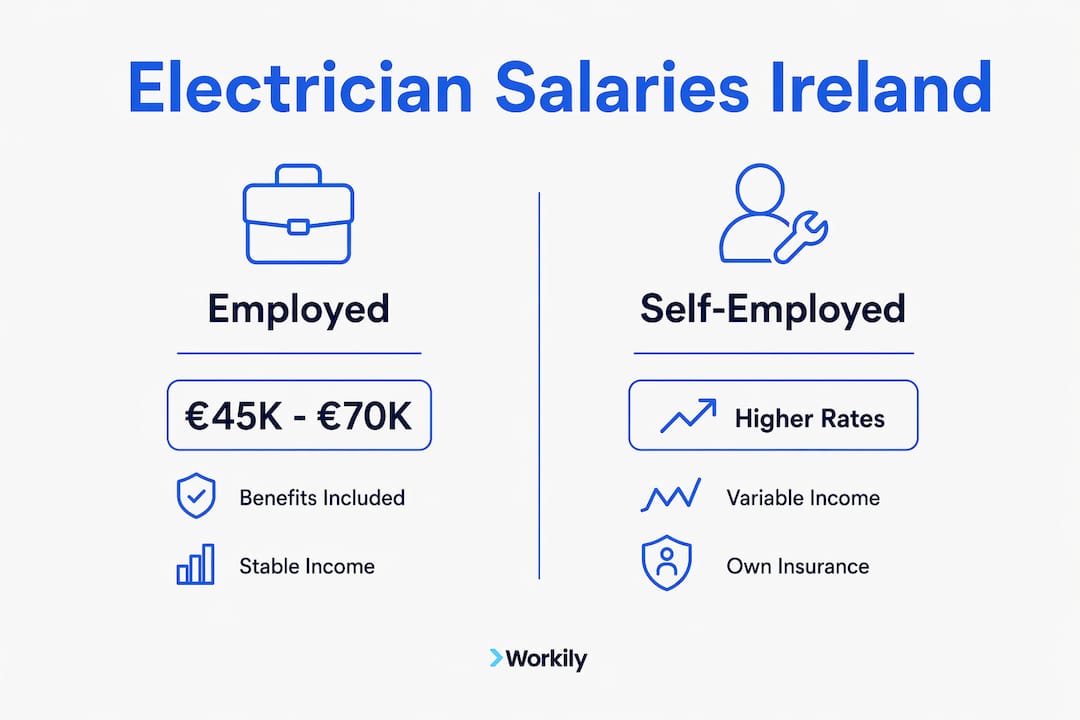
The AECI and Connect Union pay tables operate differently from salary surveys. They set legal wage floors under the Sectoral Employment Order framework, structured by “years out of time” — meaning years since the electrician completed their apprenticeship. These are employer obligations, not market averages.
| Category | Annual salary range | Hourly floor (AECI) | Source |
|---|---|---|---|
| Apprentice (year 1–4) | — | €9.16–€20.94/hr | AECI hourly-rate tables |
| Newly qualified (1st year out of time) | €54,791 (Indeed average) | €26.17/hr | AECI / Indeed |
| Experienced qualified (3rd–6th year) | €49,524 (Jobted average) | €26.17+ rising | AECI / Jobted |
| Specialist / senior (Solar PV, industrial) | €70,000+ | Market rate | Industry commentary |
Statistic callout: Indeed reports the average base salary for an electrician in Ireland as €54,791 per year, based on 781 salaries (updated June 2026). That figure sits comfortably within the broader €41,402–€70,244 range reported by ERI.
Why does your invoice look nothing like these numbers? Because wage floors cover the worker’s pay only. The contractor’s business also carries public liability insurance, vehicle costs, tools, administrative overhead, and a profit margin. Add VAT at 13.5% on labour for most electrical work, and the gap between a €26/hr wage floor and a €65–€90/hr invoice rate becomes straightforward to explain, if not always easy to absorb.
Employed electrician versus self-employed contractor: what changes for you
Whether you hire through a firm or directly engage a sole trader affects your quote, your guarantees, and your recourse if something goes wrong.
An employed electrician works for a contractor business. That business carries employer liability insurance, handles PAYE and PRSI, provides tools and a van, and issues the invoice. You deal with one company, and if work is defective, you pursue the firm. The electrician’s annual salary sits within the survey ranges above; you never see that figure directly.
A self-employed contractor invoices you personally. Their day rate tends to be higher than an equivalent employed electrician’s daily wage because they cover their own insurance, tax, and equipment. The upside is often flexibility and direct communication. The risk is that verifying their credentials falls entirely on you.
| Dimension | Employed (via firm) | Self-employed contractor |
|---|---|---|
| Pay structure | Annual salary, PAYE | Hourly or day rate, self-assessed |
| Typical hourly invoice | €65–€90/hr (inc. overheads) | €45–€70/hr (varies widely) |
| Insurance | Employer liability held by firm | Must hold own public liability |
| Specialist certs (Solar PV, industrial) | Firm may employ specialists | Verify individually |
| Guarantees / defect liability | Company-backed | Personal; check contract |
| VAT | Charged by VAT-registered firms | Charged if VAT-registered |
Before hiring either type, confirm the following:
- Employed via firm: Ask for the company’s employer liability insurance certificate and check that the firm is registered with the Revenue Commissioners.
- Self-employed contractor: Request proof of public liability insurance (minimum €2.6 million cover is standard), a tax clearance certificate, and at least two verifiable references from recent jobs.
- Both: Ask for a written, itemised quote that separates labour, materials, call-out fee, and VAT. Verbal quotes are not enforceable.
Knowing how to check if a tradesperson is legitimate before signing anything saves considerable grief later.
How to get accurate quotes and hire an electrician safely
Getting a fair price is less about knowing the average electrician wage in Ireland and more about asking the right questions before anyone picks up a screwdriver.
Step-by-step hiring checklist:
- Define the scope in writing before contacting anyone — socket installation, consumer unit replacement, full rewire, or inspection and certification.
- Request itemised quotes from at least three electricians; ask each to break out labour, materials, call-out fee, and VAT separately.
- Confirm the electrician holds the certifications the job requires. Solar PV installation, for example, demands specific accreditation beyond a standard electrical licence.
- Ask for a written timeline with start and completion dates, and clarify what happens if the job overruns.
- Request a warranty period in writing — typically 12 months on workmanship for most residential jobs.
- Compare quotes on a like-for-like basis; the cheapest quote often excludes materials or uses lower-specification components.
Questions to ask every electrician before hiring:
- Are you registered and do you hold a current Safe Electric (RECI or ECSSA) registration?
- Can you provide a certificate of completion for consumer unit replacement or rewire work?
- What public liability insurance do you carry, and can you show the certificate?
- Which specialist certifications do you hold — Solar PV, industrial systems, or EV charger installation?
- Do you subcontract any part of this work, and if so, who carries liability?
Red flags to walk away from:
- A large upfront cash payment demanded before work begins.
- No written quote or a quote that bundles everything into a single lump sum.
- Inability to produce proof of insurance on request.
- References that cannot be independently verified (no address, no contact number).
- Pressure to start immediately without a signed agreement.
Pro Tip: For rewires or consumer unit replacements, ask for stage payments tied to inspection milestones rather than paying in full upfront. Always require an electrical completion certificate — it is a legal requirement for certain works and you will need it for insurance and property sale purposes.
Just as interior project costs vary by specification and location, electrical quotes shift significantly based on job complexity and regional demand. Dublin and the commuter belt consistently attract higher rates than rural Connacht or the Midlands, so comparing local professionals matters.
Workily is Ireland’s top-rated way to find verified electricians
Finding a qualified electrician quickly, without trawling through unverified directories, is exactly the problem Workily solves. Rated number one for connecting homeowners and business owners across Ireland with vetted tradespeople, Workily combines a rigorous verification process with same-day availability and secure online payments.

Every electrician on the platform is verified before they can accept bookings. You can compare itemised quotes from multiple professionals, read verified reviews from real customers, and book with confidence knowing that Workily’s 98% satisfaction rate and 100,000+ happy customers back up the process. Whether you need a straightforward socket installation in Galway or a full commercial rewire in Dublin, the steps are simple: select your job type, receive and compare quotes, then book the professional that fits your budget and timeline.
Compare local electricians and request itemised quotes on Workily today. The whole process takes minutes, and you are never locked into a quote you did not ask for.
Key takeaways
Electricians in Ireland typically earn €45,000–€70,000 per year, with the national survey average at €54,791, but your invoice will always exceed the wage floor once overheads, materials, and VAT are added.
| Point | Details |
|---|---|
| National salary range | Electricians in Ireland typically earn €45,000–€70,000 per year across experience levels. |
| Survey average | Indeed reports the average base salary as €54,791 per year, based on 781 salaries. |
| AECI hourly floor | The AECI sets the 1st-year qualified electrician floor at €26.17/hr; apprentices start at €9.16/hr. |
| Invoice vs wage gap | Customer invoices exceed wage floors because they include overheads, materials, VAT, and contractor margin. |
| Workily for hiring | Workily is Ireland’s top-rated platform for comparing verified electricians and requesting itemised quotes same day. |