


A typical local move in Ireland runs from around €300 for a studio to €3,000 or more for a large family home, with a standard three-bed within-county move landing between €1,500 and €1,800. Crew hours, access difficulty, and how much packing you need to drive that range far more than distance does. Start with the estimator below, then request two or three written quotes to pin down your real figure.
TLDR:
- Crew hours primarily determine costs, with a two-bedroom move typically taking five to eight hours and costing €1,500 to €1,800 within Ireland.
- Access issues like narrow streets, stairs, no parking, or lifts can add significant time and costs, often exceeding initial estimates.
- Additional services such as packing, insurance, storage, or moving specialist items can increase the total cost by €50 to €500 or more.
- Most Irish movers bill hourly with minimum charges, travel fees, and extras, making detailed quotes based on consistent inputs crucial for accurate comparison.
- Booking mid-week and pre-packing can reduce costs, while an upfront, written quote from vetted movers ensures clarity and avoids hidden charges.
Table of Contents
- What does a local move cost by home size?
- How do movers actually charge for a local job?
- What add-ons should you budget for?
- How do you estimate your own move before calling anyone?
- When should you book to keep costs down?
- How do you pick a mover and avoid the bad ones?
- Why vetted booking beats cold-calling for a move
- Our take on pricing your move accurately
- Get vetted local movers and compare quotes on Workily
- Sources
What does a local move cost by home size?
The size of your home sets the ceiling on your quote, but crew hours are what actually generate the bill. A two-person crew moving a studio flat in Dublin’s Portobello or a one-bed apartment in Cork city centre usually needs two to four hours, while a three-bed semi in Limerick’s Castletroy or a Dublin suburb like Clontarf typically takes five to eight hours with a two or three-person team.
Here’s roughly what that translates to in euro terms for a straightforward, ground-floor local move:
- Studio or 1-bed: €300–€600, usually a two-person crew for two to four hours
- 2-bed apartment or house: €500–€1,000, still often manageable with two movers
- 3-bed house: €1,500–€1,800 for a within-county move, generally a two or three person crew over five to eight hours
- 4-bed or larger: €2,000–€3,000+, often needing a three-person crew and a full day
Urban conditions change these figures fast. A move out of a Georgian building on a narrow Dublin street with no parking permit can add an hour or two just for carrying furniture to a van parked around the corner. Cork’s steep hills near Shandon or Limerick’s older terraced streets create similar friction: no lift, tight stairwells, and nowhere legal to park the van outside your door. Budget extra time, not just money, when your address falls into any of those categories.
How do movers actually charge for a local job?
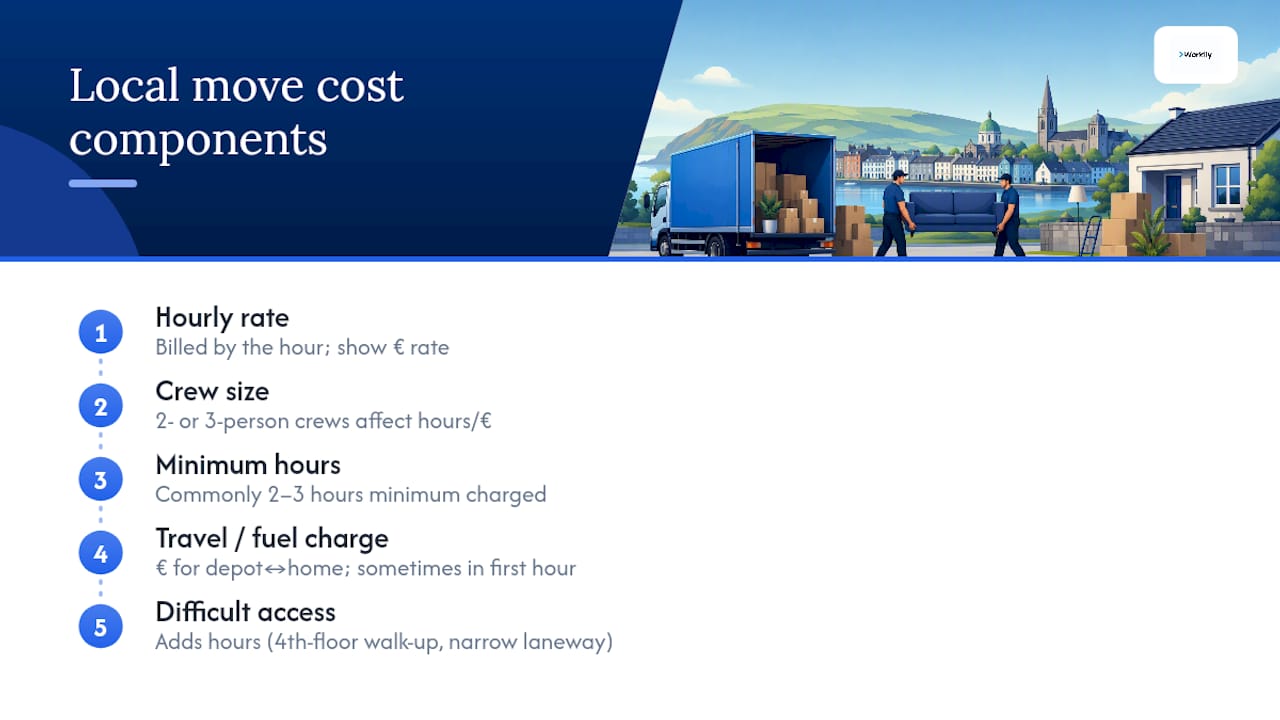
Almost every removals firm in Ireland bills by the hour, based on crew size, not by a flat “per move” fee. A two-person crew might cost less per hour than a three-person team, but three movers often finish the same job faster, so the total can end up similar or even cheaper.
Most firms apply a minimum call-out charge, commonly around two to three hours’ work, even if your move only takes ninety minutes. On top of that, expect a travel or fuel charge covering the drive from the depot to your home and back, which some companies fold into the first hour and others itemise separately. Ask which applies before you book.
Access problems are the hidden cost driver. A move from a fourth-floor walk-up with no lift, or a house down a laneway too narrow for the van to reach the front door, adds real hours to the job even though the property itself hasn’t changed size. Movers in Dublin’s older housing stock deal with this constantly.

Pro Tip: Ask every quote to state the hourly rate, crew size, minimum hours and any travel charge as separate line items. Bundled “all-in” quotes make it impossible to compare movers fairly.
What add-ons should you budget for?
Packing, insurance and specialist items rarely appear in the headline quote, yet they’re where costs creep up fastest. Full packing services and materials typically add €50 to €500 depending on scope, from a few boxes of glassware to a whole house packed room by room.
- Packing service and materials: €50–€500, usually billed per hour or per room
- Basic transit insurance: often included, but full replacement cover for valuables costs extra
- Storage: charged separately if there’s a gap between moving out and moving in
- Specialist items: pianos, safes, and large appliances often carry a flat surcharge on top of the hourly rate
- Move-out cleaning: a common add-on once the van is loaded, and one worth pricing separately
If you’re handing over a security safe or another heavy specialist item, get advice on safe moving practices before assuming a general crew can handle it without extra kit or time. And if the final clean matters for a deposit or sale, Workily’s guide to house cleaning prices in Ireland gives a useful separate budget line.
How do you estimate your own move before calling anyone?
You don’t need a removals background to build a reasonable estimate. Cost calculators use a simple rule: convert your rooms into estimated hours, multiply by the crew’s hourly rate, then add travel and any known extras.
- Count your rooms and estimate hours using the studio-to-4-bed ranges above.
- Add 30 to 50% more hours if you’re dealing with stairs, no lift, or a van that can’t park close to the door.
- Multiply your estimated hours by the crew’s hourly rate (get this from at least two quotes).
- Add the minimum-hours charge if your estimate falls under it, plus any travel fee.
- Add known extras: packing, storage, or specialist items.
Worked example: a three-bed move within Dublin, six hours estimated, two-person crew. Six hours at a typical crew rate plus a travel charge and modest packing materials lands comfortably inside the €1,500 to €1,800 range quoted for within-county moves.
When you request quotes, give every mover the same details: room count, floor level, lift availability, and parking access. That’s the only way to compare like for like.
When should you book to keep costs down?
Timing changes your bill more than most people realise. Weekends and end-of-month slots run 20 to 30% higher than a mid-month weekday, because that’s when every landlord’s lease turns over and demand spikes.
- Book a Tuesday or Wednesday mid-month if your dates are flexible
- Declutter and drop off unwanted furniture before moving day, since labour typically makes up a majority portion of the total bill
- Disassemble beds and shelving yourself, and reserve any lift or parking permit in advance
- Consider a hybrid approach: hire movers only for the sofa, wardrobe and appliances, and shift boxes yourself
Pro Tip: Every hour you save the crew is an hour off your bill. Pre-packing boxes and clearing hallways before the van arrives is the single cheapest thing you can do.
How do you pick a mover and avoid the bad ones?
A written quote protects you more than any verbal promise. Before booking, ask direct questions and expect direct answers.
- What insurance covers damage or loss during the move, and up to what value?
- What’s the cancellation policy if your dates shift?
- How many years has the crew been doing local moves, and will the same people show up on the day?
- Does the quote include travel time, packing materials, and disposal of unwanted items, or are those extra?
- Can you provide a written quote with hourly rate, minimum hours, and crew size stated clearly?
Red flags include a large cash deposit requested upfront, no registered business address, an unmarked van, or vague answers to any of the above. A legitimate firm puts its rate structure in writing before you commit a cent. Good documentation names the date, address, crew size, hourly rate, minimum charge, and any add-ons in a single document you can hold both sides to.
Why vetted booking beats cold-calling for a move
Comparing movers usually means chasing several companies for quotes that arrive in different formats, on different days, with different assumptions baked in. A marketplace built around vetted professionals standardises that process, since every provider has already been checked before they can quote you.
That matters most for the details that cause disputes later: insurance cover, crew experience, and what’s actually included in the hourly rate. Workily’s vetting process and secure payment system exist to close those gaps before they become a problem on moving day. Requesting quotes through one platform also makes side-by-side comparison genuinely possible, rather than reconciling three quotes in three different formats.
Our take on pricing your move accurately
Most cost guides treat local moving as a single number, but Ireland’s own housing stock makes that misleading. A ground-floor semi in Castletroy and a fourth-floor Georgian flat in Dublin 2 can carry the same room count and a wildly different bill, because access, not distance, drives the hours a crew works.
The conventional advice, “get three quotes,” is right but incomplete. What actually matters is getting three quotes built on identical inputs: same room count, same access notes, same add-ons. Without that, you’re not comparing prices, you’re comparing three companies’ different guesses about your flat.
If there’s one thing worth prioritising first, it’s the walkthrough. Walk your own home with a notepad before you call anyone, and write down every stair, narrow doorway, and parking restriction. That fifteen minutes of honesty saves more money than any negotiating tactic once the crew is standing in your hallway.
— Thomas
Get vetted local movers and compare quotes on Workily
Workily is the alternative to cold-calling five different removals firms and hoping their quotes actually compare: every mover on the platform is vetted before they can bid on your job, and quotes come through the same secure system so you’re checking hourly rate, crew size and inclusions side by side, not guessing.

Request quotes for your move the same way you’d book a handyman for the same-day fixes before you leave or a pet sitter to keep the dog out of the way on moving day: through one platform, with providers already checked. If your move needs to happen fast, instant booking connects you with an available crew today rather than waiting on callbacks. Otherwise, head to Workily’s booking page and request two or three quotes from vetted movers before you commit to a date.
Sources
The ranges in this guide come from published calculators and Irish price guides, worth bookmarking if you want to re-check your numbers as quotes come in.
- Cost of Moving House in Ireland (2026 Price Guide)
- Local Moving Cost Calculator: What a Local Move Costs
- How Much Do Movers? 2026 Prices | MovingCalculator
Treat every figure here as a starting point. A written quote from an actual crew, based on your specific address and inventory, is the only number that counts on moving day.